Buyer's guide · Last updated July 28, 2026
Oilfield work management software,built for operators, not service companies.
Most work management software in the oilfield descends from field service management: tools built for service companies that receive tickets and dispatch billable technicians. Operators live in a different world. Nobody opens a ticket when a well underperforms. The work has to be generated from field signals and ranked by dollars, or the crew spends the day faithfully executing the wrong list.
The category mismatch
FSM manages tickets. Operators need something upstream of tickets.
Field service management earns its keep at service companies: a customer calls, a ticket opens, a technician with the right skills gets dispatched inside an SLA, the job gets billed. Every assumption in that loop (external requester, roughly uniform job value, single-destination dispatch) breaks at an operator.
An operator's work originates inside the asset: a SCADA trend, a downtime flag, a tank forecast, an overdue test, a failing rod pump signature. If the software waits for a human to open a ticket, the highest-value work never enters the system, because the wells that quietly defer production do not file requests. And when work does get in, a queue sorted by age or severity color treats an $80 task and an $8,000 task as peers. The same gap shows up on the maintenance side, which is why a CMMS built for upstream has to know what a well is worth before it can order the queue.
The result is familiar on any fixed-route field: crews are busy, tickets close on time, the dashboard is green, and production stays flat. Busy is not the same as valuable. The measure of work management for an operator is not tickets closed; it is dollars of deferred production recovered per crew-day.
Operator-grade requirements
Four things operator work management must do that ticket queues cannot.
Work is generated, not requested
A service company works tickets that customers open. An operator has no customer opening tickets: the work request is a pressure trend drifting since 2 AM, a tank forecast crossing its haul threshold, a well test overdue. Operator-grade work management watches those signals and writes the work order itself, overnight, before anyone logs in.
Ranked by dollars, not by queue age
Ticket queues sort by age, SLA, and severity color, which is correct when every ticket bills the same. On a producing field, one open item is worth $80 and the one below it is worth $8,000. Work management for operators has to price every task on cash flow at risk and safety constraint, then put the $8,000 item first regardless of when it entered the queue.
The plan is a drivable day, not a list
Dispatching one technician to one job site is routing trivia. Running a pumper route across dozens of leases is a sequencing problem: the ranked list has to become a drivable day that respects geography, lease access, crew qualifications, and daylight. A work list that ignores the truck is a suggestion, not a plan.
The loop closes back into the score
When a crew closes a ticket in an FSM tool, the story ends. When a crew works a well in an operator-grade system, the outcome (what was found, what it restored, how long it took) feeds the next morning’s score. The ranking gets sharper with every field observation, which is what makes the same crew progressively more valuable.
The work, visible
Every job, its stage, and its dollar value on one board.
Work generated from field signals arrives already scored. The board tracks it from surfaced to scheduled to done, and the foreman's morning becomes approving a ranked plan instead of assembling one.
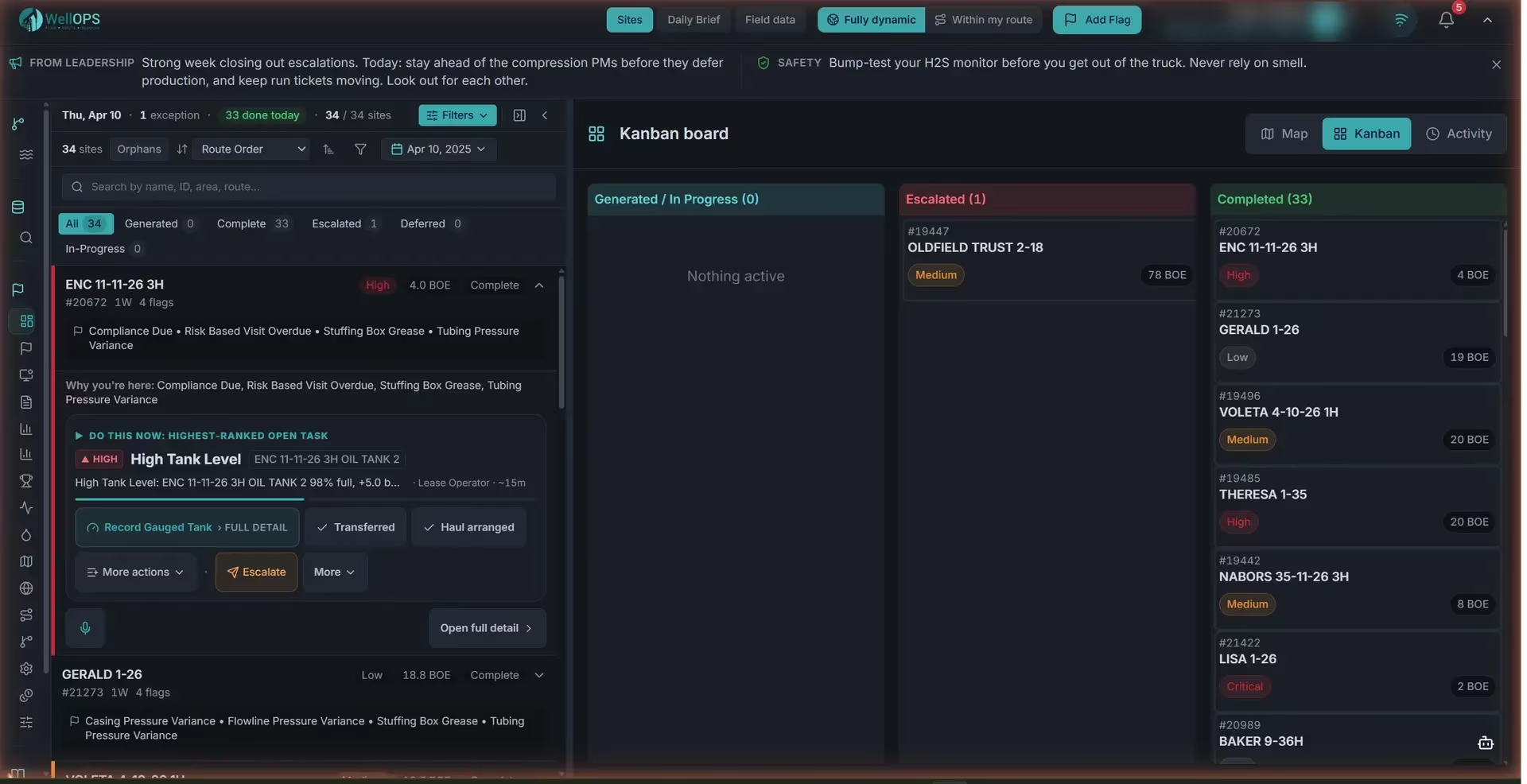
The work board: signal-generated jobs, scored and staged. Synthetic demo data. Scroll the capture sideways to read it.
Where WorkSync fits
WellOPS is work management with the decision layer built in.
WellOPS runs the full operator loop: the Work Engine generates and prices work from the signals in your existing systems, the most sophisticated prioritization engine in the category ranks it against cash flow and safety constraints, the Route Optimizer turns the ranking into a drivable day, and Field Data Capture closes the loop from the truck. Fit-for-purpose. Plug-and-play. It deploys read-only on the SCADA, historian, CMMS, accounting, and GIS stack you already own. Where the work originates as a SCADA deviation rather than a scheduled task, pricing and routing the exception queue is the same decision layer applied one step upstream.
The results are measured, labeled, and published: 15% free cash flow uplift on the same crew and 35% fewer miles driven, measured across 5,000+ wells in live deployments, at the same production coverage. Don't leave field capacity on the table because the day was sorted by ticket age.
The sequencing half of that loop, turning a ranked list into a drivable day, is its own buying decision. It is covered end to end in the guide to route planning software for oil and gas, including the dispatch decision behind it.
Oilfield work management, common questions
What is oilfield work management software?
Software that decides, sequences, tracks, and learns from the daily work of a producing field: which wells get visited, what gets fixed first, who drives where, and what got found when they arrived. For operators, the hard part is not tracking work but generating and ranking it, because nobody opens a ticket when a well quietly underperforms. The system has to read field signals (SCADA, historian, accounting, work history) and write the ranked plan itself.
Why do field service management (FSM) tools fall short for operators?
Most FSM products were designed for service companies: businesses that receive work requests from customers and dispatch billable technicians against SLAs. Operators are structurally different. The work is self-generated from field signals, its value per task varies by orders of magnitude, and the crew runs multi-stop routes rather than single-job dispatches. An FSM queue faithfully tracks the wrong thing: it manages tickets, when the operator problem is deciding which work is worth doing at all, and in what order.
How does WorkSync rank oilfield work?
Every candidate task is scored overnight on cash flow at risk (deferred production cost, escalation risk, haul economics), with safety as a hard constraint rather than a weighting. The scored list is then sequenced into a drivable route per crew. In live deployment this ranking produced a 15% free cash flow uplift on the same crew and 35% fewer miles driven, measured across 5,000+ wells (deployment figures).
Does it replace my CMMS or my SCADA system?
No. WorkSync deploys read-only against the systems of record you already run (SCADA, historian, CMMS or EAM, production accounting, GIS) and adds the decision layer those systems were never built to provide. Work orders and history can stay synchronized with the existing system of record. Nothing is ripped out, which is why integration takes about a week rather than a year.
What does implementation look like?
The productized 4-week stand-up: read-only integration in about the first week, the scoring loop running nightly in weeks two and three with the ranked plan in the truck cab, and a measured comparison against your pre-deployment baseline in week four. One signed metric decides the outcome. Under the Impact Guarantee, we charge when your number moves.
Is this just a work order app with a map?
The visible surface (ranked list, route map, mobile capture) is the easy 20%. The differentiating 80% is the engine underneath: nightly economic scoring across every well, constraint-aware route optimization, and a learning loop that reprices work from every field outcome. That is the difference between digitizing the old fixed-route day and actually changing what the crew works on.
Are your best people working on your most valuable work today?
Manage the work by what it is worth.
Four weeks from read-only integration to a ranked plan in the truck cab, against one signed metric.
Continue the cluster: Route planning software for oil and gas · Lease Operator Routes · Fit-for-Purpose Software · WellOPS, the ranked work platform