Pump by Exception finds problems.
Pump by Priority prices them.
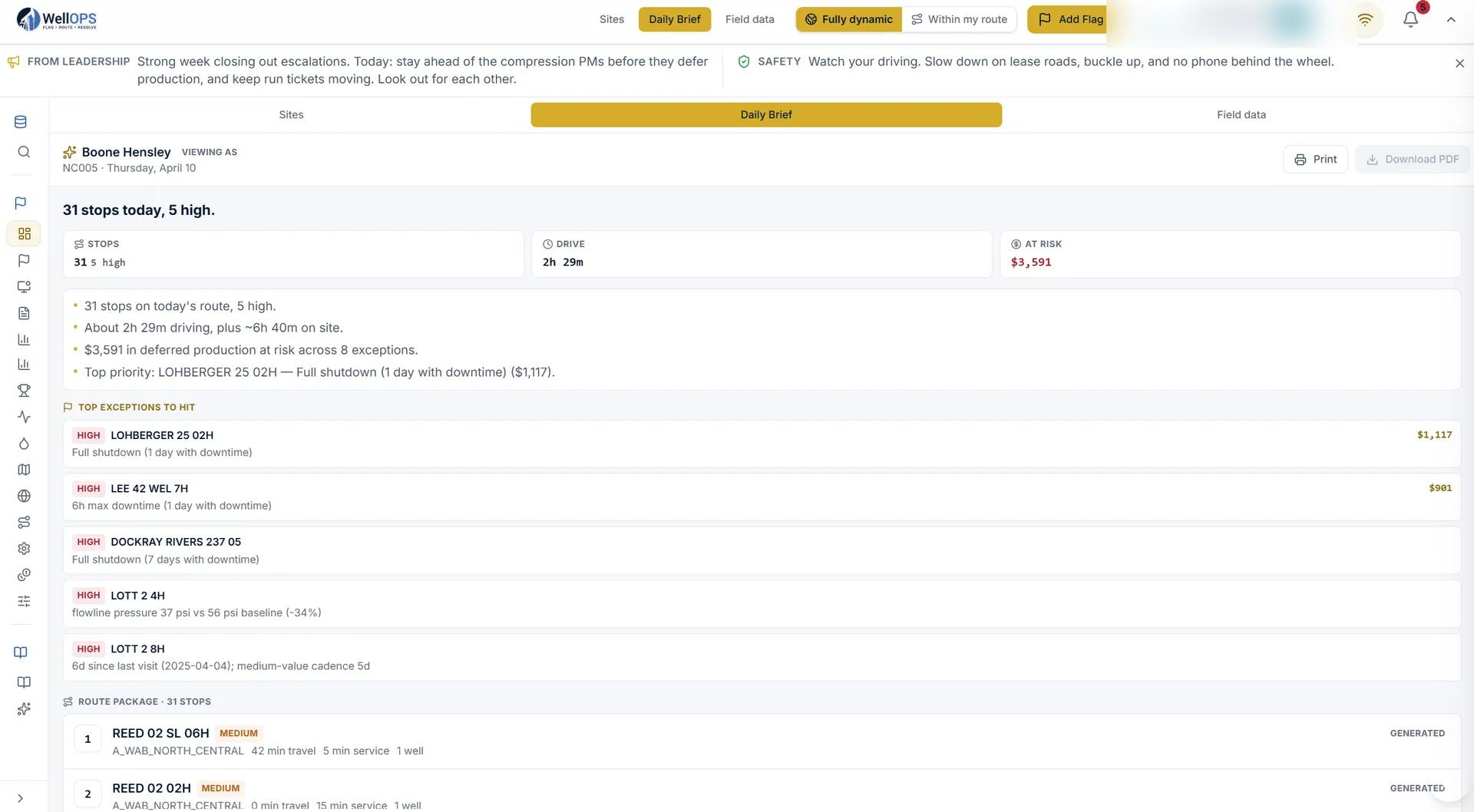
WorkSync prices every exception in dollars per day, ranks the whole field against one ruler, and sequences the ranked list into a drivable day. The plan is in the cab by 6 AM with the work order, the field ticket, and the accrual attached to it.
New to the model, or mapping where you stand today? Read the in-depth guide: the three layers pump by exception runs on, the five ways it stalls at scale, and the four rungs between a threshold queue and a ranked day.
“…starting to see the benefits of that in terms of moving to a pump-by-exception company, a lot more automation.”
COO, large Permian operator · Q2 2026 earnings callWorkSync prices the exception before anyone decides whether to drive to it.
Pump by Priority is pump by exception, priced. The prioritization engine takes OT data, financial data, and the work record and stitches them into one number per job: dollars per day. Deviation comes from SCADA tags, allocated volumes, and well tests. Value comes from your price deck, your interest, and the production the deviation is actually deferring. Cost and exposure come from equipment history, failure codes, permits, and crew qualifications. One number, one ruler, every open job in the field on it.
That number is the thing a threshold screen has never carried. A 5 BOPD well trips the same color and the same row height as your highest cash flow producer, and on a normal morning the spread between a $200 nuisance signal and a $15,000 production loss runs to more than two orders of magnitude with nothing on the screen to separate them. (The dollar pair is illustrative mechanism, not a measured claim.) Pricing the queue settles the argument with arithmetic.
The ranking then becomes a plan. WorkSync sequences the ranked list into each person’s drivable day, delivers it to the cab by 6 AM, and carries the CMMS work order, the field ticket, and the accrual in the same motion, so the close-out is one screen at the wellhead rather than paperwork at shift end.
Fifty exceptions become one ranked plan: every job priced in $/day and ordered by dollars and risk. Illustrative data.
Dispute it. Defer it. Nothing is ever silently suppressed.
A field team member can dispute a flag, which lifts it to the engineer and holds it until resolved. A well already scheduled for workover can be deferred with a reason and stops generating noise. When the control room sees something the system missed, they add the flag and the system reconciles. A list people stop checking is how real problems get masked, so nothing disappears.
Ranking is also overridable, one tap with a reason code, and the override is recorded as data: a well the field consistently pulls forward is carrying information the scoring has not captured yet. Read the six mechanics that keep a ranked plan trusted before you hand one to a crew.
What goes in
Four kinds of data, stitched into one score.
A ranking is only as good as what feeds it. The engine reads four streams on a schedule, over read-only connections to the systems you already run, and resolves them to a single dollars-per-day figure per job.
OT and surveillance
SCADA tags, historian trends, controller states, allocated volumes, and well tests. Deviation is measured against what the well should be doing this week, so a declining well is judged against its own expected curve rather than a limit set the year it was drilled. Thresholds stay current without anyone re-tuning them by hand.
Financial
Your price deck, working and net revenue interest, lifting cost, and the volume the deviation is deferring. A barrel deferred on an oil-weighted well and a barrel deferred on a gassy one price differently, so they rank differently. An hour down is not the same hour everywhere.
Equipment and work history
Failure codes, run life, parts consumed, and the close-out from the last time this equipment failed this way. A well that has failed the same way three times carries that history into its score, and the repeat offenders in the fleet become visible without a data project.
Constraints and data quality
Permits, qualifications, lone-worker rules, and a validation layer that runs first: calibration drift, stuck values, communication gaps, and physically impossible spikes are caught and tagged before they reach the queue. A transducer reading high stops earning a truck roll.
Scoring an unrationalized queue produces precise rankings of garbage, which is why the validation layer runs ahead of the scoring layer rather than beside it. See how deviation is scored and ranked.
The closed loop
Flag, price, rank, route, close, learn.
Closed loop means the last step changes the first one. Six steps run every day, on every well, and the sixth is the one that compounds.
Flag
Every well, every hour. Deviation, liquids, equipment condition, and safety and regulatory exposure all raise flags into one queue. A control room analyst who spots something the models missed adds a flag by hand and it carries the same fields as a machine-raised one.
Price
Each flag resolves to dollars per day: production deferred while it waits, the failure cost if it is left to run, and the exposure it carries. The reason for the number travels with the flag, so the score can be checked rather than believed.
Rank
One ordered list across the whole field, not one list per area or per system. Regulatory deadlines stay absolute where the regulator sets them. Everywhere else, value orders the list and constraints bind it.
Route
The ranked list becomes one drivable day per person, solved against real drive times, crew qualifications, equipment, and hours of service. The plan is in the cab by 6 AM, and it re-solves when a well goes down mid-morning.
Close
One screen at the wellhead, gloves on, online or offline. Readings, volumes, downtime, parts, labor, and the work actually performed are captured once, and the field ticket, the work order, and the accrual are booked with the work, not at month-end.
Learn
The close-out answers the question the queue was asking: was this exception worth the visit? Recovered production is measured against the estimate, disputes and overrides are recorded with their reason codes, and both feed the scoring that runs the following week. A well the field keeps pulling forward is carrying information the model has not captured yet.
Two operators can buy identical software. The one whose operating model feeds outcomes back accumulates calibration the other never gets, and the gap widens every quarter. Read the guide on what keeps a ranked plan trusted.
What operators get. In this order.
Downtime Reduction
WorkSync works the exception that is costing money first. Every flag arrives carrying what the deviation is worth per day, not just the fact that a threshold tripped.
Optimal Liquid Management
Tank state, fluid levels, and hauling raise exceptions on the same ruler as the wells, so a tank heading for a shut-in outranks a nuisance alarm.
Proactive Risk Management
The engine attaches permit, qualification, and integrity constraints to the exception itself, so the riskiest flag is scheduled with what it needs to be worked safely.
The Full Picture of Value Sinks
Every flag, deferral, and close-out lands in one ledger. The exceptions nobody worked are visible before the variance review finds them.
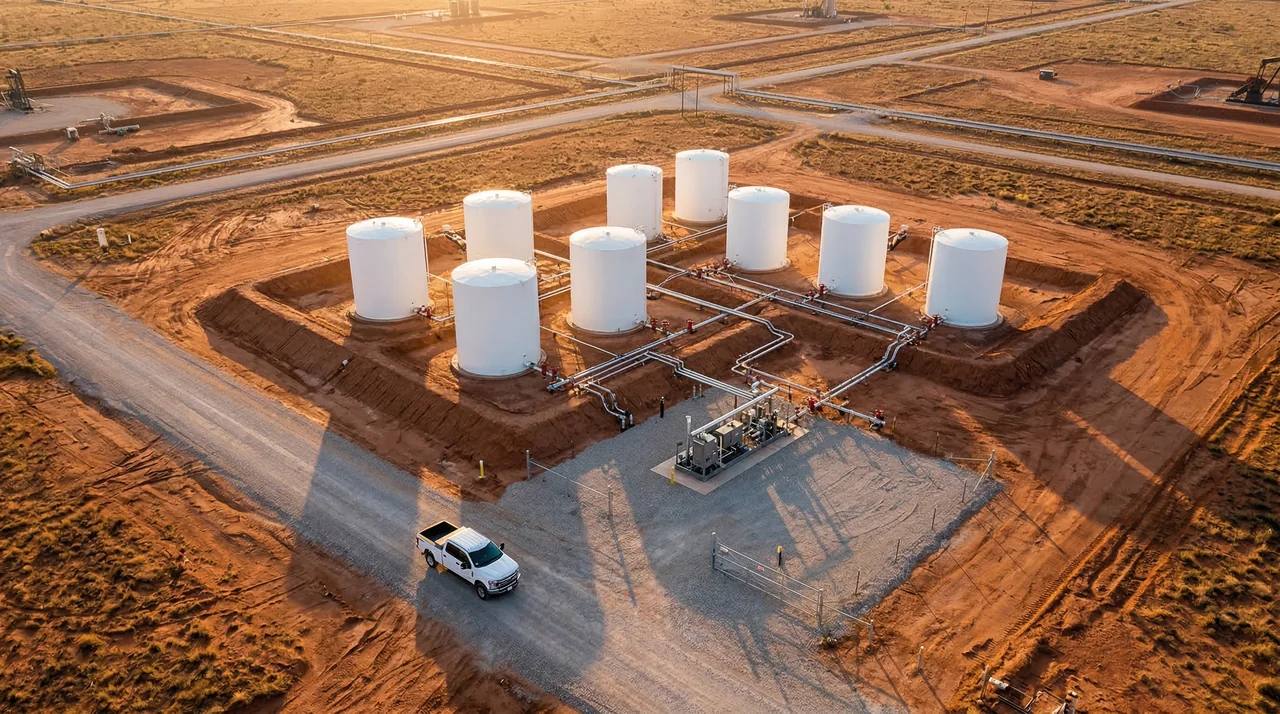
Every site raises its hand. Only some of them are worth the drive.
Built to work with your lift program, your operations center, and the platform underneath
Your lift optimization, executed
Rod pump, ESP, and gas lift optimizers recommend. WorkSync prices each recommendation on deferment and failure cost, ranks it against everything else in the field, routes it to the right crew, and books the accrual with the work.
See the artificial lift story →Your remote operations center, connected to the field
The control room and the field share one ranked queue, live in both directions. The center re-prioritizes and the cab sees it in seconds; the field closes work and the center sees status, downtime recovered, and cost.
See the remote operations story →The platform underneath
Five components, one ranked work loop: the data layer, the engine that prices the work, equipment and safety management, and the accrual that closes with the job.
Walk the five components →How an exception becomes a ranked job
The engine that turns a threshold breach into a priced, sequenced, crew-matched job: what goes into the score, how constraints bind it, and how the close-out feeds back.
See how deviation is scored and ranked →How WorkSync fits in
Your systems flag it. WorkSync prices it, ranks it, and routes it: routeless, AI-driven operations that put every field team member on the highest-value work.
Your systems
WellOPS
Your field team
The support that keeps your field equipment running. Driven by one ranked queue, with a UX field teams love: built for the cab, offline-capable, and held to a design standard of under 20 minutes a day of software per field team member.
Pump by exception software, common questions
What is pump by exception software?
Pump by exception software is the tooling layer that turns SCADA readings into a field work signal: it holds the normal operating window for each parameter, watches live and historian data against it, raises an exception when a reading leaves the window, and delivers that exception to a field team member on a phone or tablet. The category as it is sold today stops at the alert. What happens next, deciding which of the open exceptions is worth a truck this morning, is still a person with a list.
What should pump by exception software do after it flags the alarm?
Four things, and they are the buying criteria worth writing down. Price it: the flag arrives carrying production at risk per day of inaction at your working interest and your price deck, not just the fact that a threshold tripped. Rank it: every open job in the field sits on one ruler, so maintenance, safety, regulatory and production work compete on the same number. Route it: the ranked list is solved into one drivable day per person against real drive times, crew qualifications and hours of service. Learn from it: the close-out records whether the exception was worth the visit, and that answer feeds the ranking that runs the following week.
Do we have to replace our SCADA or exception system to add pricing and routing?
No. The scoring, routing, and feedback layers read from the SCADA, historian, and alarm discipline you already run, over read-only connections, with nothing placed on your control network. Nothing is migrated and no system of record moves. The exception engine you bought keeps doing exactly the job it does today, and the layers above it consume what it already produces.
How long does it take to get pump by exception software running?
Four weeks to crews live, on one field, against one metric you pick before anything is connected. Week one is read-only integration to the SCADA or historian, production accounting, and the EAM or CMMS already in place. Week two stands up the scoring. Weeks three and four put the ranked plan in the truck cab and measure it against your own baseline. The stand-up is a real production deployment on your data rather than a sandbox.
How do we justify this internally?
Build the case from a method rather than a projection. First, you and your controller pick one operating metric and write it down before anything is connected: cash flow per BOE, operating cost per well, drive miles, or TRIR. Second, run your own well count, crew count, and drive times through the route economics calculator on this site, which puts a dollar figure on a day of your field capacity using your inputs rather than ours. Third, run the four-week pilot on one field against that single agreed metric, with the baseline set in week zero, so the business case is measured on your wells. The Impact Guarantee carries the commercial risk while that happens: license fees only when the metrics move. What reaches your approver is your own baseline and your own delta, which is the only version of the number that survives a finance review.
Run the route economics calculator on your numbers →How is pump by exception software priced?
Under the Impact Guarantee: license fees only when the metrics move. You and your controller sign one operating metric at the start, cash flow per BOE, operating cost per well, TRIR, or drive miles, and the 4-week stand-up runs on the stack you already own. What drives the size of a deployment is the number of fields in scope, how many systems of record have to be connected, the module mix, crew count, and how ready the data is. Scoping those with the implementation team is the conversation, not a price list.
The long answers, the three-layer mechanism, and the maturity ladder are in the in-depth guide. Already running pump by exception and weighing the move? The executive migration page is from pump by exception to pump by priority.
See your wells, ranked by dollars, tomorrow morning.
Bring one field’s data. We’ll show you the ranked plan your crew would have run today, and what it was worth.
See Your Wells Ranked