Lift optimization creates work.
WorkSync keeps it running.
WorkSync flags the underperforming well, prices the underperformance on deferred production and failure cost, ranks it against every other job in the field, and routes it to the crew qualified to do it. Set point control stays with your lift engineers.
“We are accelerating the implementation of AI-enabled artificial lift optimization and advanced analytics well beyond the pilot programs…”
President & CEO, large US independent · Q4 2025 earnings callEvery lift program stands on physical work. WorkSync runs that work.
Rod pumps wear, ESPs fail, gas lift valves drift, and the preventative maintenance that prevents the next failure competes with today’s fires for the same crews. Who does that work, in what order, and at what cost is where a lift program turns into produced barrels or into deferred ones.
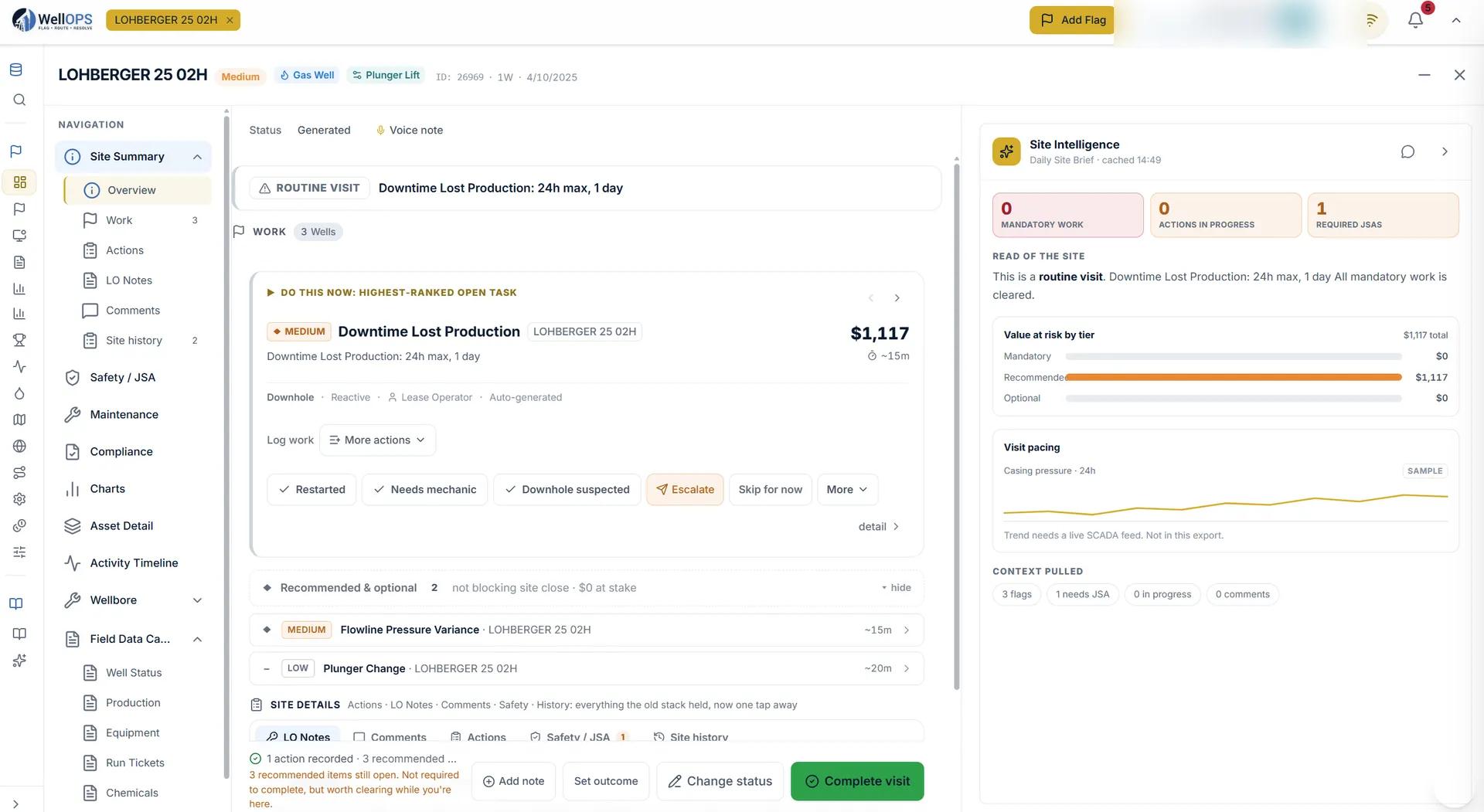
WellOPS is the closed-loop system for that work. Issues and PMs flow in from your SCADA, surveillance, and lift systems. The engine prices each one on deferred production and failure cost and ranks it against everything else in the field. Routeless dispatch puts the job in front of the person qualified to do it: Lease Operator, Technician, Mechanic, Electrician, or Roustabout Crew, with the pulling unit or hot oil truck co-routed when the job needs iron. The loop closes when the fix is confirmed, recovered production is measured against the estimate, and the ticket and the accrual are booked with the work, not at month-end.
Your lift systems keep wells tuned. WorkSync keeps them running. The two are complementary by design: the optimizer recommends a change, WorkSync prices the change against every other claim on the crew-day and gets it executed.
Lift work, ranked: failures, pulls, and PMs priced in $/day against everything else in the field. Illustrative data.
Where this sits against your lift program
WorkSync flags the underperforming well, prices the underperformance, and routes the right person. Set point control stays with your lift engineers and their tools.
Deviation is measured against what the well should be doing, not a fixed threshold, so a failing pump surfaces as a trend. The escalation from Lease Operator to production engineer is part of the product, not an email. Connections to your surveillance, historian, and optimizer are read-only, and a pilot reads from those source systems and stays read-only until you promote it. SOC 2 Type II is in progress, report targeted Oct 30, 2026: read the security and deployment detail or see how deviation is scored and ranked.
What the engine reads
Each lift type degrades in its own signature. The engine watches the signature, not the limit.
A failure that presents as a well down on Thursday was present in the data on Tuesday as a change in shape. These are the patterns the models track per lift type, each one compared against what that well has been doing rather than against a fixed band.
Rod pump
Peak and minimum polished rod load, pump fillage, card shape, runtime and cycle counts, and motor current draw. A worn traveling valve, a rod part starting, and chronic pump-off all move the pattern before they move the production number, and each one carries a different repair and a different crew.
ESP
Intake pressure trend, motor temperature drift, drive frequency and current, and vibration signature where the well is instrumented for it. Bearing wear and impeller erosion show in the signature well ahead of the drive fault, which is the difference between a planned pull and an unplanned one.
Gas lift
Injection rate against target, casing and tubing pressure, valve response, and unloading behavior. Valve drift reads as an injection efficiency trend rather than as an alarm, so it is priced on the barrels it is quietly costing rather than ignored because nothing tripped.
Plunger and chemical
Arrival times, cycle counts, and shut-in behavior on plunger wells; injection rates, tank levels, and corrosion coupon trends on the chemical system. Paraffin, scale, and corrosion enter the queue priced as the deferment they will cause, so they compete with active failures on the same ruler.
Escalation is part of the product. A Lease Operator who cannot clear a flag lifts it to the production engineer with the trend, the score, and the failure history attached, and the job stays open until it is resolved or deferred with a reason. Run life, failure codes, and the recovered production measured after each fix feed back into the next estimate for that well and that equipment class.
What operators get. In this order.
Downtime Reduction
WorkSync surfaces a failing pump as a trend rather than a threshold breach, so the pull is scheduled while the well is still making oil.
Optimal Liquid Management
The engine reads fluid level, submergence, and tank state together with the lift signal, so a pump problem and a hauling problem are told apart.
Proactive Risk Management
Well control, pressure, and lone-worker risk score into every lift job, so the pull that needs two people and a permit is staffed before it is scheduled.
The Full Picture of Value Sinks
Failure codes, run life, and repair cost post against the well and the lift type, so the repeat offenders in your fleet are visible without a data project.
The work behind every lift program, done in the right order.
Built to work with your lift program, your operations center, and the platform underneath
Your remote operations center, connected to the field
The control room and the field share one ranked queue, live in both directions. The center re-prioritizes and the cab sees it in seconds; the field closes work and the center sees status, downtime recovered, and cost.
See the remote operations story →The platform underneath
Five components, one ranked work loop: the data layer, the engine that prices the work, equipment and safety management, and the accrual that closes with the job.
Walk the five components →What the crew captures at the wellhead
Readings, volumes, downtime, and the work actually performed, captured once with gloves on, online or offline, and validated at the point of capture rather than at shift end.
See how field capture works →How WorkSync fits in
Your systems flag it. WorkSync prices it, ranks it, and routes it: routeless, AI-driven operations that put every field team member on the highest-value work.
Your systems
WellOPS
Your field team
The support that keeps your field equipment running. Driven by one ranked queue, with a UX field teams love: built for the cab, offline-capable, and held to a design standard of under 20 minutes a day of software per field team member.
See your wells, ranked by dollars, tomorrow morning.
Bring one field’s data. We’ll show you the ranked plan your crew would have run today, and what it was worth.
See Your Wells Ranked