WellOPS · Route Optimizer · Crew Dispatch
Not the shortest route. The most profitable one.
Route Optimizer maximizes the impact of your team. It plans on value density, dollars of production impact per crew-hour, and builds the day that captures the most value the field can physically execute under crew qualifications, site access windows, hours of service and co-routed equipment. 35% fewer miles driven for the same production coverage, measured across 5,000+ wells in live deployments.
Part of WellOPSYou buy WellOPS from WorkSync. Route Optimizer is the route optimization capability of WellOPS, the operating platform for production operations, and it ships with the platform.
Category guideThis page covers the WellOPS module. For the buyer's guide to the category, including how oilfield routing differs from delivery routing and five questions to ask any vendor, start with route planning software for oil and gas.
What the module does
Route Optimizer maximizes the impact of your team
It solves a harder problem than a delivery router does. A lease operator's day mixes six classes of work (scheduled maintenance, failure response, regulatory deadlines, risk-based visits, liquid management, routine gauging), each with its own time windows, qualification requirements, and cost of deferral. The stops interact: a hauler dispatched late shuts in a well; an inspection missed by an hour erases a month of capture credit. Generic fleet routing has no way to see any of that.
The deeper difference is the objective. Delivery routing minimizes distance because every stop is worth the same. In the oilfield, stops differ in value by orders of magnitude on the same day: a failing pump on a high-rate producer against a routine gauge on a stripper. A solver that minimizes miles first is optimizing the wrong number, which is why Route Optimizer scores before it sequences.
Value density beats the shortest path
Route Optimizer plans around value density: dollars of production impact per crew-hour, not miles per stop. Each candidate stop carries the economic score from the ranked work plan. The solver then builds the day that captures the most value the field can physically execute, subject to qualifications, time windows, and hours of service. The shortest route and the most profitable route are rarely the same day; the difference between them is what fixed loops leave on the table. Operators who follow that logic all the way stop maintaining standing routes entirely and run sensor-driven dispatch instead of a route sheet.
The result, measured across 5,000+ wells in live deployments: 35% fewer miles driven at equal economic coverage, because crews stop driving to low-value stops out of habit. The category-level treatment of that trade, including the constraint reality and the dispatch decision behind it, is in the guide to oilfield route planning and dispatch. The dollar economics are modeled on the route economics calculator, the operator-level playbook lives at lease operator and pumper routes, and the ranking that feeds the solver is pump by priority.
How the day gets solved
One objective, six binding constraints.
The objective is value captured per crew-day. Everything below is a hard bound the solver works inside, which is why the output is a day a crew can actually run rather than a wish list sorted by dollars.
Qualifications
H2S-certified crews to sour wells, pressure-vessel inspectors to PV assets, electrical work to electricians. An unqualified crew never sees the stop, so the constraint holds before the audit rather than after it.
Time windows
Site access hours, landowner and surface-use restrictions, regulatory inspection windows, and the windows on other people the job depends on, such as a hauler or a third-party inspector.
Hours of service and shift shape
Shift length, mandatory breaks, yard start and yard end, and travel to the first site. No crew is assigned more than it can safely complete, which is what keeps a value-maximizing plan from becoming an unsafe one.
Equipment co-routing
Jobs that need a pulling unit, a hot oil truck, a vac truck or a specific tool get that equipment scheduled to arrive with the qualified crew, rather than a crew arriving to a job it cannot start.
Drive time on real roads
Travel is estimated on the road network and on your own traversal history, because no public feed covers private lease roads. Your crews driving the leases is the data that makes the estimates true.
Value density, the objective
Each candidate stop carries its economic score from the ranked work plan. The solver maximizes dollars of production impact per crew-hour, which is why the shortest route and the most profitable route are rarely the same day.
And when the day changes
The 6 AM plan is a forecast, so it re-solves within limits.
Re-optimization fires on a defined trigger set: a well down, a higher-value flag, a crew or vehicle out, a weather event, a hauler slipping. It pushes only to affected crews, behind a minimum-improvement bar so small re-orderings are not worth the cognitive cost of a changed plan, and in-progress work is interrupted only by a safety gate. Every override a field team member makes is one tap with a reason code, and that reason is recorded as data, because a stop the field consistently pulls forward is carrying information the scoring has not captured yet.
6 capabilities that turn your existing stack into action.
- 01
Multi-stop optimization across 100+ wells per crew
A constraint-based solver assembles stops into a coherent route, formalized as a multi-class vehicle routing problem with synchronization constraints. It factors site access windows, yard start and end, vehicle capacity, and turnaround time, and returns a solve in seconds.
- 02
Crew qualifications enforced in the route
H2S-certified crews routed to sour wells. Pressure-vessel inspectors routed to PV assets. Unqualified crews never see the stop in their plan. No post-hoc audit failures.
- 03
Ranked work priority drives sequencing
Pulls from Work Engine's economic ranking. High-impact tasks scheduled first in the crew-day; low-impact backfill fills gaps. Priority can re-rank mid-shift if conditions change.
- 04
Real-time re-optimization when conditions change
Weather event, vehicle breakdown, new high-priority alert, remaining stops re-assigned across all crews without a call to dispatch. Continuous optimization, not a once-a-morning batch.
- 05
Mobile-first, offline-capable
Plans delivered to truck cabs via mobile. Cached offline for cellular-dead zones. Field completion feeds back into the ranking for tomorrow's plan.
- 06
Hours of service and equipment co-routing respected
Shift length, mandatory breaks, and travel-to-first-site time are built into every plan; no crew is assigned more than it can safely complete. Tasks that need a pulling unit or a hot oil truck get the equipment co-routed with the qualified crew.
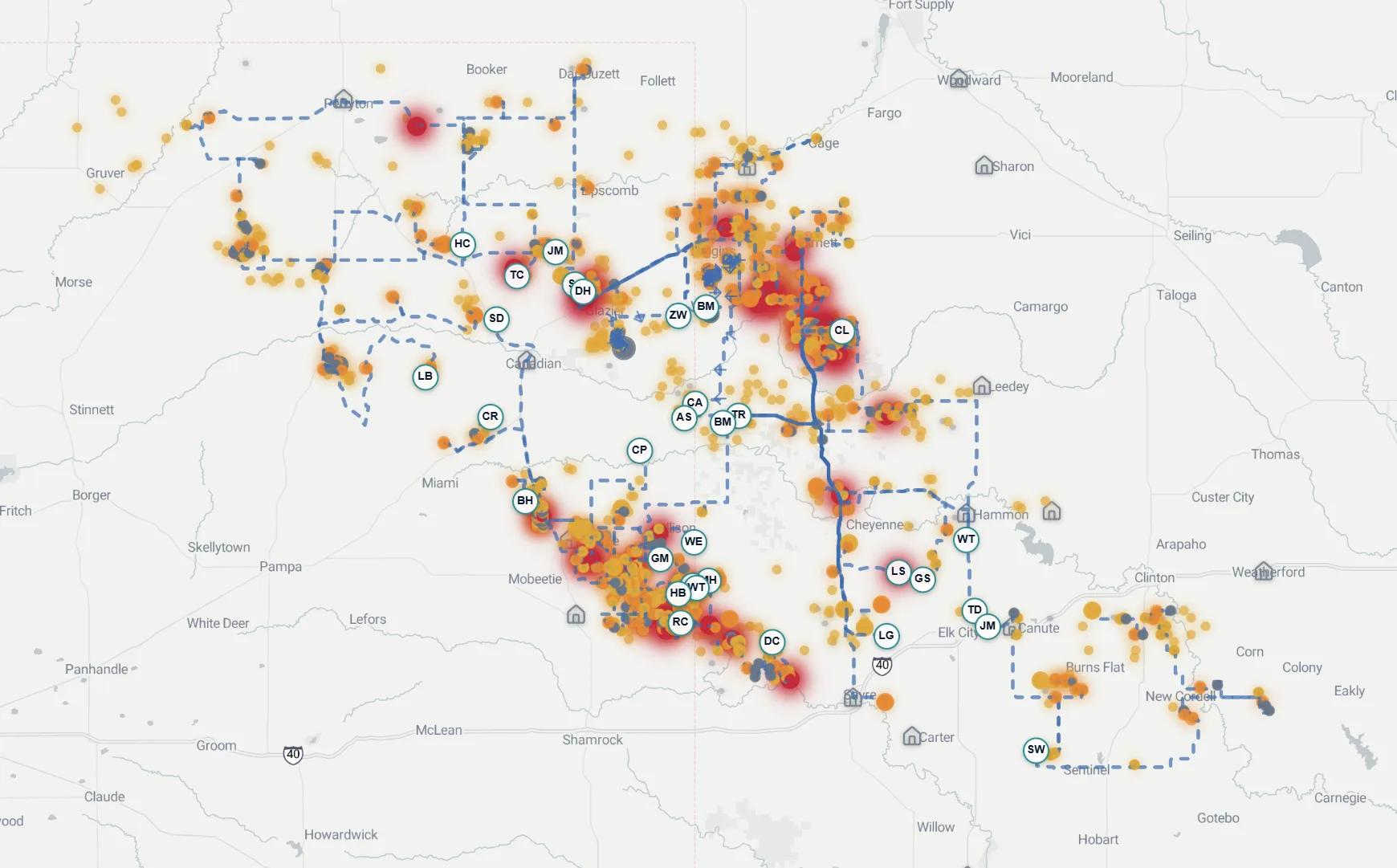
Every route, drawn where the value is.
Fleet view: each dashed line is one lease operator's day, threaded through the production heatmap. Not the shortest route. The most profitable one.
Retires the workarounds your team has been stacking for years.
Treats every well as equal on every day. The value-ranked plan cuts 35% of the miles at equal coverage (deployment figure).
Doesn't scale past one person's memory of the asset base.
Optimizes distance, not economic impact. Wrong objective function.
Three steps from your existing data to field action.
1 · Pull priorities
Ranked work list from Work Engine
Route Opt reads the economic ranking every morning. Each task has a dollar-impact score, a qualification requirement, and a time window.
2 · Solve
Constraint-based optimization
Solver assigns stops to crews, respecting qualifications, yard locations, vehicle capacity, and geography. Multi-hour solve compressed to seconds.
3 · Dispatch
Plan in the truck cab by 6 AM
Mobile delivery to each crew. Offline-capable. Real-time re-optimization as conditions change.
Works with your existing stack
- Samsara
- Geotab
- Azuga
- Esri ArcGIS
- Google Maps
- Mapbox
- iOS
- Android
- Offline caching
- ISNetworld
- Avetta
- Cornerstone
Pricing · WellOPS
Impact Guarantee · license fees only when the metrics move
You buy WellOPS from WorkSync; the tracks below are rollout scopes of that one purchase. GOOD: Route Optimization + Field Data Capture. BETTER: adds DataHub + Work Engine + Field Work Management. BEST: adds Field Safety + Operations Dashboard.
Scoped to your well count and systems with our implementation team when you plan your pilot. The pilot runs four weeks on one field, and DataHub is included.
Common questions
What is the WellOPS Route Optimizer module?
Route Optimizer is the WellOPS module that turns the ranked work list into crew-specific daily plans: a constraint-based solver assigns and sequences stops across every crew, respecting qualifications, time windows, hours of service, yard locations, and equipment co-routing, then delivers the plan to the truck cab on mobile. It is the execution layer of pump by priority. The category-level buyer guide, including how oilfield routing differs from delivery routing, is at route planning software for oil and gas.
How does Route Optimizer replace a fixed pumper route?
A fixed route visits the same wells in the same order regardless of what changed overnight. Route Optimizer rebuilds the day from current conditions every morning: which wells deviated, what each issue is worth, who is qualified, and what fits in the shift. The route changes daily because the field changes daily; the deployment-measured result is 35% fewer miles for the same production coverage.
Do I need Work Engine for Route Optimization to work?
The GOOD tier (Route Optimization + Field Data Capture) can run on static priorities you provide. The BETTER tier adds Work Engine for dynamic economic ranking, which is where most of the 35% fewer miles driven (deployment figure) comes from. Route Opt without Work Engine optimizes distance; with Work Engine, it optimizes cash flow per crew-day.
How is this different from generic fleet-routing or telematics tools?
Those tools optimize for distance or time. Route Opt optimizes for economic impact per crew-day, factoring production at risk, equipment urgency, safety constraints, and crew qualifications. We integrate with the fleet telematics you already run for the underlying vehicle data.
Does this work for mixed fleets (pumpers + technicians + contractors)?
Yes. Each crew type has its own qualifications and time windows. Contractor dispatch is handled with the same engine, qualifications flow from Vendor Management and ISNetworld integration.
What does it cost?
You buy WellOPS from WorkSync; Route Optimizer is its route optimization capability, and the tracks are rollout scopes of that one purchase. GOOD (Route Optimizer + Field Data Capture), BETTER (adds DataHub + Work Engine + Field Work Management), BEST (adds Field Safety + Operations Dashboard). Scoped to your well count and systems with our implementation team when you plan your pilot.
How fast can we deploy?
The stand-up is four weeks: telematics and HR integration in week one, the optimization engine configured in week two, crews trained and running on the mobile app in weeks three and four.
Is this validated in the field, or just a model?
Both. Our research white paper formalizes the problem (a multi-class vehicle routing problem with synchronization constraints) and was validated against a 12-month, 5,000-well, three-basin deployment: 35% fewer miles driven, 15% higher free cash flow on the same crew, and TRIR down from 1.8 to 0.3. The full 40-page paper, including the solver and the economic model, is linked above.
See Route Optimizer on your data.
Bring one area, your crew roster and your qualifications. We solve a real day against your own stops and show you the plan beside the route your crews actually drove, with the value difference between them.