Kill the milk run.
Route crews by dollars, not by habit.
WorkSync builds each field team member’s day from the ranked work list and solves it against real drive times, crew qualifications, equipment, and hours of service. The plan is in the cab by 6 AM. Same windshield time, spent on the wells that move money.
“…transitioned approximately 40% of our onshore production to routeless operations.”
CEO, large US independent · Q2 2025 earnings callThe schedule stops being a map of where the wells are. It becomes a ranking of where the value is.
WorkSync route optimization maximizes the impact of your team. It optimizes for value density, the dollars a crew-day recovers, rather than for the miles it covers. Distance is usually not the problem: compact, well-placed positions still bleed value, because the loss is in the sequencing rather than in the geography. 35% fewer miles driven (deployment figure, measured across 5,000+ wells in live deployments) falls out of the reordering rather than being the target of it.
Routeless is now an operating model that large independents describe to their own investors, and WellOPS is that machinery, productized: sensor- and exception-driven dispatch, value-ranked stops solved against real road time, and the paperwork (tickets, work orders, accruals) booked with the work, not at month-end. Live in 4 weeks (deployment figure), rather than a multi-year internal build. The exception queue is the input the ranking runs on, and software that prices what the queue flags is what turns it into a day worth driving.
The stop a fixed route makes every week and the stop a ranked day makes this morning are different stops. A fixed route allocates a crew hour by calendar and by geography. The engine allocates the same hour by what a well is losing this morning. Same hours, assigned on a different basis. Read the module detail on value density and the solve, or start from the cab’s side of the argument: stop driving the same route every Tuesday.
The routeless day: stops ranked by $/day and risk, not by the route sheet. Illustrative data.
This is what 6:00 AM looks like.
One ranked list, one solved route, one screen in the field. The reason a well is on the list travels with it.
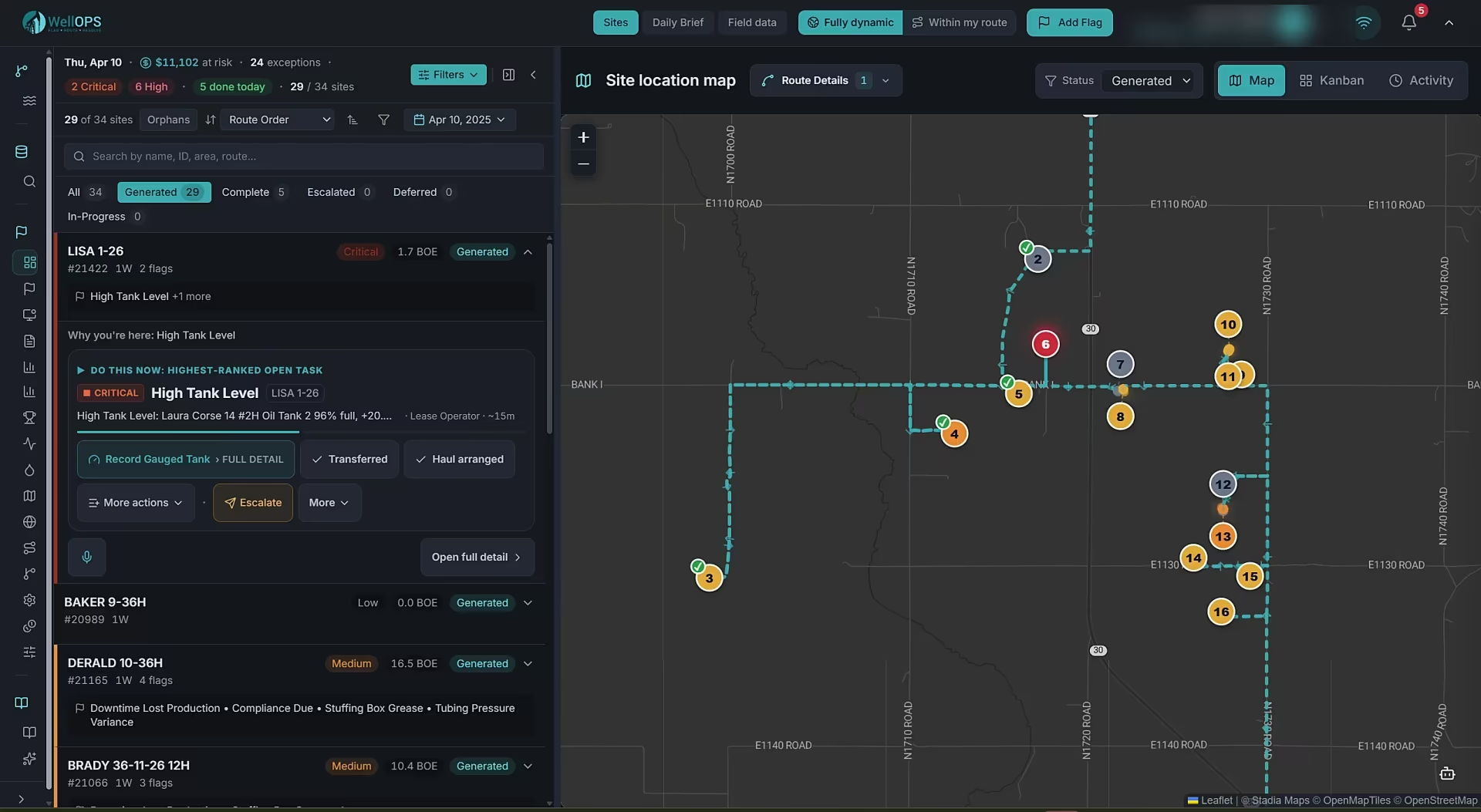
And this is what it looks like from the truck.
The next stop with its open flags and a navigate action, and the same day plotted in route order. No route sheet to reconcile against. Synthetic demo data.
How the drive day gets built
A ranked list is not a plan. Three steps turn one into the other.
Ranking answers what matters most. Routing answers who goes, in what order, with what in the truck, and whether the day can be finished inside a legal shift.
Pull the ranked work
Every open job arrives carrying a dollars-per-day score, a qualification requirement, an equipment requirement, and a time window. Break/fix, PMs, hauling, gauging, and compliance checks all come from the same list, so nothing competes from a side queue.
Solve it
A constraint solver of the class used to route large delivery fleets assigns stops to crews against measured road distances, yard start and end, vehicle capacity, and site access windows. It maximizes dollars recovered across the whole crew-day rather than sites touched, and it solves in seconds what takes a foreman a morning.
Put it in the cab
Each crew gets its own sequence by 6 AM, cached for the cellular dead zones, with the reason each stop is on the list traveling with the stop. Completion feeds straight back into the ranking that builds tomorrow.
What the solver holds constant
Six constraints, enforced inside the plan rather than checked after it.
A plan that ignores a qualification, a weight limit, or a shift length is not a plan, it is a request. These bind every route before it reaches a truck.
Crew qualifications
H2S certification, pressure-vessel inspection, electrical work, well control. A stop that requires a qualification is assigned to a crew that holds it, which is also what keeps the audit trail clean without a post-hoc review.
Equipment and co-routing
Jobs that need a pulling unit, a hot oil truck, or a vac truck get the iron co-routed with the qualified crew rather than scheduled on a separate list that has to be reconciled by phone.
Real roads, real time
Measured drive times over lease roads, seasonal access, bridge weight limits, and gate conditions, rather than straight-line distance. Your own traversal data sharpens the estimate on the private roads no public map covers.
Hours of service
Shift length, mandatory breaks, and travel to the first site sit inside the solve, so the day that reaches the cab is a day that can be finished legally and safely by the crew it was built for.
Value density
The objective is total dollars recovered across the crew-day. A high-value stop thirty minutes out can outrank three low-value stops next door, and the plan shows the arithmetic that made that call.
Live re-solve
A well goes down at 10 AM and the remaining stops re-assign across crews: the crew passing nearby later picks up what the redirected crew drops. Continuous re-optimization, rather than one batch at sunrise.
The plan stays overridable, one tap with a reason code, because the field knows the lease road that washed out and the bearing somebody heard yesterday. The override is recorded as data: a stop the field consistently pulls forward is carrying information the scoring has not captured yet.
What operators get. In this order.
Downtime Reduction
The solver puts the stop that stops deferment first, before the drive day fills up with routine.
Optimal Liquid Management
Hauling and gauging stops earn their place in the same drive day as the wells, so trucks move against value instead of against the end of the month.
Proactive Risk Management
Permit-gated, two-person, and lone-worker stops are sequenced with their constraints attached, so the day the solver builds is a day that can legally be run.
The Full Picture of Value Sinks
Miles, windshield hours, and the value each stop returned land in one ledger, which shows you which parts of the drive day paid for themselves.
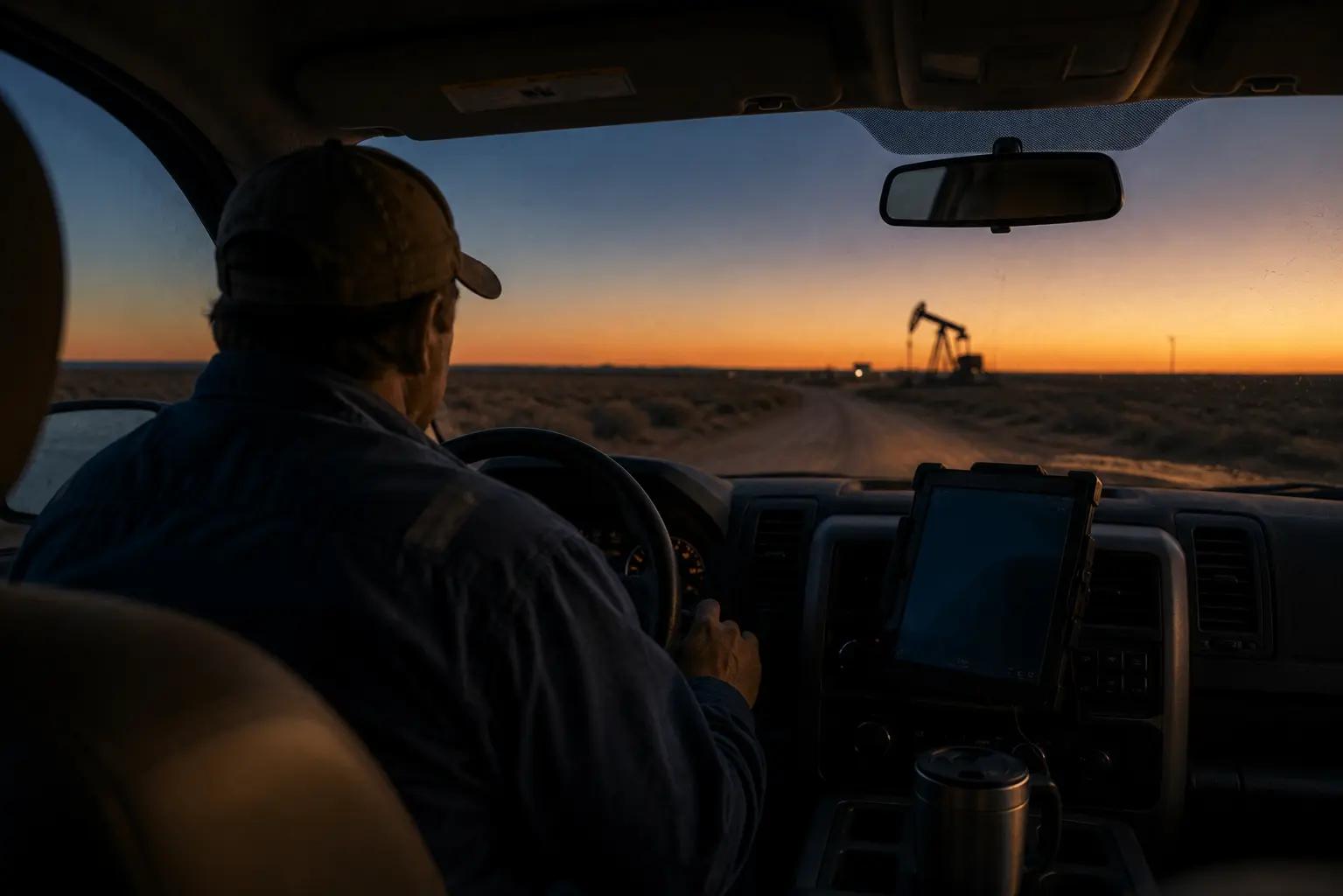
The plan rides in the cab, not on a clipboard.
Built to work with your lift program, your operations center, and the platform underneath
Your lift optimization, executed
Rod pump, ESP, and gas lift optimizers recommend. WorkSync prices each recommendation on deferment and failure cost, ranks it against everything else in the field, routes it to the right crew, and books the accrual with the work.
See the artificial lift story →Your remote operations center, connected to the field
The control room and the field share one ranked queue, live in both directions. The center re-prioritizes and the cab sees it in seconds; the field closes work and the center sees status, downtime recovered, and cost.
See the remote operations story →The platform underneath
Five components, one ranked work loop: the data layer, the engine that prices the work, equipment and safety management, and the accrual that closes with the job.
Walk the five components →How the drive day gets solved
Terrain, lease access, well status, weather, and crew skill turn the ranked list into a sequence, and it re-solves when a well goes down mid-morning. Not the shortest route. The most profitable one.
Read the routing mechanism →How WorkSync fits in
Your systems flag it. WorkSync prices it, ranks it, and routes it: routeless, AI-driven operations that put every field team member on the highest-value work.
Your systems
WellOPS
Your field team
The support that keeps your field equipment running. Driven by one ranked queue, with a UX field teams love: built for the cab, offline-capable, and held to a design standard of under 20 minutes a day of software per field team member.
Before you buy
What a field organization asks before it gives up the route sheet.
What training does the field need before the first shift?
The app is built for a truck cab at 6 AM in gloves: one screen at a time, offline capable, and it syncs when signal returns. A field team member opens it to a day that is already assembled and already in order, so the first shift is the training. Capture happens at the wellhead, by voice or in a couple of taps, rather than at shift end, and Willie walks a person through a JSA by voice. Every stop carries the reason it is ranked where it is, and any stop can be resequenced or skipped in one tap with a reason code, which keeps local knowledge in charge of the day. The rollout is gated rather than dated: flags tune against the field's own judgment first, and the ranked plan goes into a truck when the crews agree the ranking is right. The measure that matters is whether the plan survives contact with the field, and establishing that on your own crews is what the four weeks are for.
See what the field app asks for →How do we justify this internally?
Build the case from a method rather than a projection. First, you and your controller pick one operating metric and write it down before anything is connected: cash flow per BOE, operating cost per well, drive miles, or TRIR. Second, run your own well count, crew count, and drive times through the route economics calculator on this site, which puts a dollar figure on a day of your field capacity using your inputs rather than ours. Third, run the four-week pilot on one field against that single agreed metric, with the baseline set in week zero, so the business case is measured on your wells. The Impact Guarantee carries the commercial risk while that happens: license fees only when the metrics move. What reaches your approver is your own baseline and your own delta, which is the only version of the number that survives a finance review.
Run the route economics calculator on your numbers →See your wells, ranked by dollars, tomorrow morning.
Bring one field’s data. We’ll show you the ranked plan your crew would have run today, and what it was worth.
See Your Wells Ranked