WellOPS · Field Data Capture · Mobile Workflows
Field data capture built for the cab.
One screen, gloves on, offline, with the day already assembled before the truck leaves the yard. Field Data Capture is the mobile capture layer for every field task in oil and gas: one-tap completion, voice-to-text notes, photo and signature capture, and validation at the moment of entry against each well’s own history. It records the reading once, at the wellhead, and lands it in your systems of record without anyone re-keying it.
Part of WellOPSYou buy WellOPS from WorkSync. Field Data Capture is the field data capability of WellOPS, the operating platform for production operations, and it ships with the platform.
Definition
What is field data capture software?
Field data capture software digitizes the readings, observations, and paperwork that oil and gas field crews record at the wellsite: tank gauges, meter reads, well tests, equipment checks, downtime notes, inspections, JSAs, and the pumper's daily log. Instead of a grease book, a clipboard form, and an end-of-shift Excel session in the truck, the pumper records each reading once, on a phone or tablet, and the data lands in the systems of record automatically.
Oil and gas field data capture is a harder problem than generic form apps admit. Most wellsites have no cell coverage. Crews work in gloves, in wind, next to running equipment. A tank gauge only matters if it reconciles against SCADA and lands in production accounting before month-end close. So field data capture systems for the oilfield are judged on four things: offline reliability, speed of capture, validation at the moment of capture, and how deep the integration into the back office actually goes.
Field Data Capture is the WellOPS module built to that standard. It is the mobile layer for every field task, and the front door of the same pipeline that feeds the ranked daily work plan and digital field tickets.
What an oil and gas field data capture system has to handle
Oilfield daily log software
Gauge sheets, production readings, runtime, and downtime notes, captured per well and per shift. Oilfield daily log software replaces the grease book only if it is faster than the grease book: one-tap entries, voice notes, and defaults from yesterday's reading.
Inspections and HSE forms
JSAs, hazard observations, facility inspections, and regulatory checklists, with photo evidence and signature capture where sign-off is required. The same app the pumper already has open, not a second one.
Well tests and tank gauges
Structured readings that reconcile against SCADA automatically. When the manual gauge and the sensor disagree, the discrepancy surfaces the same day as a work item, not at month-end as a mystery.
Field tickets
Vendor and company-labor tickets captured against the job they belong to, so cost lands on the right well. The full ticket-to-invoice story lives on the digital field tickets page.
The mechanism
How mobile data capture works in the oilfield
Mobile data capture in the oilfield works in four moves: the day's sites and forms are cached on the phone or tablet while it still has service, the field team member records readings and observations on the device at the wellsite with no connection, every entry is validated on the device at the moment it is recorded, and the device syncs to the systems of record once it is back in range. The offline step is what separates oilfield capture from a generic mobile forms app, because most wellsites have no cellular service, so the app has to carry a working copy of the route rather than a connection to a server.
- 01
Load the route before coverage runs out
The day’s sites, the forms they call for, and each well’s prior readings are cached on the device while it still has service, so the rest of the route does not depend on a live connection.
- 02
Capture at the wellsite, offline
Tank gauges, well tests, runtime and downtime notes, inspections and JSAs are recorded on the device at the location: one-tap entries, voice-to-text for notes, photos for what a number cannot carry, signature capture where sign-off is required, and a GPS and time stamp on every entry.
- 03
Validate at the moment of entry, not at month-end
Range checks against that well’s own history, required fields that cannot be skipped, and unit guards all run on the device, offline. A suspect reading gets questioned while the person who took it is still standing at the tank.
- 04
Sync and reconcile on the way back in
When the device returns to coverage, entries sync through DataHub into the production accounting system of record, and gauges reconcile against SCADA where sensors exist. Discrepancies surface the same shift as work items instead of at close as an allocation argument.
What the sequence produces is a plan the crew opens the next morning. That part does not summarize.
View a Sample 6 AM PlanWhere capture happens
On the device, at the site, in gloves.
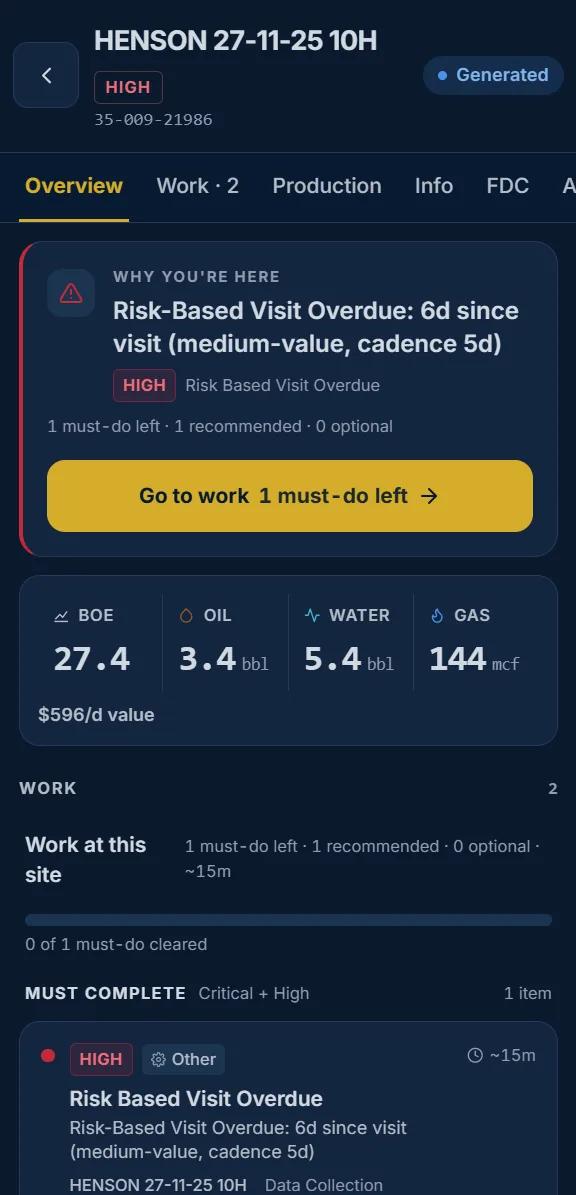
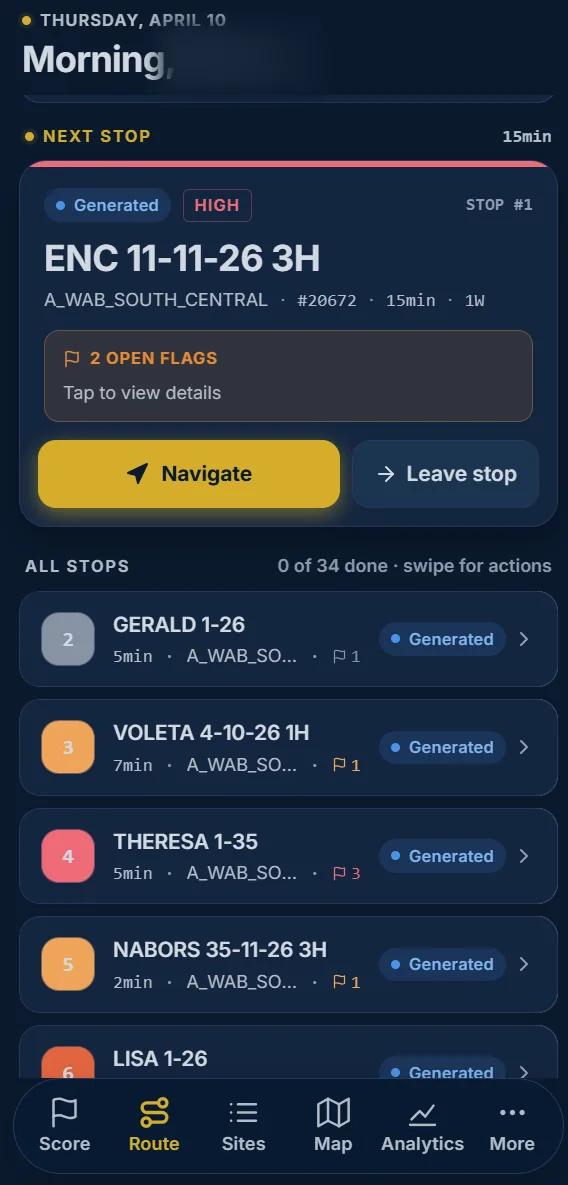
The site screen carries why the visit is on the plan, what the well is doing, and the work waiting there. Readings and forms are recorded against that site while the field team member is still standing at it. Synthetic demo data.
Why capture quality decides everything downstream
Validation at capture, not at month-end
The failure mode of paper and spreadsheet capture is not that data goes missing. It is that bad data goes unquestioned for weeks. A transposed tank level or a gauge read against the wrong well flows into production accounting, gets trusted, and surfaces as an allocation fight at close.
Field Data Capture validates every entry at the moment it is recorded: range checks against that well's own history, required fields that cannot be skipped, unit guards, and a same-shift reconciliation against SCADA where sensors exist. The pumper fixes a suspect reading while still standing at the tank, which is the only cheap moment to fix it.
Clean capture is also what makes the rest of the platform work. The ranked plan in Work Engine is only as good as the field data underneath it, and DataHub can only reconcile systems that received the reading once, correctly, with a GPS and time stamp attached.
6 capabilities that turn your existing stack into action.
- 01
Offline-first mobile capture
Works in cellular-dead zones, the majority of real oilfield locations. Syncs automatically when the truck comes back in range. No data loss, no manual reconciliation.
- 02
One-tap completion, voice-to-text notes
Pumpers can record readings and notes with their hands full or gloves on. Voice transcription handles oil-and-gas vocabulary. Photo capture for visual inspections, signature capture for regulatory sign-off.
- 03
Validation at the point of capture
Range checks against the well's own history, required fields, and unit guards catch the bad reading while the pumper is still on location. Gauges reconcile against SCADA automatically; discrepancies flagged the same shift.
- 04
Configurable forms without IT tickets
Build custom inspection forms, daily logs, well tests, and tank gauges from a drag-and-drop template editor. Changes pushed to every crew on next sync, no app store rebuild cycle.
- 05
Syncs directly to the source systems
Field data lands in Enertia, Quorum, or Oildex through DataHub, no duplicate entry. Captured once, synced once, one data pipeline into accounting, engineering, and the ranked work plan.
- 06
Captures context, not just numbers
Photos of leaks. Voice notes on equipment condition. GPS stamp on every reading. Context that gets lost in paper workflows is now queryable downstream for pattern detection.
Retires the workarounds your team has been stacking for years.
Re-keyed at end of shift or never. Errors compound and erode trust in the data.
Each one captures one data type behind its own login and its own sync. Field Data Capture handles every field workflow in one app.
Attachment chain breaks. Version control nightmare. No offline support.
Three steps from your existing data to field action.
1 · Configure
Build your forms in hours, not weeks
Drag-and-drop editor. Well tests, daily reports, tank gauges, inspections, JSAs. Version-controlled and pushed to crews on next sync.
2 · Capture
Offline-first in the field
Pumper opens the app, taps complete, adds voice notes and photos. Works in the back-forty of a lease with zero bars.
3 · Sync
Direct to source systems
Data syncs to Enertia / Quorum / Oildex via DataHub. SCADA reconciliation runs automatically. Exceptions flagged for review, no manual data entry.
Works with your existing stack
- Enertia
- Quorum
- W Energy
- Oildex
- Ignition
- AVEVA PI
- Cygnet
- iOS
- Android
- Tablet + phone
- Excel
- CSV
- Direct API
Pricing · WellOPS
Impact Guarantee · license fees only when the metrics move
You buy WellOPS from WorkSync; the tracks below are rollout scopes of that one purchase. GOOD: Field Data Capture standalone. BETTER: adds DataHub + Workflow Automation. BEST: adds Work Engine + Field Work Management.
Scoped to your well count and systems with our implementation team when you plan your pilot. The pilot runs four weeks on one field, and DataHub is included.
The field does not need an eighth app. It needs one: the exception, the maintenance job, the capture, the cost, and the safety paperwork on one screen with one login, which is what ends the end-of-shift re-keying session in the truck. Captured once, synced once, one data pipeline.
Capability statement · no per-app count claimed
Common questions
What is field data capture software?
Field data capture software digitizes the readings and paperwork field crews record at the wellsite (tank gauges, well tests, daily logs, inspections, JSAs, field tickets) on a mobile app, validates each entry at the moment of capture, and syncs it to the systems of record. For oil and gas it must work offline, capture fast enough to beat the grease book, and integrate deeply enough that nobody re-keys anything.
How does mobile data capture work in the oilfield?
In four moves. The day’s sites, forms, and prior readings are cached on the phone or tablet while it still has service. The field team member records tank gauges, well tests, runtime and downtime notes, inspections and JSAs on the device at the wellsite with no connection, using one-tap entries, voice-to-text, photos and signature capture, with a GPS and time stamp on every entry. Each entry is validated on the device as it is recorded, against range checks built from that well’s own history. When the device returns to coverage it syncs to the systems of record and gauges reconcile against SCADA. Offline operation is the part that matters most, because most wellsites have no cellular service.
What should an oilfield data capture app include?
Four things decide whether a field data capture system survives contact with a real route: offline-first operation (most wellsites have no coverage), speed of capture (one-tap entries, voice notes, gloves-on usability), validation at capture (range checks, required fields, SCADA reconciliation), and direct integration into production accounting so the data lands without re-entry. Photo, GPS, and signature capture cover the inspection and compliance side.
What happens when pumpers are in cellular-dead zones?
Field Data Capture is offline-first by design. Readings, photos, and voice notes cache locally and sync when the device comes back in range. No data loss, no manual reconciliation. Mobile data capture that only works with coverage is not field-ready.
Can it replace our oilfield daily log?
Yes. The daily log workflow (per-well gauge sheets, production readings, runtime, downtime notes) is a standard template: one-tap entries with defaults from the previous reading, voice-to-text for notes, and automatic rollup into the daily report the foreman actually reads. The grease book only disappears when the app is faster than the grease book, which is the design bar.
Can I customize forms without hiring a developer?
Yes. The drag-and-drop form editor lets admins build and version forms without code. Changes push to crews on the next app sync, no app store rebuild.
Does data actually land in Enertia / Quorum cleanly?
Yes, direct API integration via DataHub. Fields map to production accounting schema with reconciliation against SCADA, and the elimination of manual gauge entry takes the re-keying step out of month-end close entirely.
How is this different from single-purpose field data apps?
Most operators run several single-purpose capture apps: one for production readings, one for inspections, one for safety forms. Each captures one data type behind its own login and sync. Field Data Capture handles every field workflow (production, inspection, safety, completions) in one app, one sync, one data pipeline. The field does not need an eighth app. It needs one.
What does it cost?
You buy WellOPS from WorkSync; Field Data Capture is its field data capability. The engagement is scoped to your well count, your systems, and the capabilities you actually need, in a pilot-planning conversation with our implementation team. Under the Impact Guarantee, license fees only when the metrics move.
See your own gauge sheet in the app.
Bring your gauge sheet, your well test form and one inspection checklist. We build them in the editor with you and put them on a crew device in the first week, validated against each well’s own history.