The comparison · Last updated August 20, 2026
Pump by Exception vs Pump by Priority.Two operating models, one question apart.
Pump by exception asks
Which wells have a problem?
Pump by priority asks
Which problem is worth solving first?
This is why WellOPS is the world’s most advanced Pump by Exception platform: the advancement is that it does not stop at the exception. It goes past flagging to pricing and routing, which is the whole difference this page walks through.
The same morning, twice
47 exceptions. One first truck.
A field team member opens the morning screen to 47 exceptions. An exception system can name every one of them: Well 104, line pressure low. Well 217, pump issue. Well 388, tank level rising. What the list does not carry is an order. Someone still ranks those 47, usually in the cab, usually by memory and windshield order.
Take an illustrative morning: WellOPS answers with the ranked version of it. Well 217 goes first: $8,400 per day at risk, 42 minutes away, a qualified crew on shift. Well 104 goes second at $3,100 per day. Well 388 already has a haul scheduled and holds. The other 44 are priced and sequenced, or parked because the value at stake does not pay for the drive. The ranking arrives with its reasoning, so it can be checked rather than believed.
- FlagWell 104: line pressure low
- FlagWell 217: pump issue flagged
- FlagWell 388: tank level rising
- Flagand 44 more, in the order they arrived
Every exception named, every row the same weight. The ranking still happens in someone’s head. Illustrative data.
The same 47 exceptions: priced in $/day, sequenced by dollars, drive time, and crew, staffed before the first truck rolls. Illustrative data.
The exception is not the decision. It is the input to the decision.
Side by side
Detection vs valuation. Alarms vs the ranked plan. Reacting vs operating.
The industry evolution
Four generations of field operations.
- Generation 01
Fixed Routes
Visit every well.Every well on a calendar cadence. Complete coverage, bought with windshield time: most visits confirmed that nothing was wrong. - Generation 02
Pump by Exception
Visit wells when something changes.SCADA put surveillance on every well and broke the fixed-cadence assumption. Real progress: fewer blind miles, faster response to real problems. The list still arrives unranked. - Generation 03
Pump by Priority
Visit wells when the economics justify it.Every exception priced in dollars per day, ranked against every open job in the field, and sequenced into a drivable day. This is the generation WellOPS implements. - Generation 04
Intelligent Operations
Continuously decide what the operation should do next.The loop runs continuously: Flag. Price. Rank. Route. Execute. Learn. The direction the industry is heading, and pump by priority is the step that makes it reachable.
Partial credit, specific failure modes
What pump by exception got right, and where a decade of attempts struggled.
Pump by exception deserves an honest accounting. It broke the assumption that every well needs a visit on a fixed cadence, it put SCADA data to work as an operating signal rather than a record, and wherever alarm discipline held, it genuinely reduced windshield time. Operators who adopted it were right to.
Where it struggled, three failure modes repeat almost universally. Alarm fatigue: static thresholds, set conservatively and rarely revisited, produce hundreds of exceptions a day with no dedupe and no ranking. The field learns that most alarms are noise, which means the field also learns to ignore the one that is not. No economic context: a threshold trip on a low-rate well and a high-value well drifting off forecast arrive on the same list with the same urgency, so crews work the list in whatever order the windshield suggests, and the deferred-production numbers do not move. No routing and no loop: an exception list is not a drivable day, and whatever the pumper found at the well never flows back into the logic.
Operators who lived through this era are right to be skeptical of the phrase. The failure was not the principle. It was an implementation that stopped at detection. That distinction is exactly why the next generation exists, and why WellOPS is the world’s most advanced Pump by Exception platform: it finishes what the exception era started.
The difference, on screen
An alarm queue is a list. This is a ranked plan.
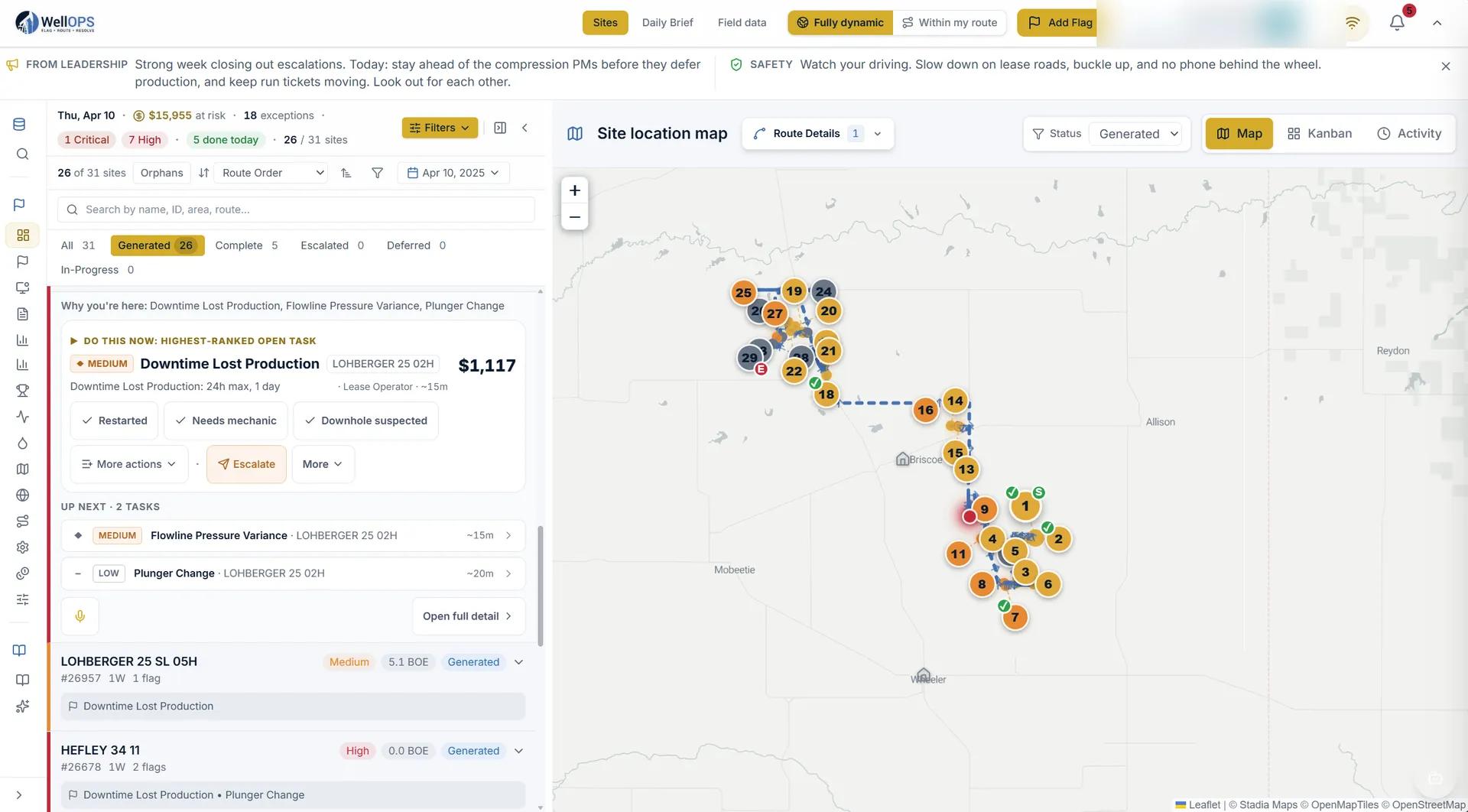
Every stop priced, sequenced, and explained, before the first truck rolls. The same plan, typeset, is the ranked half of the 47-exception morning above.
The buying decision
When each model is the right purchase.
Pump by exception is the right purchase when the binding problem is visibility: wells go down and nobody knows until the next calendar visit. An operator with no alarm discipline at all should fix that first. Just price it as what it is: detection, without economics, routing, or learning. Do not book deferment-recovery economics against a detection purchase; there is no published case we know of where detection alone moved LOE or deferred production at portfolio scale.
Pump by priority is the right purchase when the alarm list already exists and the question has become which of these deserves a truck today, in what order, and who goes. That is a valuation and routing problem, and it is where the published full-loop numbers come from: at the deployed reference, a top 25 private producer running 5,000+ wells across the Western Anadarko, Permian, and Wyoming, the measured deployment figures are 15% more free cash flow on the same crew and 35% fewer miles driven for the same coverage.
Keep your SCADA. Keep your historian. Keep your exception system. The migration adds the layer that turns exceptions into economic decisions: scoring that prices the exceptions you already surface, routing that turns the scored list into a drivable day, and the feedback loop that makes tomorrow’s ranking sharper than today’s. The productized version of that migration is a 4-week stand-up: read-only integration in week one, scoring in week two, crews live in weeks three and four, one signed metric, and under the Impact Guarantee you owe no license fee unless it moves.
Frequently asked
Common questions
What is the difference between pump by exception and pump by priority?
What is the difference between management by exception and pump by exception?
Why did pump by exception struggle for a decade?
Is a SCADA "pump by priority" feature the same as the pump-by-priority operating model?
When is pump by exception enough?
What is the migration path from pump by exception to pump by priority?
What comes after pump by priority?
Are your best people working on your most valuable work today?
Pump by exception tells you where something changed. Pump by priority tells you where to send your people.
See the difference between an alarm queue and a ranked plan, on your own wells, in four weeks.