The argument · Last updated July 28, 2026
The field should not adapt to enterprise software.Enterprise software should adapt to the field.
Most software running in oilfield operations today was built for something else: plants, fleets, service companies, office analysts. It reached the field through adaptation, and the cost of that adaptation is paid daily, by the crew, in workarounds, double entry, and decisions the tool cannot make. Fit-for-purpose is the opposite bet: build for the producing field first, and hold the software to the field's standard, not the other way around.
The adaptation tax
Adapted software makes the field pay the difference.
Horizontal software earns its scale by being generic, and it becomes “industry software” through configuration: a services team maps wells onto a generic asset model, pumper work onto generic tickets, and the field's vocabulary onto custom fields. The demo looks right. Then the gap between the generic model and the field's reality starts collecting its tax, every shift, from the people with the least time to pay it.
The tax has a recognizable shape: a rollout measured in years; a training program the field resents; screens that ask the pumper for data the system should already have; and, at the end of it, a tool that records the day without ever deciding it. The most reliable symptom is what happens next: the field quietly routes around the system, the real plan moves back to the whiteboard and the group text, and the software becomes an expensive place where work is documented after the fact.
None of this is a failure of effort. It is a failure of origin. Software inherits the assumptions of the problem it was born solving, and no amount of configuration changes what a system believes a day's work is.
The incumbent patterns
Four patterns, one shared gap.
We describe patterns, not vendors. Most operators run some mix of these four, and each covers a real part of the job. The shared gap: none of them generates, prices, and routes the daily work of a producing field.
The adapted enterprise asset system
Built for plants and fleets, configured for wells by a consulting team. It tracks assets beautifully and decides nothing: no economic ranking, no route, no overnight score. The field feeds it forms; the field gets nothing back it can drive.
The SCADA dashboard layer
Real-time visibility with no work loop. It shows every trend and ranks none of them by dollars, so the screen is green, the alarms are plentiful, and the Monday route is unchanged. Visibility without action is a very expensive form of watching.
The generic field service tool
Built for service companies dispatching billable tickets. It assumes the work arrives from a customer and every job is worth roughly the same, two assumptions that are false on a producing field, where the work must be generated from signals and one task can be worth a hundred times its neighbor.
The spreadsheet operation
The foreman rebuilds the plan every morning from memory, texts, and a workbook. It is genuinely fit for purpose, which is why it persists. It just does not scale past one person, does not survive retirement, and cannot score five thousand wells before 6 AM.
The fuller pattern-by-pattern comparison, still unnamed, lives on Why WorkSync.
The standard to hold
Four tests for fit-for-purpose field software.
Run these against any tool, ours included. They are cheap to ask in a demo and expensive to discover in year two.
It fits the field day, not a training course
A pumper should be productive on day one of the pilot. If the rollout plan opens with a curriculum, the software was built for someone else and the field is being asked to absorb the difference.
It asks for under 20 minutes a day
The standard worth holding field software to: under 20 minutes a day of software, more than 8 hours on work that creates value. The plan arrives finished at 6 AM; capture happens by voice in the truck; the system does its thinking overnight, off the clock. And it should be measured, not promised.
It runs on the systems you already own
Fit-for-purpose is not rip-and-replace. It deploys read-only on the existing SCADA, historian, CMMS, accounting, and GIS stack, adds the decision layer those systems never had, and stands up in weeks. A multi-year integration program is the clearest possible signal the tool was not built for this.
It speaks operator, natively
Deferred production, lease roads, plunger cycles, haul thresholds, JSAs: in the object model from the start, not as custom fields bolted onto assets and tickets. When the software has to be taught what a well is, everything downstream inherits the translation error.
Built for a gloved hand
Field capture that fits the field day.
Gauge sheets, JSAs, hazards, and inspections in one interface: voice-enabled, offline-first, auto-filled from SCADA and prior shifts. The operator confirms what is true instead of typing what the system should have known.
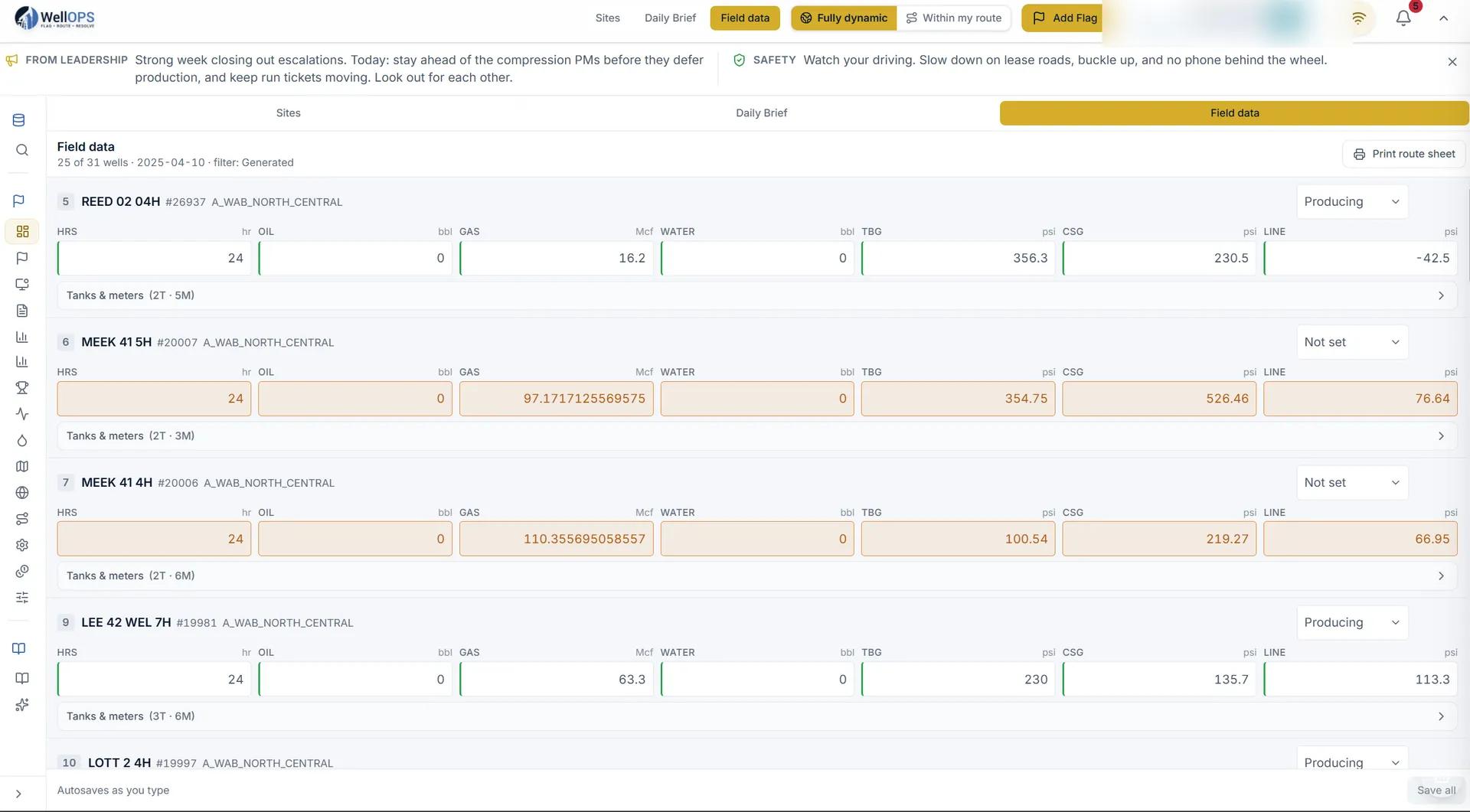
One capture surface for everything a field worker observes. Synthetic demo data. Scroll the capture sideways to read it.
Where WorkSync fits
Fit-for-purpose. Plug-and-play.
WorkSync was built from the producing field outward: WellOPS scores every well overnight, routes crews by dollars, and captures the field day in operator vocabulary, on the systems of record you already own. Integration is read-only and takes about a week; the productized 4-week stand-up puts the ranked plan in every truck cab and measures the result against your own baseline. Implementation in days and weeks, not years, by a team that has done it before.
The proof holds the same standard we ask you to hold vendors to: measured figures, labeled, on the numbers page, including the 15% free cash flow uplift on the same crew, measured across 5,000+ wells in live deployments. Don't leave value on the table paying an adaptation tax to software that was never built for your field.
Fit-for-purpose, common questions
What does fit-for-purpose software mean in oil and gas?
Software whose core model was built for the producing field: wells, routes, deferred production, crews, and lease roads as first-class objects, not as customizations of a generic asset, ticket, or dashboard model. The practical test is what the tool does before you configure it: fit-for-purpose software understands a pumper route on day one; adapted software understands it after a services engagement.
Why does adapted enterprise software struggle in the field?
Because the adaptation cost lands on the field. Horizontal platforms are configured toward the oilfield through long services projects, and every gap between the generic model and the field reality becomes a workaround the crew performs daily: extra screens, double entry, decisions the tool cannot make. The field should not adapt to enterprise software. Enterprise software should adapt to the field, and when it cannot, the field quietly reverts to the whiteboard.
What are the incumbent patterns operators typically run today?
Four recur, in some mix: an enterprise asset system adapted from plants and fleets, a SCADA layer that provides visibility without a work loop, a generic field service tool built for service-company dispatch, and the spreadsheet operation run from the foreman's truck. Each covers part of the job; none generates, prices, and routes the daily work of a producing field. The unnamed pattern comparison lives on the why-WorkSync page.
Is fit-for-purpose the same as a point solution?
No. A point solution solves one task and adds another tool to the pile. Fit-for-purpose describes the platform's shape, not its size: WellOPS covers the whole field work loop (scoring, routing, capture, safety) inside one operator-native model, and deploys module by module. Fit-for-purpose. Plug-and-play. You start with the module aimed at your loudest leak and expand on results.
How fast should fit-for-purpose software deploy?
Weeks, measured. WorkSync's productized stand-up is 4 weeks: read-only integration in about the first week, nightly scoring and ranked plans in the truck by weeks two and three, and a baseline comparison on one signed metric in week four. Implementation measured in years is the defining symptom of software that needed adapting.
Are your best people working on your most valuable work today?
Hold us to the four tests.
Run the fit tests against WellOPS on your own data. Four weeks, one signed metric, your baseline.
Continue the cluster: Should We Build It In House? · Oilfield Work Management · Lease Operator Routes · WellOPS, the field operations product