Plan your pilot
One field. Four weeks. License fees only when the metrics move.
Our implementation team scopes your systems, well count and operating metric in one call. The pilot runs on one field’s data, read-only, DataHub included, live in four weeks, with a first read against your signed baseline. Fit-for-purpose. Plug-and-play.
Straight talk on how the pilot is priced
There is no price on this page, on purpose.
A number without your scope would be a guess. What a pilot involves turns on three things we cannot see from here:
- How many wells are in the field you pick
- Which systems of record we read from
- Which modules the pilot runs
Our implementation team scopes all three in one call and puts the plan in writing. The offer itself does not need a number:
The Impact Guarantee. License fees only when the metrics move.
- 01
You pick the metric.
Cash flow per BOE, OPEX per well, drive miles: the number you already run the field on. The baseline and how it is measured go in writing before week one.
- 02
The 4-week pilot measures it.
One field, on your data, read-only against your systems of record, measured against the baseline you signed.
- 03
License fees start only if it moves.
If the number does not move, you walk away. No license fee, no kill fee.
Adoption gates come first, and they are ours to hit, not yours.
A tool the field does not use has no effectiveness to measure. We measure usage and uptime before we ask you to measure anything. Then the number is judged against the baseline you signed before week one, and if it did not move, we say so and you keep the baseline work.
The 4-week pilot
The scoping call. You pick the metric. The baseline and how it is measured go in writing.
Week 1Connect read-only to your systems
Deliverable: Credentials your IT team issues. Data flowing, verified by your team.
Week 2Configure and rank
Deliverable: Flags tuned to your wells. A ranked plan generated every morning.
Weeks 3 to 4The ranked plan in the field
Deliverable: Pilot crews run on the ranked plan from week three, all live by week four. Their corrections feed the next ranking.
Week 4Measure the metric you picked
Deliverable: A first read of your metric against the baseline you signed.
The pilot plan
What the plan covers, in writing.
A pilot should not be a leap of faith. Before anything is stood up, our implementation team writes the plan down: scope, data, integration, schedule, and the guarantee.
01
A scoping call
Our implementation team walks your operation with you: well count, basins, systems of record, crew structure, and the operating metric you want to move. You leave the call with a written pilot plan.
02
One field's data
The pilot runs on a single field or asset group you pick. Big enough to prove the number, small enough that nobody has to bet the company to see it.
03
Read-only integration
DataHub connects to your SCADA, production accounting, and CMMS read-only. Your systems of record stay authoritative. No rip-and-replace, no data entry.
04
The schedule and the guarantee
The 4-week pilot and the Impact Guarantee terms, both set out above.
Are your best people working on your most valuable work today?
That is the question the pilot answers, on your wells, against your baseline.
We name the metric before week one. We charge when it moves.
How the Impact Guarantee works ↑The catalog
Eight modules. Your pilot starts with the one that maps to your sharpest pain.
Every module runs on the same backbone: the most sophisticated prioritization engine in the field, fed by DataHub. The scoping call picks the module, the field, and the metric; our implementation team scopes the engagement to your well count and systems. The pilot itself is four weeks on one field, and license fees wait for the metric.
WorkSync DataHub
The integration backbone. Pre-built connectors to your ERP, SCADA, production accounting, and historian: the systems your team already runs. Included with any WellOPS or FlowSync module. Sold standalone too.
Module deep-dive →Field Data Capture
Gauge sheets, JSAs, hazard observations, equipment inspections, environmental readings. Voice-enabled, offline-capable, one-tap completion. The form fills itself; the field team member confirms what is true.
Module deep-dive →Field Work Management
Permits, lone-worker check-ins, MOCs, hot work, lockout/tagout, incident investigations, compliance audits. Every job has an owner. Every permit has a clock. Every lone worker has a check-in.
Module deep-dive →Work Engine
Ranked daily work plan in every truck cab by 6 AM, scored on cash-flow impact and risk. Includes Opportunity Scoring. The brain that decides what your field does today.
Module deep-dive →Route Optimizer
The most profitable drive day, re-solved when something changes. Not the shortest route. Multi-stop optimization with crew qualifications, priority, geography, and time windows. 35% fewer miles driven, measured across 5,000+ wells in live deployments.
Module deep-dive →Model Builder
Build the model from PDFs, P&IDs, datasheets, GIS layers, and as-builts you already have. Automatically. The hydraulic model that took weeks of an engineer's time and was six months stale, now minutes of verification and current.
Module deep-dive →Flow Simulator
Steady-state and transient hydraulic simulation, on live data. Liquids and gas, gathering, transmission, distribution. Interoperates with and feeds the hydraulic simulators your engineers already trust, or runs alongside them. Customer's choice.
Module deep-dive →Process Simulator
Process simulation for gas processing, dehydration, sweetening, compression, separation, and small-facility design. Full-scale simulation for the everyday work that does not need a full-scale license. Sized for the work that fills your day, not the once-a-decade greenfield.
Module deep-dive →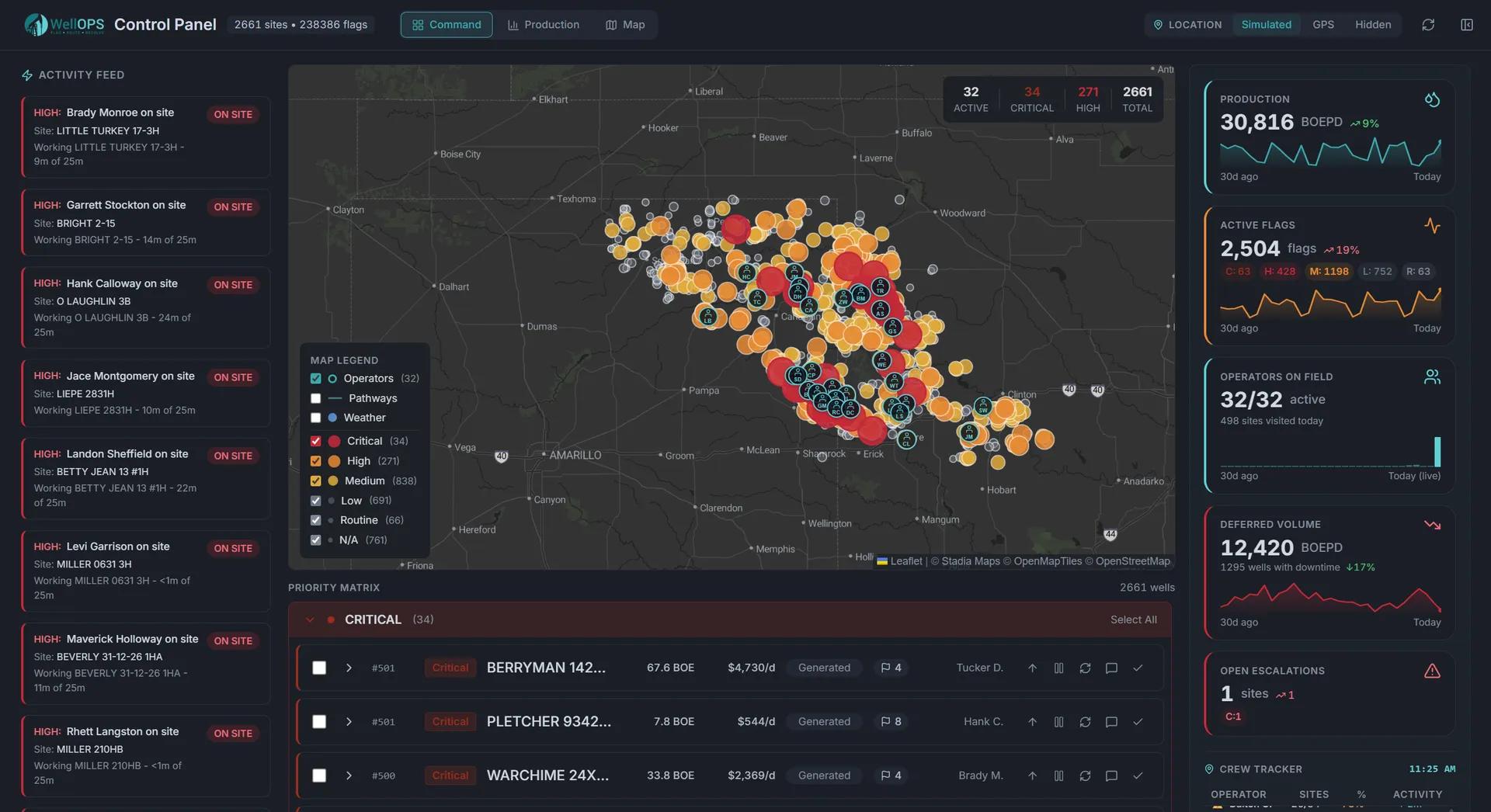
Paid diagnostic · Results in 14 days
Route Economics Diagnostic
We connect to your data, analyze your routes by cash-flow impact, and hand you the gap and the fix. Fixed scope, agreed in the planning call, no surprises.
The full platform
Both products on one backbone.
WellOPS plus FlowSync plus DataHub plus Willie and Taylor embedded. Most operators land with one module and expand as the metric proves out. Scope the mix with our implementation team.
ROI Calculator
What could WorkSync deliver on your data?
Three inputs, one order-of-magnitude estimate. Put in your numbers and the calculator applies the deployment benchmarks noted below them.
Your operation
Calculation assumes $55 oil. Benchmarks are deployment figures from the multi-basin reference (a top 25 private producer, Western Anadarko + Permian + Wyoming): 10% optimizable production × 15% capture, and a 35% drive-mile reduction at the same production coverage.
Expected annual impact
Onboarding walkthrough
See Your Wells Ranked
Prove value on one module. Four weeks to stand up (integrate week one, configure week two, crews live by week four), under the Impact Guarantee: license fees only when the metrics move. Name and work email; the scoping call collects the rest. This same form reaches our implementation team if you would rather start with a conversation than a pilot plan.
Before you commit
See the pilot in context: by basin, by alternative, by module.
By basin
The math in your basin
- Permian operators→
LOE math for the Delaware Basin
- Bakken operators→
LOE math for the Williston
- Anadarko operators→
Reference customer ran 5,000+ wells on this
- Eagle Ford operators→
The math for NGL-rich plays
- Mid-tier upstream→
The 500–5,000 well sweet spot
- LOE reduction pillar→
How the math works across basins
By alternative
Compare the approaches
By module
Module deep-dives
- Work Engine→
Ranked daily plan, the brain
- Route Optimizer→
35% fewer miles driven
- Field Data Capture→
Mobile, voice-enabled, offline
- Field Work Management→
Permits, MOCs, lone-worker
- DataHub: Included→
Integration backbone, included in your WellOPS or FlowSync subscription
- Field Ops Blind Spot Test (no cost)→
Ten questions, score your field operation
Before you ask
Frequently asked
What does a pilot plan cover?
What is the Impact Guarantee?
How do we justify this internally?
What training does the field need before the first shift?
What does WorkSync cost?
How is the DataHub included?
Can I pilot one module without the others?
How fast can we deploy?
What counts as implementation?
Pick the metric that matters.
WellOPS, the best Pump by Priority platform in oil and gas, on your data. Plan the pilot with our implementation team, stand up in four weeks, and read the number against your baseline at week four. License fees only when the metrics move. Don’t leave value on the table.