Field operations · Last updated July 28, 2026
Lease operator routes.Not the shortest route. The most profitable one.
The pumper route is where field strategy becomes physical: whatever the plan says, what actually happens is where the trucks go. Most routes are still fixed loops drawn years ago, driven on a calendar. This page covers how lease operator routes get built, why the fixed loop leaks value every day it runs, and what changes when the route is rebuilt each morning from a dollar-ranked well list.
Why the route is the leverage point
Crew hours are the scarcest resource in the field. The route allocates them.
A lease operator's shift is a fixed budget: so many hours, so many miles, so many stops. The route is the spending plan for that budget. When the route is a fixed loop, the budget is spent by habit: every well gets its calendar visit whether it needs one or not, and the day's biggest problem gets whatever time is left after the schedule is served.
The waste compounds quietly. Value-dense stops and empty stops cost the same miles. The well drifting off forecast since 2 AM waits for its day in the rotation while the crew confirms that twelve healthy wells are still healthy. Add the drive time between stops that earned nothing, and a large share of the shift is spent producing certainty about wells that were already fine, which is the most expensive form of reassurance an operator buys.
There is a second cost hiding in the same miles: exposure. Vehicle incidents are the leading safety risk in field operations, and every mile a pumper does not need to drive is exposure the operation does not take. The same ranking that removes low-value stops from the route removes the road hours and the site hours that went with them, and risk-aware dispatch keeps unqualified workers off unsafe jobs in the first place.
The fix is not driving faster or adding a crew. It is changing what the route is made of: rank first, then route. Which is a software problem, because the ranking has to be rebuilt from the overnight data every single morning. Taken to its conclusion, the standing route stops existing at all, which is the shift described in dispatching without a fixed route.
How routes get made
Three generations of the pumper route.
The inherited loop
The route a previous superintendent drew, driven the same way every Monday, Wednesday, and Friday. It survives because it is fair, predictable, and easy to staff. It leaks because it treats the well running clean and the well quietly dying as equal stops, forever.
The shortest path
Mapping software that minimizes miles across a fixed stop list. Better fuel math, same blind spot: it optimizes the order of the wrong list. The most efficient possible tour of low-value stops is still a day spent on low-value stops.
The value-ranked route
Score every well overnight on dollars at risk, drop the stops that earn nothing today, then sequence what remains into a drivable day with geography, lease access, qualifications, and daylight as constraints. The route gets shorter because the list got smarter. Not the shortest route. The most profitable one.
The measured difference between the loop and the value-ranked route: 35% fewer miles driven with the same production coverage, measured across 5,000+ wells in live deployments (deployment figure). The route shrinks because the stop list earns its place, not because anyone drives less carefully. The full labeled proof set is on the numbers page, and you can model your own miles and dollars in the route economics calculator.
6 AM, in the truck
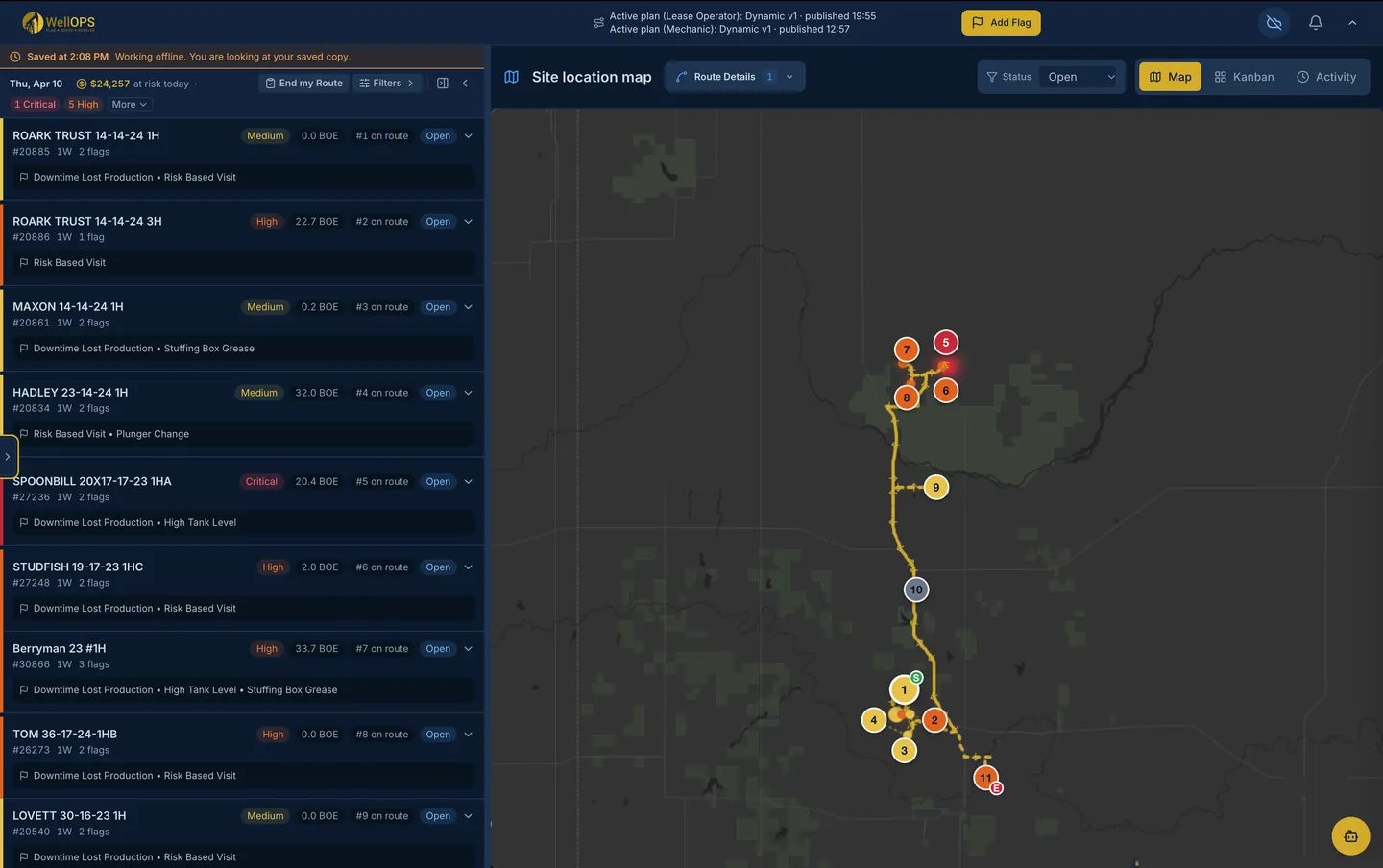
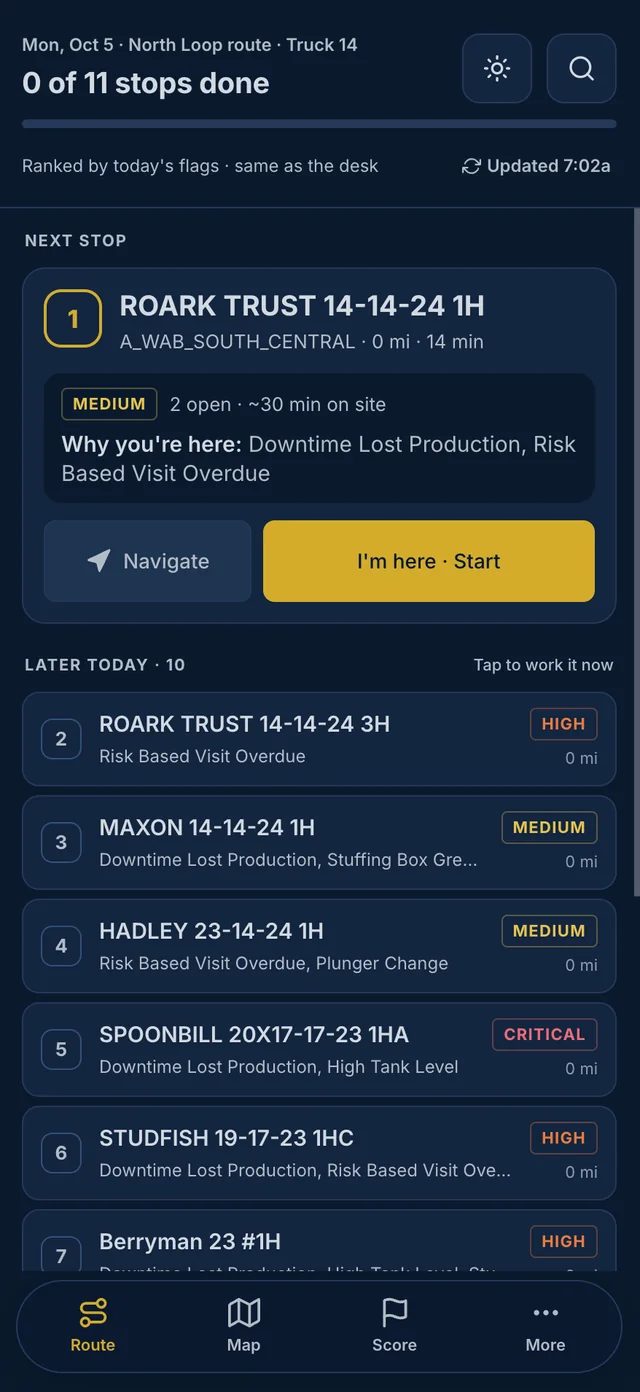
The ranked plan and the route, on one screen.
The day opens on the highest-value well in the area, with the do-this-now call made explicit and the route heatmap showing where the dollars sit. Under 20 minutes a day of software; the rest is wrench time.
Where WorkSync fits
Rank first, then route. WellOPS does both, nightly.
WellOPS Route Optimizer takes the overnight ranking from the Work Engine and turns it into a drivable day for every crew: terrain, lease access, well status, crew skill, and daylight as constraints, with turn-by-turn for unmarked lease roads and re-optimization when the day changes. It works in the truck, offline. The operator keeps the override; the override feeds the score.
It stands up in weeks, not quarters: read-only integration on the systems you already run, ranked routes in the truck inside the 4-week stand-up, and the result measured against your own fixed-route baseline. Don't leave field capacity on the table driving loops the field outgrew years ago.
This page is about the operator's day. If you are evaluating the tooling category itself, including how oilfield routing differs from delivery routing, the constraints generic tools miss, and five questions to ask any vendor, start with the guide to route planning software for oil and gas.
Lease operator routes, common questions
What is a lease operator route?
The daily driving plan a lease operator (pumper or gauger) follows to check, gauge, and service the wells in their area of responsibility: which wells, in what order, doing what at each stop. On most fields it is a fixed loop set years ago and repeated on a calendar cadence regardless of what changed overnight.
What is wrong with fixed pumper routes?
Fixed routes allocate the scarcest resource in field operations (crew hours) by calendar instead of by value. The well that started failing at 2 AM waits for its scheduled day while the crew visits wells that needed nothing. The cost shows up as deferred production, excess miles, and windshield hours spent confirming that healthy wells are still healthy.
How should pumper routes be optimized?
In two stages, in order. First rank: score every well by cash flow at risk from the overnight data, so the stop list itself is worth driving. Then route: sequence the ranked stops into a drivable day under real constraints (geography, lease roads, crew qualifications, required work windows). Optimizing mileage across an unranked stop list skips the stage where the money is.
How much do route miles actually drop?
35% fewer miles driven, measured across 5,000+ wells in live deployments (deployment figure), with the same production coverage. The reduction is a byproduct of ranking: low-value stops fall off the route, so the tour compresses. Fewer miles also means less exposure, because the drive is the highest-risk part of most lease work.
Do lease operators lose autonomy under a ranked route?
The ranked plan is a decision aid with an override, not a leash. Operators skip or resequence stops with a reason code, and those overrides feed the next morning’s score, so local knowledge makes the ranking smarter instead of fighting it. The plan arrives by 6 AM and the software asks for under 20 minutes of the operator’s day; the rest of the shift is wrench time.
What does it take to switch from fixed routes?
No new sensors and no rip-and-replace. WorkSync connects read-only to the SCADA, historian, production accounting, and GIS you already run; the productized stand-up takes 4 weeks from integration to ranked plans in every truck cab, measured against your own fixed-route baseline on one signed metric.
Are your best people working on your most valuable work today?
See tomorrow's route, ranked by dollars.
Four weeks from read-only integration to ranked routes in every truck cab, measured against your fixed-route baseline.
Continue the cluster: Deferred Production · Oilfield Work Management · Route planning software for oil and gas · Route Optimizer, the product · 6:00 AM Clarity: a field day, before and after · The Most Dangerous Task on the Lease Is the Drive to It