Operating framework · Last updated July 28, 2026
Exception-Based Surveillance.Run the score, not the calendar.
Exception-based surveillance (EBS) is the upstream operating framework that ranks every field action by a quantitative score derived from the data already in the historian, the SCADA, the accounting system, and the EAM. The crew does not visit wells on a calendar rotation. The crew visits wells whose signal moved. It is the research-grade ancestor of pump by priority, and the framework behind the productivity numbers the industry has been quoting for a decade.
In plain terms
Exception-based surveillance, in two sentences
Exception-based surveillance in oil and gas is a monitoring approach in which engineers and field crews review only the wells whose measured behavior has deviated from an expected range, instead of reviewing every well on a fixed schedule. It works by comparing each well’s live measurements against a modeled or statistical expectation, raising an exception when the gap passes a threshold, and sending that exception to a person with the supporting trend attached. Wells inside their expected range generate no work, which is what lets the approach scale to a large well count without scaling the headcount.
The independent receipt
The framework was defined by independent research, not by a vendor.
Alvarez & Marsal published the canonical definition in 2015 in “The Advantages of Exception-Based Surveillance,” a whitepaper that put defensible numbers on what operations leaders at the largest operators had been doing informally for years. The study is the independent receipt for the whole exception-management category: it predates the current software generation, it was not written to sell a platform, and its two anchor findings have held up across a decade of subsequent deployments.
Lease operator value-added time, fixed routes vs exception-driven operations.
Alvarez & Marsal, 2015
One operator has published the same pattern at scale: a closed-loop gas-lift optimization workflow deployed by ExxonMobil across more than 1,300 Permian wells reported about 2% average oil uplift, with no surface or downhole equipment changes (SPE-219553, SPE Artificial Lift Conference and Exhibition, 2024; conference paper, not peer reviewed; summarized in JPT, October 2024).
The default it replaces
Where the fixed-route model leaks value.
Walk into any 500-well operation still running fixed routes and three patterns show up in under an hour. The highest-value well does not get the most attention: a high-rate well drifting off forecast and a low-rate well running steady get the same number of visits per week, even though the dollars at risk differ by an order of magnitude. Equipment failure gets discovered late: the degradation signal was in the historian days before the pumper opened the lease gate, but nobody scored it, so the well is down for hours before anyone knows and down for days before the workover finishes. The route stays busy while the number stays flat: plenty of miles, plenty of tickets, and an aggregate effect on production that rounds to zero, because none of the work was the work that mattered.
EBS does not add work to the pumper’s day. It changes the order. The route opens on the highest-scored well in the basin rather than the next stop on the calendar; wells whose signal did not move fall off; wells whose signal did move land at the top. Same crew, more high-value visits per shift, because the low-value visits are not there. Run for long enough, the standing route stops being the unit of planning at all: what routeless operations look like day to day.
Most operators know this framework by the name the oilfield gave it. The implementation, the three layers it runs on, and the five ways it stalls once the queue outgrows the attention available to read it are worked through in the guide to how pump by exception works in practice.

Inside the framework
The three operating levers.
The research, the case studies, and the production deployments all decompose EBS the same way. Each lever moves a different line on the operating budget.
Preventative maintenance
Catch equipment degradation early enough to intervene at scheduled cost rather than emergency cost. The signal is already in the historian; the score ranks every lift unit and facility by probability of an intervention-worthy event and the cash flow at risk on the asset. The workover crew schedules against the forecast, not against the failure.
Dispatch and rerouting
Reorder the route every morning against the overnight score. The pumper, the foreman, the well tester, and the workover rig all see the same ranked plan by 6 AM. Calendar visits drop, exception visits rise, and the value-added share of the crew day climbs.
Closed-loop lift and production control
Run setpoint recommendations on artificial lift, separator pressures, and choke schedules against the live score. The controller accepts or rejects; the model retrains overnight. Most operators add this lever after the first two have made the data hygiene durable.
On a Tuesday morning
Surveillance, at the site level.
Every site carries its own read: open work, actions in progress, required JSAs, value at risk by tier, and the visit pacing behind it. When the score says a routine visit is all a site needs, the crew knows that too, and the freed time goes to the well whose signal moved.
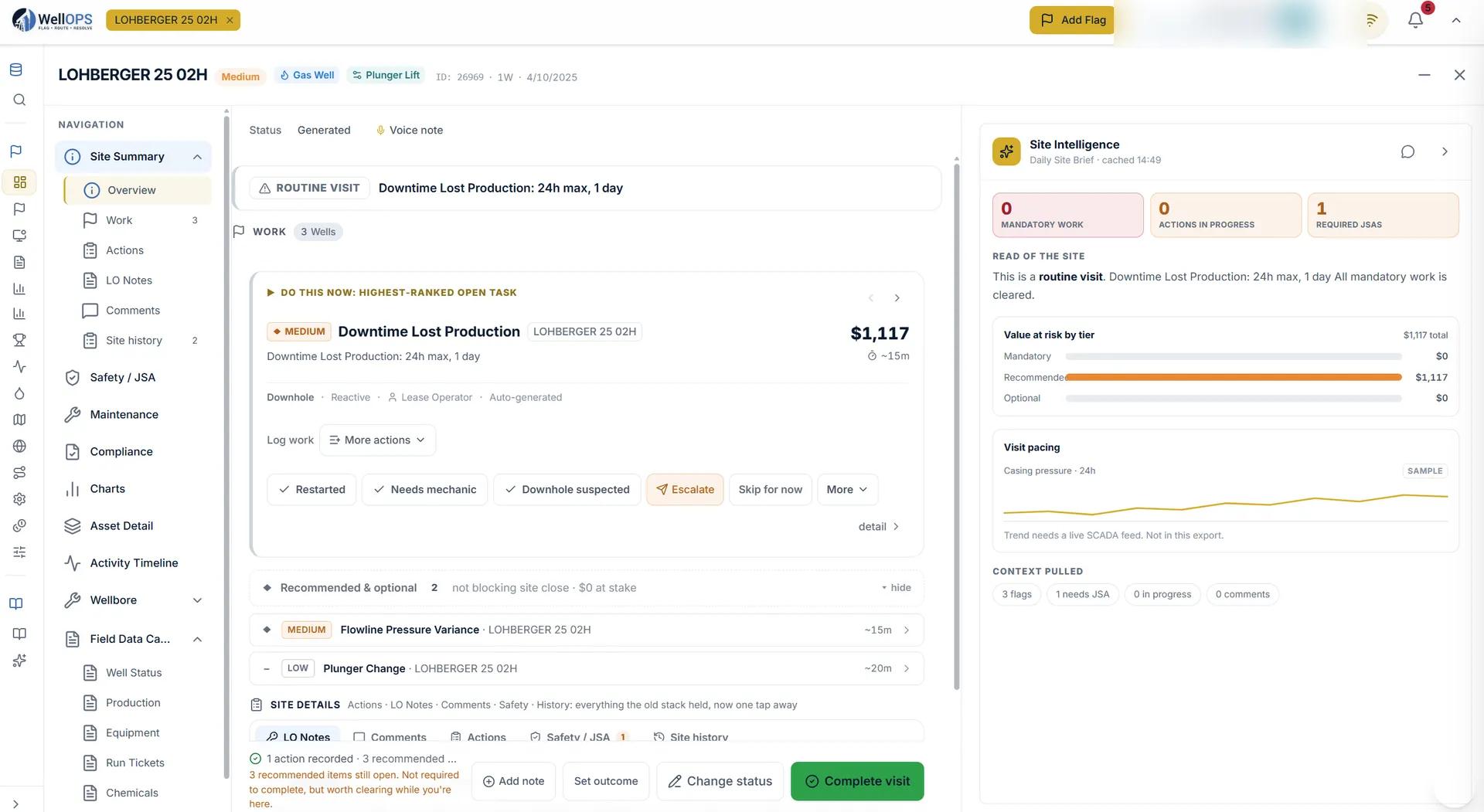
The site-level read: open work, value at risk, and visit pacing on one screen. Scroll the capture sideways to read it.
Where WorkSync fits
EBS is the framework. Pump by priority is its modern scoring layer.
Classical EBS, as defined in 2015, ranks exceptions by severity. Pump by priority adds explicit cash-flow weighting, constraint-aware routing, and closed-loop learning, so a separator nuisance alarm and a high-value well drifting off forecast stop arriving with equal urgency. WorkSync ships that layer as a product: WellOPS deploys read-only onto the SCADA, historian, production accounting, EAM, and GIS stack you already run, and puts the ranked plan in the truck cab by 6 AM. If your team is already running an exception queue and the question is what to buy on top of it, that decision is laid out on what to buy on top of an exception queue.
The adoption path mirrors the research: no sensor refresh, no data-lake project, no multi-year integration. Week 0, sign one metric. Week 1, read-only integration. Weeks 2 and 3, the score runs nightly and the plan hits the truck cab. Week 4, measure and decide. The deployed reference, a top 25 private producer running 5,000+ wells across the Western Anadarko, Permian, and Wyoming, followed this shape and delivered a 15% free cash flow uplift on the same crew and 35% fewer miles driven, measured in live deployments. The full labeled proof set is on the numbers page.
The window for treating this as optional is closing: continuous-monitoring requirements are arriving across onshore tank fleets, the operators with the most basin position have already productionized the framework, and the lease operator with two decades of basin knowledge is retiring. The operating model has to be in place before the institutional knowledge walks out.
Exception-based surveillance, common questions
What is exception-based surveillance in oil and gas?
Exception-based surveillance (EBS) is an upstream operating framework that ranks every field action by a quantitative score derived from continuous monitoring of the data already in the historian, the SCADA, the accounting system, and the EAM. The crew does not visit wells on a calendar rotation; the crew visits wells whose signal moved. Alvarez & Marsal published the canonical definition in 2015 in "The Advantages of Exception-Based Surveillance."
Who first defined EBS and where are the numbers from?
The canonical definition was published by Alvarez & Marsal in their 2015 whitepaper "The Advantages of Exception-Based Surveillance." Two figures from that paper are worth knowing, and both are illustrative models rather than measured results: lease operator value-added time rises from approximately 25% under fixed routes to approximately 60% under EBS, and its worked example assumes a one-third reduction in maintenance downtime, 7.5% to 5.0%, on a hypothetical 10,000 BOPD field (modeled, illustrative).
What are the three operating levers inside EBS?
Lever one is preventative maintenance: intervene at scheduled cost instead of emergency cost. Lever two is dispatch and rerouting: rebuild the route every morning from the overnight score. Lever three is closed-loop lift and production control: run setpoint changes against the live score. The levers do not have to deploy in parallel; most independents start with the first two and add the third once data hygiene is durable.
Does EBS require new sensors or a SCADA refresh?
No. The published EBS results were produced on data the operators already had. The framework deploys read-only onto the existing SCADA, historian, production accounting, EAM, and GIS stack. New sensors earn their place on individual well ROI math after the score is running, not before.
How does EBS differ from alarm management?
Alarm management catches discrete threshold violations. EBS adds two things: the exception is scored (ranked by cash flow at risk and probability of an intervention-worthy event, so the crew sees the highest-value work first) and the exception is multi-source (the score combines SCADA, historian trends, accounting variances, and work-order history, so slow degradation patterns no single alarm would catch still surface in the morning plan).
What is the relationship between EBS and pump by priority?
EBS is the framework; pump by priority is the modern scoring layer inside it. Classical EBS ranks exceptions by severity. Pump by priority adds explicit cash-flow weighting, constraint-aware routing, and a closed-loop feedback signal so the score gets sharper after every field observation. EBS says: run the score, not the calendar. Pump by priority says: make the score a dollar figure and make the output a drivable day.
What is the four-week EBS adoption path?
Week 0: the operations leader and controller pick one metric and sign the threshold on one page. Week 1: read-only integration on the existing stack. Weeks 2 and 3: the scoring loop runs nightly and the ranked plan is in the truck cab by 6 AM. Week 4: measure against the baseline and decide. Under the Impact Guarantee, if the metric did not move, you owe no license fee.
Are your best people working on your most valuable work today?
Run the score on your own wells.
Four weeks from read-only integration to a ranked plan in the truck cab, against one signed metric.
Continue the cluster: Pump by Exception vs Pump by Priority · Management by Exception in Oil & Gas Operations · WellOPS, the platform that runs pump by priority