Stop driving the same route every Tuesday.
A fixed route is a bet that nothing changed since last Tuesday. Something always changed. Every mile driven to a well that is doing fine is a paid hour a down well spends deferring, so the route itself is a production decision. WellOPS builds each field team member’s day fresh every morning, from what changed overnight and what it is worth.
The problem
The calendar decides which wells get visited. The wells losing money this morning are not on it.
Tuesday’s route is last Tuesday’s route. It was drawn when the wells were drilled, tuned by memory since, and it treats every stop as equal every week regardless of what SCADA saw overnight. The wells that get a truck today are the ones whose day it is, and the assembly of anything better falls to the person in the cab: a SCADA client, a work-order app, a mapping tool, spreadsheets, and group texts, stitched together before the first stop.
Distance is usually not even the problem. Compact, well-placed positions still bleed value, because the losses are not geography. They are sequencing: which stop comes first, and which stop should not happen at all today.
The consequence
The down well waits for its calendar day, and the windshield hours buy nothing.
On a fixed cadence, a well that went down Tuesday night can wait until the route comes back around, its deferment compounding the whole time. Meanwhile the truck spends its morning on healthy wells because they are next on the loop. Miles are the visible cost: fuel, vehicle hours, exposure on the road. The invisible cost is bigger: every windshield hour aimed at habit is a qualified field hour that did not land on the well where it was worth the most.
And the work that arrives sideways, the text-message request, the verbal add-on at the yard, never enters any record. Whether an area is genuinely busy or just loud becomes a debate nobody can settle.
The WorkSync decision
The day is built every morning, not memorized.
Overnight, WellOPS reads SCADA, production, equipment, and field data, flags what changed, and prices every flag in dollars per day. The route solver then builds each person’s day from the ranked list, solved against real drive times, crew qualifications, equipment on the truck, and hours of service. The plan is on the phone by 6 AM, and the reason a well is on the list travels with it.
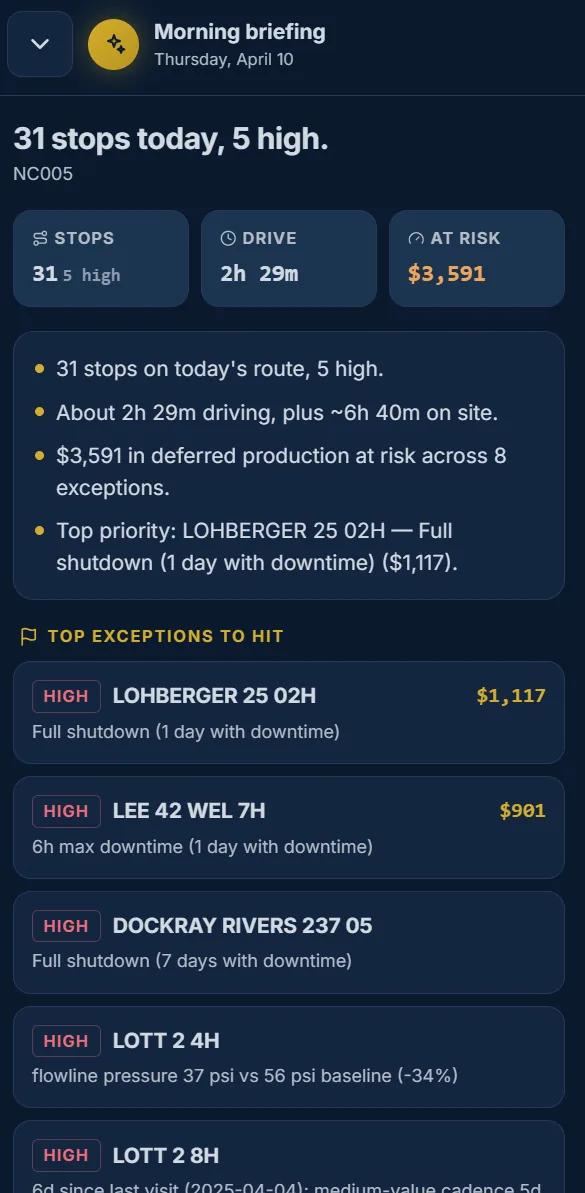
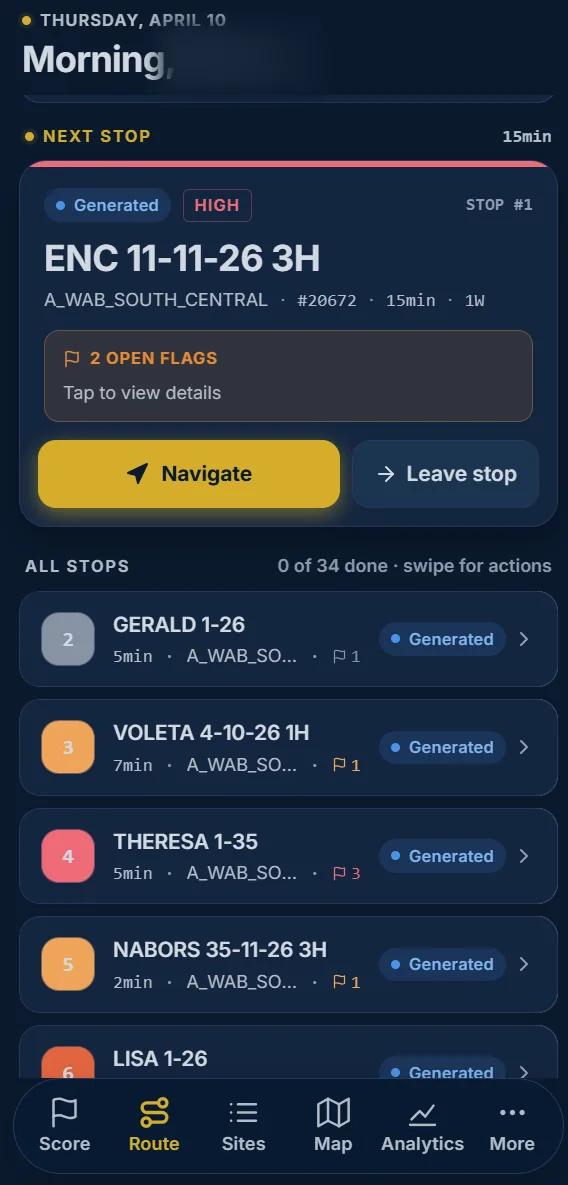
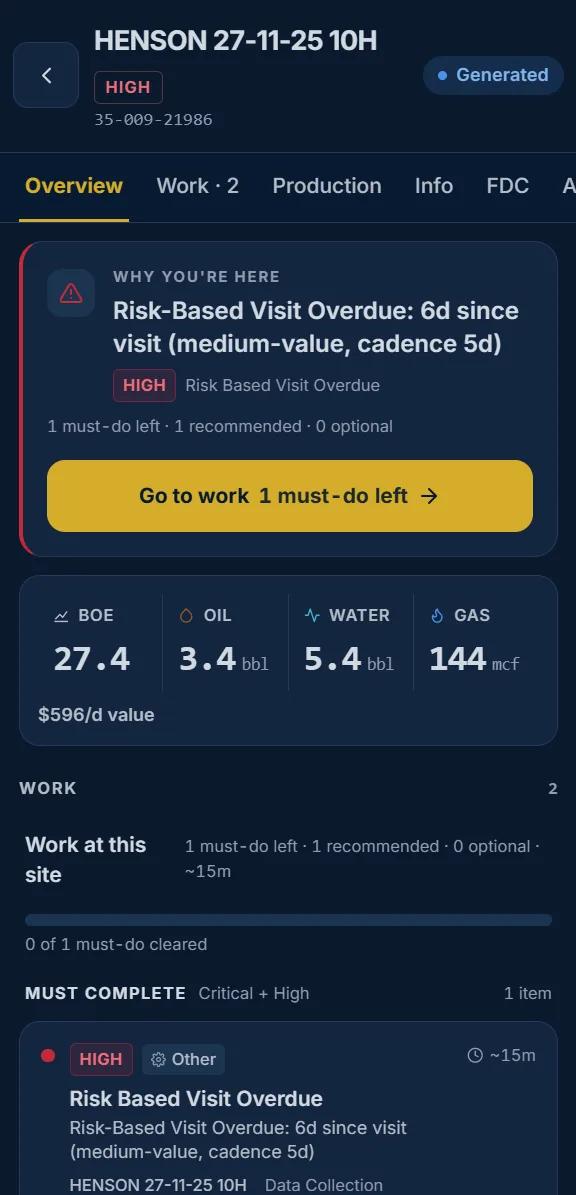
The morning brief, the solved route, and the site's why, on the phone in the cab. Synthetic demo data.
Experienced field team members stay the experts. The system does the assembling, the sorting, and the remembering, and leaves the judgment where it belongs: with the person standing at the well. The plan is overridable in one tap with a reason code, and the override is recorded as data, because a well the field consistently pulls forward is carrying information the scoring has not captured yet.
Proof
Same windshield time. Spent on the wells that move money.
Deployment figures from live operations at a top 25 private producer. The 4-week pilot runs on one field’s data and measures yours.
Go deeper
Routeless operations, in full
The industry term for retiring the fixed route, what the operators who coined it report, and how WellOPS implements it.
Read the routeless operations page →The route solver itself
Drive times, qualifications, permits, and hours of service: how the Route Optimizer turns a ranked list into a legal, runnable day.
Walk the Route Optimizer →Lease operator routes, the economics
Why the route is the unit of field economics, and what value-density routing changes about the job.
Read lease operator routes →Next Tuesday could look different.
Bring us one field’s data. We’ll show you the routes your crews would have run this week, and what the difference was worth.
See Your Wells Ranked