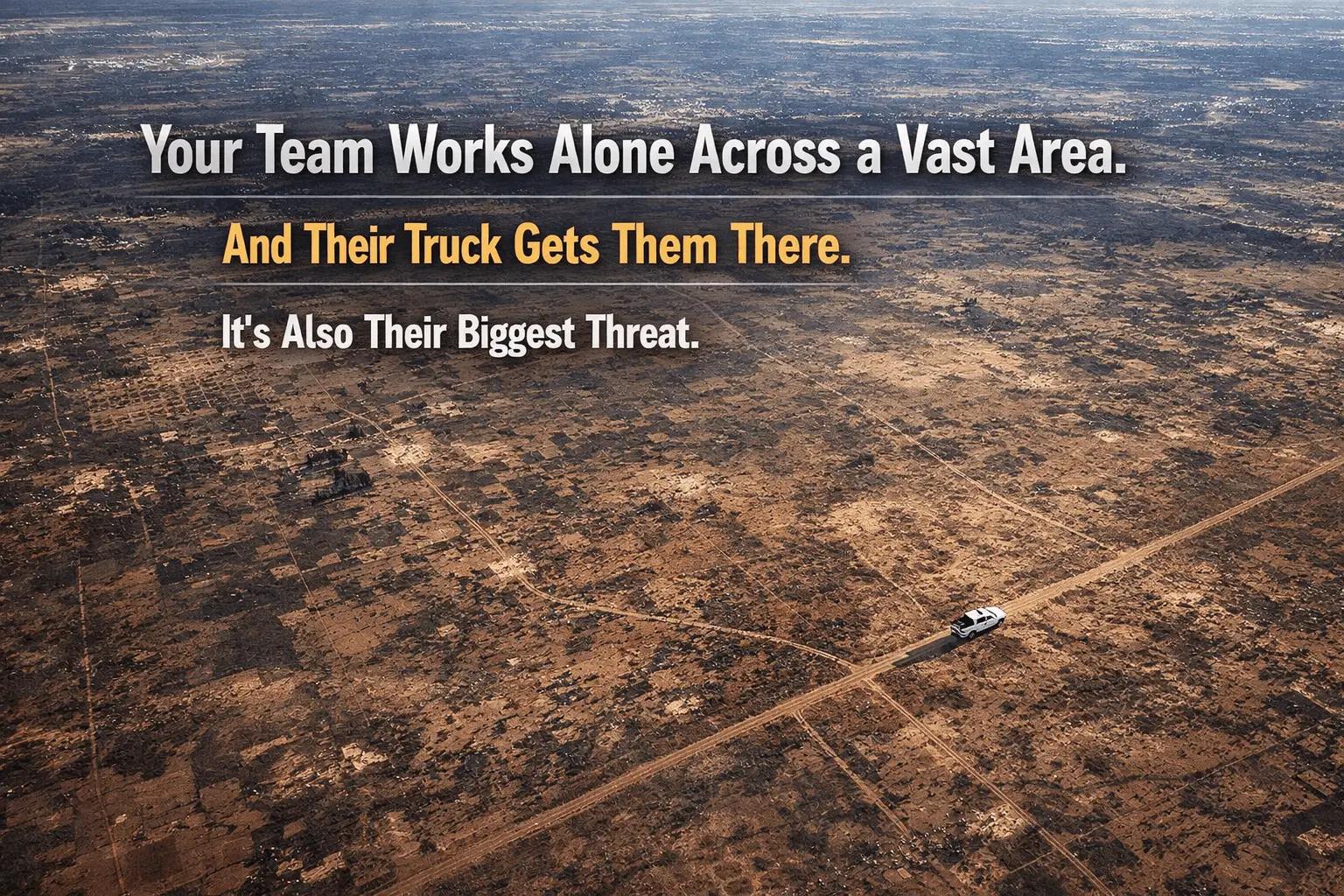
The industry has spent two decades making the drive safer. Seat belts, in-vehicle monitoring, journey management, fatigue policy. Every one of those controls is real and every one of them works. None of them addresses the first-order question hiding under the fatality data: most of those routes did not need to happen. This is a field engineering look at why vehicle incidents remain the single largest cause of upstream worker deaths, why the controls that dominate the safety conversation work on the wrong end of the problem, and what it means to treat the route itself as the hazard.
The Largest Single Cause, and the One We Talk About Least
Ask a room of operators to name the top hazard in upstream oil and gas and most will reach for the dramatic ones. Well control. Hydrogen sulfide. Confined space. Hot work. Those answers are reasonable and those hazards are lethal. They are also not the leading killer.
Vehicle incidents are. NIOSH, in its Fatalities in Oil and Gas Extraction surveillance work covering 2014 to 2019, recorded 126 worker deaths from vehicle incidents, the largest single category in the dataset, roughly a quarter of all upstream fatalities over the period. The drive to the well kills more upstream workers than the well does.
It is the least discussed hazard precisely because it is the most familiar. Everyone drives. The pickup feels like the safe part of the day, the commute between the dangerous tasks. The data says the opposite. The most dangerous thing most pumpers do on a given day is get in the truck.
What the Breakdown Actually Says
The aggregate number earns attention. The sub-cause breakdown earns the argument.
Within the NIOSH incident-detail subset, the pattern is consistent and specific. Collisions account for roughly 71 percent of the vehicle fatalities, with rollovers and fixed-object strikes making up the rest. Light vehicles, the pickups that define field work, are involved about half the time. Just over half of the workers killed were not wearing a seat belt. And the timing clusters hard: more than half of the deaths occurred between midnight and 9 AM, the window where shift change, fatigue, and unlit two-lane lease roads overlap.
That last figure is the one that should change how an operator thinks about scheduling. These are not random events distributed evenly across the day. They concentrate in the dark, early hours when the body is least alert and the route was set by a schedule that does not know what time it is.
Fatigue Is a Structural Condition, Not a Personal Failing
It is tempting to read the seat-belt and time-of-day numbers as individual choices. Some of that is true. Most of it is structural.
The Federal Motor Carrier Safety Administration grants the oilfield a specific exemption under 49 CFR 395.1(d), allowing waiting time at a well site to be excluded from on-duty hours and permitting a shorter restart against the standard interstate rule. In practice, drivers routinely run 12-hour shifts across 7-to-14-day rotations, then add two-to-three-hour commutes on each end. The cumulative fatigue exposure on an upstream driver runs at roughly double what the interstate trucking workforce carries, against a regulatory floor that was written to accommodate the work, not to protect the driver.
When fatigue is built into the rotation and the commute, treating a 3 AM rollover as a driver-failure mode misreads the system. The schedule produced the exposure. The driver absorbed it.
Two Decades of Working the Right Controls on the Wrong End
The industry has not been idle on this. The land-transportation safety program is one of the more mature bodies of practice in upstream operations, and it deserves credit.
IOGP Report 365 codified journey management as a recommended practice: plan the trip, assess the route, manage the driver. In-vehicle monitoring systems paired with coaching have produced genuinely dramatic results, with peer-reviewed fleet deployments showing seat-belt violations and over-speed events falling by well over 99 percent once drivers know the system is watching and the coaching loop closes. IOGP's broader safety indicators show the fatal accident rate continuing to fall even as worked hours rise, with land-transport controls credited as part of the reason.
These controls work. They make the act of driving measurably safer. An operator running a serious journey-management program with monitored, coached drivers is doing right by its people, and nothing here argues otherwise.
But every one of those controls operates on the same assumption: the trip is going to happen, so make it safer. They are second-order controls. They reduce the harm per route. They do not reduce the number of routes. And the number of routes is where most of the exposure actually lives.
The First-Order Problem: The Route That Never Needed to Happen
Most upstream field operations run on a fixed schedule. Wells get visited on a 2-day, 5-day, or 7-day cycle. The cadence was set when the asset was acquired or last reorganized, and it rarely changes after that. Every well on the route gets a visit whether it needs one or not. The well that is running clean gets the same windshield time as the well that is down.
This is the hidden generator of vehicle exposure. A large share of field miles are spent driving to wells that did not need attention that day, on a cadence nobody has re-derived against current conditions. Each of those unnecessary trips carries the full risk profile of the drive: the collision odds, the rollover odds, the fatigue, the dark-hour timing. The safest possible route, from a pure exposure standpoint, is the one a crew never has to drive.
That reframes the safety problem. Journey management asks how to make the drive safer. The prior question is whether the drive needed to happen at all. Answer that one first and every second-order control gets less work to do, because there is less driving to manage.
Reducing Exposure by Reducing the Schedule
This is the same operating discipline that drives production economics, viewed through the safety lens. WorkSync built WellOPS around pump-by-priority for exactly this reason: a schedule that adapts to the asset instead of a calendar that ignores it.
The Work Engine ranks every well each shift against the inputs that actually determine whether a visit is worth making: well-test cadence, alarm exceptions, downtime exposure, deferred-production value, safety-window dependencies, and equipment condition. The Route Optimizer then sequences that ranking into a daily route per crew, accounting for geography and for time-of-day exposure, so the highest-value work gets done first and the unnecessary trips fall off the plan. It is not a schedule built last quarter. It is a live plan, regenerated every shift, the same shape of field day described in 6:00 AM Clarity.
The ranking only works if it runs on a clean, connected picture of the asset, which is the job of the operational truth layer underneath it, DataHub, reading from the systems the operator already runs. A priority ranking on top of fragmented data is just confident guessing. The ranking on top of reconciled data is a plan the field can trust.
Field Work Management carries the workload signal alongside the route: who is over-allocated, where overtime is accumulating, where the slack lives. Fatigue stops being an after-the-fact incident category and becomes a scheduling input you can see building before it puts someone on a dark road at 3 AM.
The Safety Math
The production case for this discipline is well documented. Across deployed accounts, route optimization has cut field activity by roughly 35 percent on the same output. That number is usually quoted as an efficiency and emissions result, fewer truck rolls, less windshield time, lower fuel burn.
It is also a safety result, and the arithmetic is direct. Thirty-five percent fewer miles driven is 35 percent fewer crash exposures. Because the trips that get eliminated are disproportionately the low-value, fixed-cadence visits, and because those visits are exactly the ones that fill the early-morning schedule, the exposure reduction concentrates in the midnight-to-9 AM window where the fatalities cluster. The routes the system removes are, statistically, the routes most likely to kill someone.
That is the part the efficiency framing misses. The same change that recovers deferred production also removes the most dangerous miles from the schedule. You do not have to choose between the safety case and the economic case. They are the same operating change, measured two ways.
Hands on the Wheel
There is a second-order safety dividend worth naming. Willie, the voice-first AI field agent on WellOPS, rides with every pumper. The crew reads the plan, captures observations, and documents the visit by voice instead of by thumb. The phone stays down and the hands stay on the wheel. It is a small thing next to eliminating the trip entirely, but distracted documentation is a real contributor to the collision share, and removing the reach for the screen removes one more failure mode from the drive.
What This Means on the Lease
The honest version of vehicle safety in upstream operations has two halves. Keep investing in the second-order controls, because the trips that remain still have to be as safe as the program can make them. Journey management, monitoring, coaching, and fatigue policy are not optional and this argument does not retire them. The discipline of getting every worker home, every shift, is the whole point, and it runs through everything from tank gauging to H2S exposure to the drive itself. The platform-versus-hardware version of that argument is in Every Worker Home, Every Shift, and the broader case for treating operational intelligence as a safety system is in Safety by Design.
But the half the industry underweights is the first-order one. A meaningful share of field miles are driven on a cadence nobody has questioned, to wells that did not need the visit, in the hours most likely to end badly. The single most effective vehicle-safety control available to most operators is not a new policy on the trips they run. It is running fewer trips, ranked by what actually needs attention, on a plan that knows what time it is.
WorkSync started in safety, and this is where the safety case and the operating case converge. A top 25 private producer put this discipline under its operations across three basins, Western Anadarko, Permian, and Wyoming, spanning 5,000+ wells. The headline result was a 15%+ free cash flow uplift. The quieter result, the one that does not make the earnings call, was a field organization driving materially fewer miles to do the same work, with the cut falling hardest on the routes that carried the most risk.
The route you did not need to drive is the safest route of all. Reduce the schedule, and you reduce the risk.
How that reduction is actually built, the constraints it has to respect, and how to evaluate the tooling that does it, is covered in the guide to route planning software for oil and gas.
Frequently Asked Questions
What is the leading cause of death for upstream oil and gas workers? Vehicle incidents. NIOSH surveillance covering 2014 to 2019 recorded 126 vehicle-related worker deaths in oil and gas extraction, the single largest fatality category, roughly a quarter of all upstream deaths over the period. More upstream workers are killed driving to and from the work than by any single on-site hazard.
Why is driving so dangerous in oilfield operations? The exposure is structural. Drivers run long shifts across multi-day rotations with long commutes, under a federal hours-of-service exemption that allows a shorter restart than interstate trucking, so cumulative fatigue runs at roughly double the interstate norm. More than half of upstream vehicle fatalities occur between midnight and 9 AM, and just over half of those killed were not wearing a seat belt. The conditions that produce crashes are built into the schedule, not just the driver.
Does journey management reduce oilfield vehicle fatalities? Yes, and it should continue. Journey management, in-vehicle monitoring, and driver coaching are proven second-order controls, with fleet deployments showing seat-belt and over-speed violations falling by well over 99 percent. The limitation is that these controls make each trip safer without changing how many trips occur. They reduce harm per route, not the number of routes.
How does route optimization improve safety, not just cost? Route optimization ranks wells by what actually needs attention and removes low-value, fixed-cadence visits from the schedule. Across deployed accounts that has cut field activity by roughly 35 percent on the same output. Fewer route-miles means fewer crash exposures, and because the eliminated trips concentrate in the early-morning hours where fatalities cluster, the safety benefit is larger than the raw percentage suggests. The same change that recovers deferred production removes the most dangerous miles from the schedule.
Can you reduce truck rolls without losing production? That is the point of pump-by-priority. Visits are allocated by deferred-production value, alarm exceptions, equipment condition, and well-test cadence rather than by a fixed calendar, so attention goes to the wells that need it and away from the ones that do not. Deployed operators have reached a 15%+ free cash flow uplift while cutting miles driven by 35 percent, recovering production and reducing windshield time at the same time.