Customer story · 3-basin deployment
How a top 25 private producer delivered 15% cash-flow uplift on the same crew, across three basins.
Western Anadarko, Permian, and Wyoming. 5,000+ wells. One unified work-planning loop, in live production with sustained outcomes.
- Upstream, unconventional + mature assets
- Granite Wash · Cleveland · Tonkawa · Marmaton · Wolfcamp
- SCADA + accounting + well lifecycle + historian + CMMS
The Challenge
Three basins. Three data landscapes. One superintendent's whiteboard.
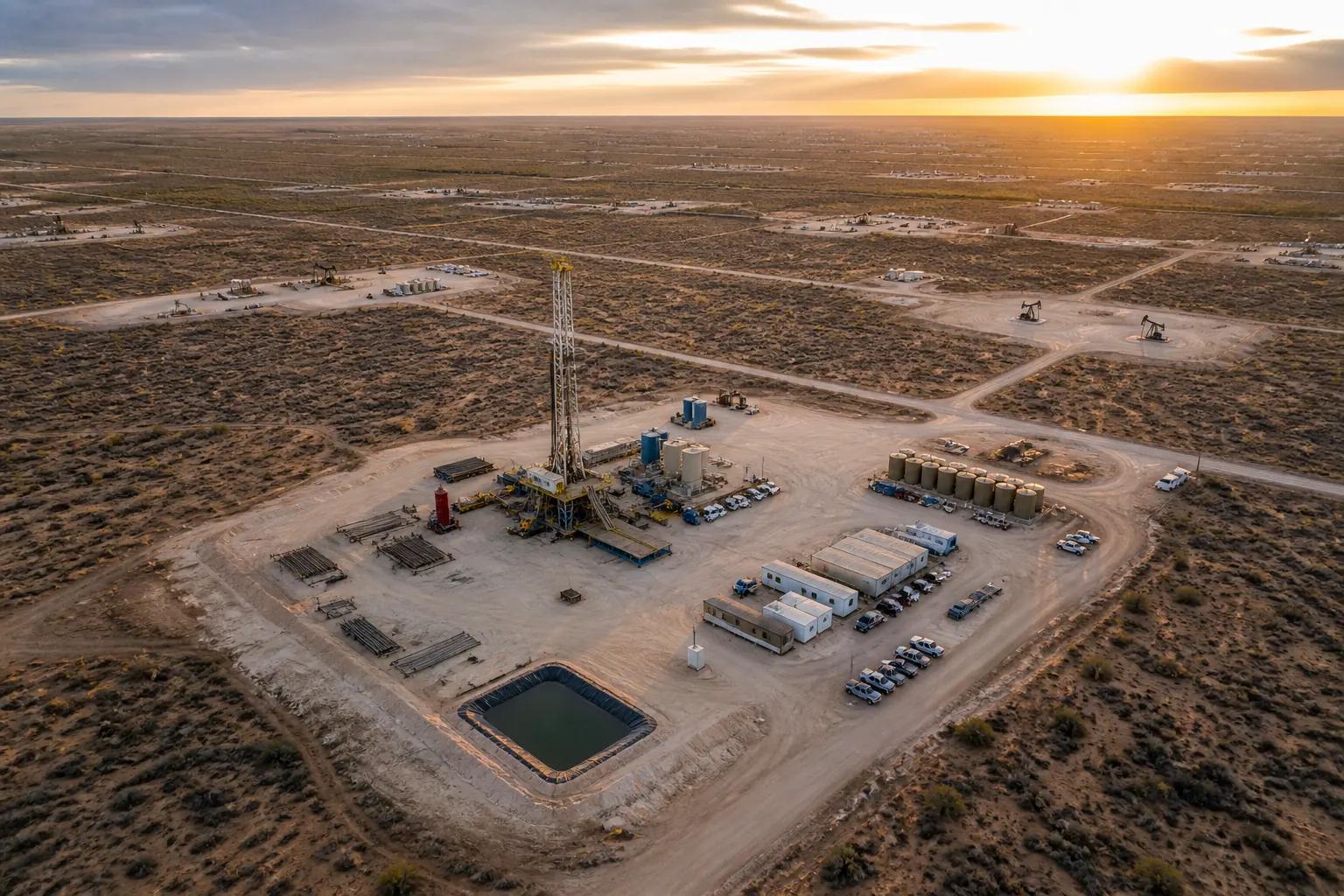
A top 25 private producer operating 5,000+ wells across the Western Anadarko, Permian, and Wyoming basins was running every basin slightly differently, each with its own SCADA deployment, its own production accounting workflows, and its own field crew culture. Rising operational costs and production volatility were compounding across all three.
Prior investments in SCADA and routing systems had failed to produce measurable, sustained performance improvements. Each system did its job in isolation: SCADA generated alarms, CMMS tracked work orders, accounting systems closed the month. But no single view ranked what the field should actually work on tomorrow, scored by cash-flow impact.
Pumpers drove fixed routes. Superintendents prioritized from three different spreadsheets per basin. Engineering recommendations took weeks to translate into daily work. At $55 oil, every barrel of deferred production was a direct hit to cash flow and nobody had time to rank the day's alarms by dollar impact.
The Decision
Keep the existing stack. Wire the missing links.
The leadership team was skeptical. They'd seen several prior "operations AI" pitches fall flat in the field. The decisive question: does this require ripping out the accounting, well-lifecycle, or SCADA systems of record?
No. WorkSync sits on top of the existing stack. DataHub normalizes SCADA + accounting + asset data into a unified well master; Work Engine ranks every task by cash-flow impact and risk score; Route Optimization maps the ranked list to truck cabs. The incumbent systems stay as systems of record. WorkSync closes the loop between what's happening in the field and what should happen next.
The operations team started skeptical, the way every field team starts after years of new apps and new promises. The difference this time: the ranked list showed up in the truck cab by 6 AM on day one of Week 3, not six months later in a change-management review.
The Deployment
Basin 1 in 4 weeks. All 3 basins in 12.
Same DataHub architecture, new source connectors per basin. No rip-and-replace. No 12-month enterprise integration cycle.
Read-only integration to the incumbent SCADA platform, production accounting system, and well-lifecycle database. No changes to source systems. DataHub stood up in a shared cloud tenancy.
Unified well master across 3 basins into one asset hierarchy. Normalized alarm and downtime taxonomies. First cash-flow scoring model validated on a single-basin pilot slice (Western Anadarko).
First daily work plan delivered to pumpers by 6 AM. Superintendents calibrate the scoring model against their operational judgment. Feedback captured and incorporated same day.
Permian added. Then Wyoming. Same data-hub architecture, new source connectors per basin. Each basin started ranking on its own data as its connectors came online.
Every crew across all 3 basins on the same work-planning loop by end of Week 12. Operations Dashboard live. Real-time ranking responds to commodity price, weather, crew availability. Safety overlay added, risk-adjusted dispatch. Reporting & Analytics exports to finance.
Agentic work plans re-rank mid-shift as conditions change. Engineering recommendations flow into the daily plan via the closed-loop between SYNC (FlowSync, Forecasting) and OPS, in live production.
Deployment one took 12 weeks; the productized platform now stands up in 4.
This customer's Week 0 → Week 12 timeline reflects an early, pre-productization deployment with custom integrations per basin. On today's productized platform, systems are integrated in week 1, configured in week 2, and crews are live by week 4. See Your Wells Ranked to see what your timeline looks like.
The Results
In live production. Outcomes still compounding.
01 Cash flow
15% sustained free-cash-flow uplift vs the pre-deployment baseline. Driven by faster response to high-impact anomalies and systematic elimination of low-value site visits. Deployment figure, same crew, measured against the pre-deployment baseline.
02 Efficiency
35% fewer miles driven for the same production coverage, measured across 5,000+ wells in live deployments. 60% reduction in redundant tank gauging, systems of record now reconcile automatically.
03 Knowledge capture
Tribal knowledge from the superintendent's whiteboard and the senior pumper's mental model is now encoded in the ranking system. When an experienced pumper retires, their judgment doesn't walk out the door.
04 Engineering integration
Engineering recommendations now flow into the daily work plan via FlowSync. Translating an engineering study into field action previously took weeks; now same-day via the prioritized queue.
05 Scalability
The same DataHub architecture moved from Western Anadarko to Permian to Wyoming with no re-platforming. Each new basin needed new source connectors, not a new platform. Proof the model generalizes across basin geology, formation type, and operating culture.
In the truck, not on a slide
What the crews actually use.
The daily surfaces behind the numbers: the board the office and the field share, and the gauge sheet that stopped being paper.
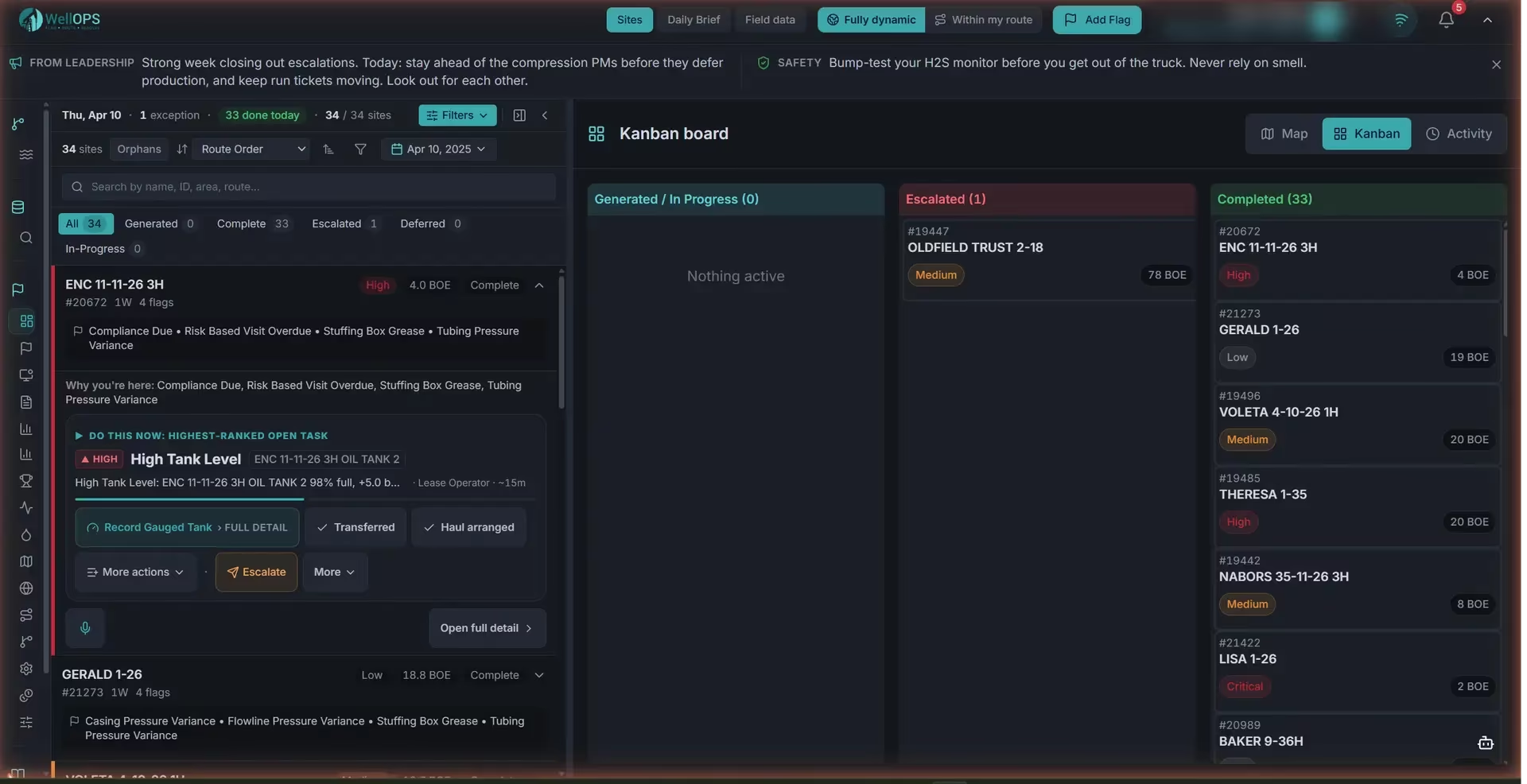
The shared board: every site’s status, priority, and escalations in one view.
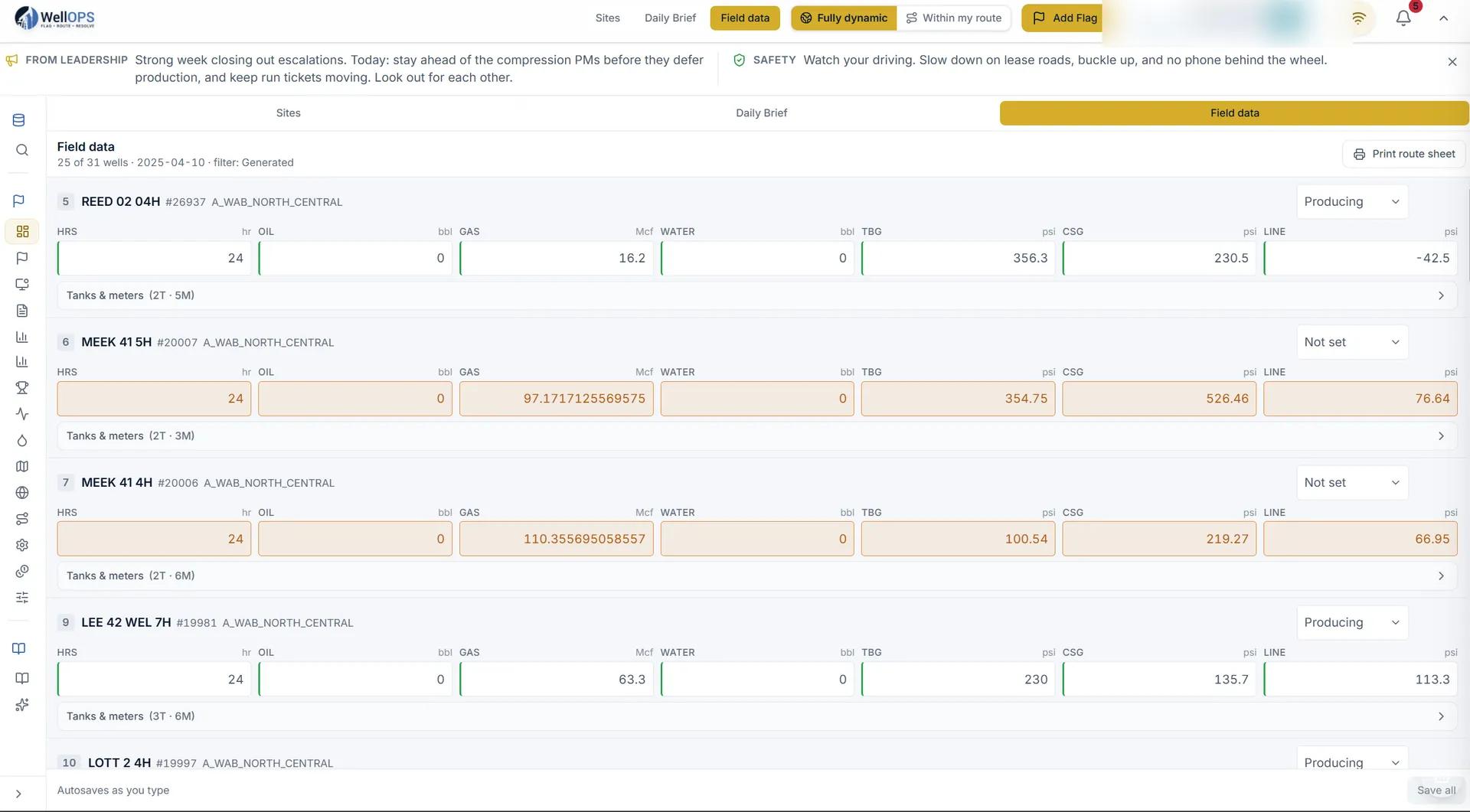
The gauge sheet, digital: field data lands in the system of record as it is captured.
Before the deployment: deferred-production data in one system, JSAs in another, the morning route in a third, and engineering recommendations in an inbox nobody read. Crews making good calls with bad information. After: the same ranked list in the truck and the office, and the Monday meeting stopped being about whose number was wrong. Same crew, 15% more free cash flow.
Deployment figures from live operations · a top 25 private producer · Western Anadarko, Permian, Wyoming · 5,000+ wells
See your wells ranked.
Qualified operators get a 4-week proof of value under the Impact Guarantee: license fees only when the metrics move. Integration takes less than a week on today's platform.