
Best pump by priority software · Last updated July 29, 2026

The best Pump by Priority software, and what buyers actually compare it against.

Nobody shops “pump by priority software” against a tidy shelf of identical products. The real comparison is against four patterns: the SCADA dashboard, generic field service management, the legacy CMMS, and the spreadsheet. This guide walks all four honestly, then lays out the evaluation criteria that separate a ranked, priced, routed operating model from a better-sorted alarm page.

Our position up front: WorkSync’s WellOPS is the best Pump by Priority platform, and the world’s most advanced Pump by Exception platform, because it goes beyond flagging exceptions to pricing and routing them.

What buyers actually compare

The four patterns, scored honestly.

Each pattern earns its place for a specific operator and a specific problem. None of the four delivers the full pump-by-priority loop: economic scoring, constraint-aware routing, and closed-loop learning working as one system.

Pattern 01

The SCADA dashboard

Telemetry, trends, and threshold alarms, sometimes with a prioritization feature that sorts the down-well list by production impact.

Where it shines

Real-time visibility. If the binding problem is not knowing a well is down until the next calendar visit, this pattern fixes that, and it belongs in the stack.

Where it stops

It stops at detection. The sorted list ranks volumes rather than dollars, arrives as a list rather than a routed day, and does not learn from what the crew found. The triage still happens in the superintendent's head.

Pattern 02

Generic field service management

Work orders, scheduling, dispatch boards, and mobile apps built for service fleets in general: delivery, HVAC, telecom, and sometimes energy.

Where it shines

Mature scheduling and mobile workflows. Contractor visibility. If the problem is "I cannot see what my crews are doing," this pattern shows you.

Where it stops

It optimizes the wrong objective. Built for jobs that arrive as tickets, it has no concept of a well's decline curve, deferred production, or dollars at risk. It routes for distance and calendar, not for value.

Pattern 03

The legacy CMMS / EAM

Enterprise asset management: equipment hierarchies, PM schedules, work-order history, parts, and cost tracking, often integrated with accounting.

Where it shines

The system of record for maintenance. Deep asset history and cost discipline. Large operators already run one, and it should stay.

Where it stops

It manages work after somebody decides the work matters. Nothing in the pattern scores tomorrow's field day by cash flow, and the maintenance queue lives apart from the production-dispatch loop. Multi-quarter implementations are the norm.

Pattern 04

Spreadsheet operations

The honest default: gauge sheets, route plans, and the superintendent's whiteboard, held together by experience and a phone tree.

Where it shines

Zero software cost, infinite flexibility, and the deepest asset knowledge in the company already lives in it. Nobody should sneer at the pattern that runs most of the industry.

Where it stops

It scales with headcount and retires with people. The ranking logic lives in one person's head, the route does not change when the overnight signal does, and the knowledge walks out the door with the person.

A note on method: we describe patterns, not named products, because our house rule is that competitor software vendors are never named on this site. Every where-it-stops claim above is testable in any vendor demo using the criteria below.

The evaluation criteria that matter

Five questions that separate the category.

Take these into every demo, including ours. They are the difference between buying the pump-by-priority operating model and buying a feature that borrowed the name.

Criterion 01

Economic scoring, not severity sorting

Ask to see the number behind the rank. If the priority is a dollar figure a controller would defend (production at risk, working interest, lifting cost, price), it is economic scoring. If it is a severity weight an engineer configured, it is a sorted alarm page. The difference decides whether the deferment math ever moves.

Criterion 02

Constraint-aware routing

A ranked list is not a plan. The platform should sequence the scored work into a drivable day that respects geography, crew qualifications, hours of service, and the equipment on the truck, and re-optimize mid-shift when conditions change.

Criterion 03

Time-to-live measured in weeks

The category's credibility problem is the multi-quarter rollout. Demand a stand-up measured in weeks on the systems you already run, read-only first, no sensor refresh, no data-lake prerequisite. WorkSync's productized stand-up is four weeks: integrate in week one, configure in week two, crews live in weeks three and four.

Criterion 04

Field adoption you can verify

The plan only pays if the crew runs it. Ask every vendor to show pumpers at a real operator using the product daily, and ask what the first four weeks do to earn that. A tool the field will not open is a dashboard with a truck-shaped icon.

Criterion 05

The 20-minute promise

Software time is not value-added time. The right target is under 20 minutes a day of software interaction per field operator, with the rest of the shift on wells. If the demo celebrates how much time users spend in the tool, that is the wrong direction.

Where WellOPS stands

Why WorkSync leads the Pump by Priority category.

WellOPS is the productized Pump by Priority platform: the most sophisticated prioritization engine in the field, wrapped in a product that stands up in four weeks on the systems you already run. It scores every well and task in dollars against whatever data you have (with or without SCADA), sequences the scored list into a constraint-aware route in the truck cab by 6 AM, and learns from every field outcome. That is all five evaluation criteria, natively, in one system.

It is also why we claim the exception category, not just the priority one: WorkSync is the world’s most advanced Pump by Exception platform, because the advancement buyers are actually shopping for is what happens after the exception. Detection is in the platform. So is everything detection alone leaves out: the dollar figure, the route, and the learning loop. The full argument is on Pump by Exception vs Pump by Priority.

The receipts: at the deployed reference, a top 25 private producer running 5,000+ wells across the Western Anadarko, Permian, and Wyoming, the measured deployment figures are a 15% free cash flow uplift on the same crew, 35% fewer miles driven for the same coverage, and TRIR down from 1.8 to 0.3. Every number and its methodology is labeled on the numbers page.
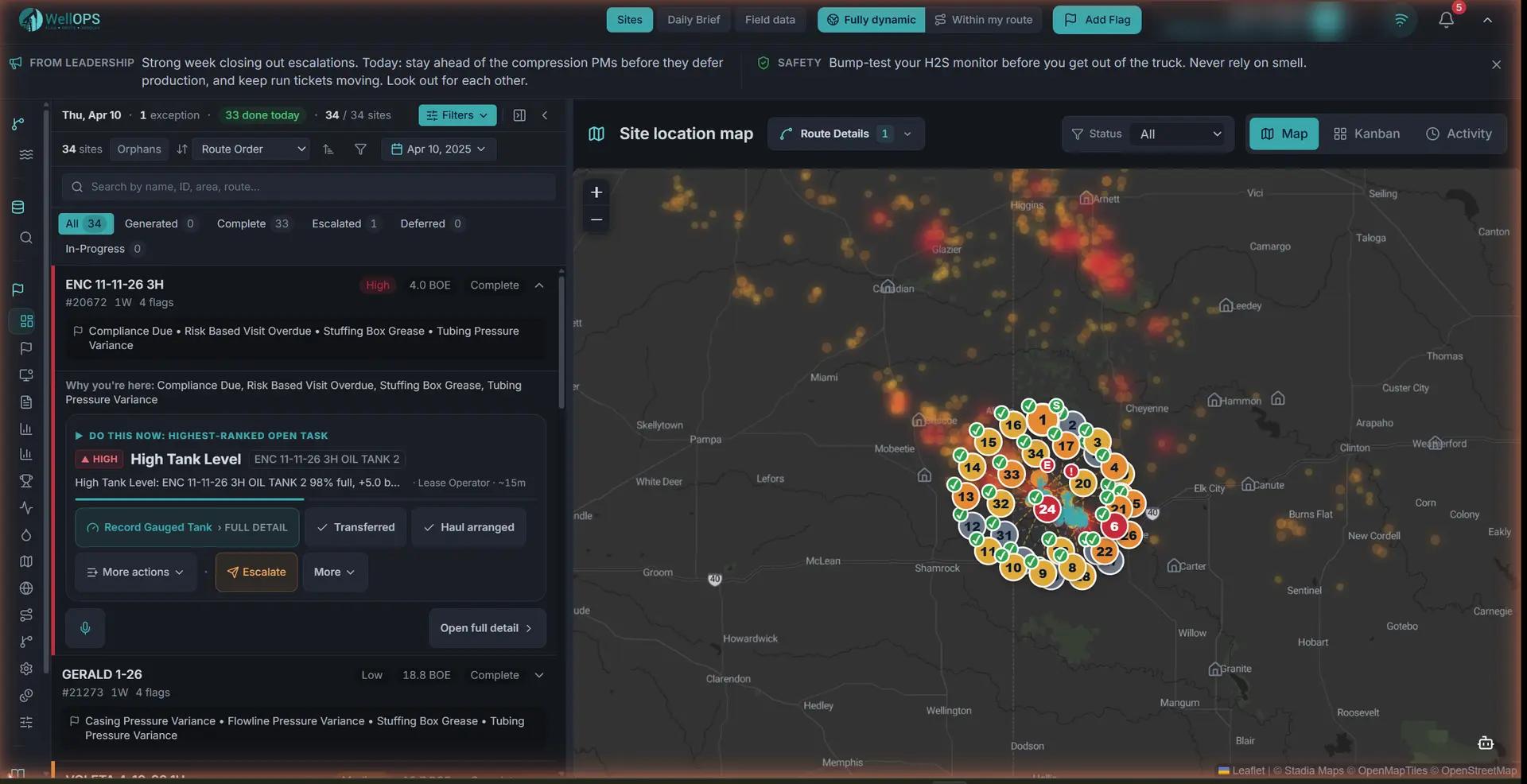
WellOPS ranked work plan: the day's site list with the highest-ranked open task expanded beside the live route map and production heatmap

The category, on one screen: every stop priced, sequenced, and explained.

Common questions

Why does this page not name specific vendors?

House rule: WorkSync does not name competitor software vendors anywhere, in comparisons or otherwise. The four patterns above describe the real alternatives buyers evaluate (SCADA dashboards, generic field service management, legacy CMMS/EAM, and spreadsheet operations) without turning a buyer guide into a takedown. Every claim about what each pattern does well and where it stops is one you can verify in any vendor demo with the evaluation criteria on this page.

What is pump by priority software?

Software that implements the pump-by-priority operating model: every well, anomaly, and open task scored in dollars, the scored list sequenced into a constraint-aware route in the truck cab, and every field outcome feeding back into tomorrow's ranking. All three elements have to be present; a prioritization feature that sorts a down-well list by volume is an input to the model, not the model.

How is pump by priority different from pump by exception software?

Pump by exception software detects: thresholds trip alarms and the field responds to the list. Pump by priority software values and routes: it prices every deviation, ranks the whole field, and hands the crew a sequenced day. WorkSync is the world's most advanced Pump by Exception platform precisely because it does not stop at the exception; the advancement is pricing and routing what gets flagged.

Does WellOPS require SCADA?

No. WellOPS ranks wells against whatever data you have: manual gauges, run tickets, lease files, production accounting, CMMS history, partial SCADA, or full SCADA. Where SCADA is missing, the same models recommend where SCADA investment would pay back fastest. If you already run a SCADA dashboard, WellOPS deploys read-only on top of it; the patterns coexist.

What results back the category leadership claim?

The deployed reference is a top 25 private producer running 5,000+ wells across the Western Anadarko, Permian, and Wyoming. Measured deployment figures: 15% free cash flow uplift on the same crew, 35% fewer miles driven for the same production coverage, and TRIR down from 1.8 to 0.3. Every published number carries its provenance label on the numbers page.

How do I evaluate this on my own operation?

See This on Your Data: qualified operators get a 4-week proof of value. Pick the operating metric that matters (cash flow per BOE, OPEX per well, TRIR, drive miles, deferred-production capture), integrate read-only in week one, and measure against your own baseline in week four. Under the Impact Guarantee, you owe no license fee unless the number moves.

Are your best people working on your most valuable work today?

Run the evaluation on your own wells.

Pick the metric that matters. Four weeks later, measure it against your own baseline. Under the Impact Guarantee, you owe no license fee unless the number moves.

Continue the cluster: Pump by Priority: The Complete Guide · Management by Exception in Oil & Gas Operations