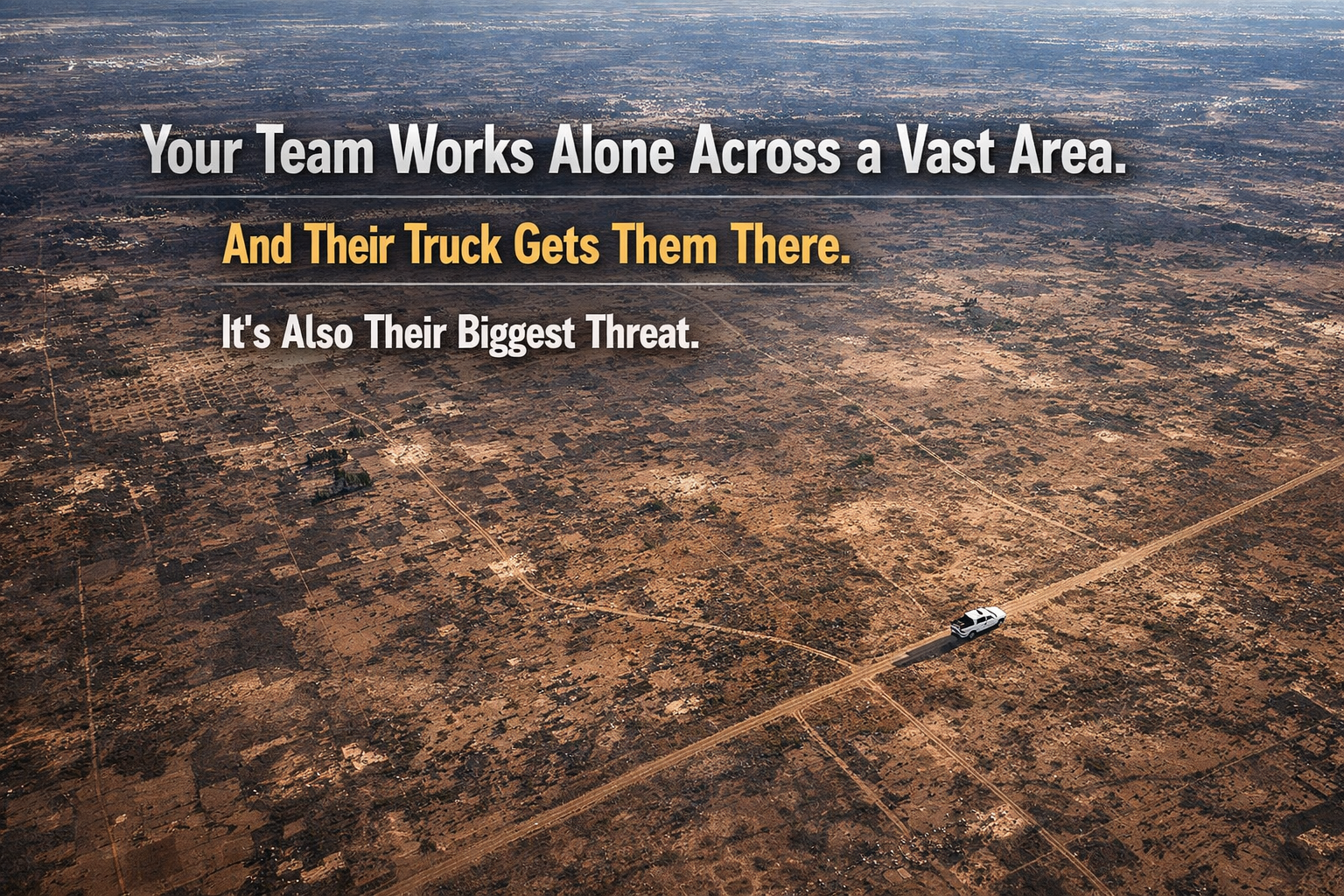
Most lease operators in upstream oil and gas drive the same route every day. They visit the same 15-20 well pads, in the same order, regardless of which wells actually need attention. The route was set months or years ago based on geographic convenience, and it rarely changes unless a well goes down hard enough to force a deviation.
This is not a technology problem. It is a prioritization problem. No one has told the operator which wells matter most today.
The Real Cost of Fixed Routes
A typical lease operator in a Permian or Mid-Continent basin covers 150-250 miles per day across 15-20 sites. At roughly 20-30 minutes per site (drive time plus on-site time), that consumes a full 10-hour shift. Every site gets roughly equal time regardless of whether it needs five minutes of visual inspection or two hours of troubleshooting.
The hidden cost is not the fuel or the truck wear. It is the opportunity cost. While the operator spends 30 minutes at a well producing normally, three wells on the other end of the field are losing production. A rod pump is showing intermittent failures. An ESP is drawing abnormal amps. A separator is running above setpoint.
These issues were flagged in SCADA overnight, but the operator will not reach those wells until tomorrow's route brings them around. By then, the rod pump may have failed completely (turning a $500 adjustment into a $12,000 pull-and-replace), and the separator issue may have caused a gauge run error that takes two weeks to reconcile in production accounting.
Field superintendents know this dynamic intimately. They spend the first hour of every morning triaging calls, reviewing overnight alarms, and trying to reprioritize the day. But with 200+ SCADA alarms and no economic ranking, the best they can do is identify the most obvious emergencies. The slower-burning losses (gradual production decline, intermittent equipment issues, wells producing below forecast) stay invisible until the monthly report.
Why GPS Routing Alone Does Not Solve This
Several fleet management and logistics platforms offer route optimization for field operations. These tools find the shortest or fastest path between a set of predetermined stops. They solve the traveling salesman problem.
But they start with the wrong assumption: that the set of stops is correct.
If a lease operator's route includes eight wells that need nothing and excludes four wells that are losing production, finding the optimal path between those eight wells does not help. You have optimized the wrong work.
True route optimization for field operations requires two steps:
- Decide which wells belong on today's route based on real-time operational data, economic scoring, and predicted equipment health.
- Sequence those wells to minimize drive time while respecting priority order and time constraints.
Step one is the hard part. It requires integrating SCADA data, production accounting, CMMS history, and engineering models into a single scoring engine that evaluates every well every night. Step two is straightforward once you know which wells matter.
Want case studies and benchmarks like these?
For upstream + midstream operations leaders. Share your work email and our team will follow up with case studies, benchmarks, and what's changing in the field.
What Intelligent Route Optimization Looks Like
Here is what a WorkSync-powered morning looks like for a lease operator in the Western Anadarko Basin:
5:45 AM: The operator opens the WorkSync app on their phone. Today's plan shows 12 stops, not the usual 18. Three low-priority wells (producing normally, no flags) have been dropped. Four new stops have been added based on overnight ML anomaly detection.
Stop 1 is a rod pump well producing 22 BOE/day that showed an abnormal polished rod load pattern overnight. Estimated production at risk: $1,800/week. The app shows the specific anomaly, the well's recent production trend, and the recommended inspection steps.
Stop 4 is a gas lift well where the injection rate has been trending away from the optimal curve for three days. Before WorkSync, this would not have been caught until the next engineering review cycle (two weeks out). Estimated impact: 8 BOE/day deferred production.
Stop 8 has been flagged as a safety priority: a high-pressure alarm on a vessel that requires a physical inspection per the operator's safety protocols. This stop was moved up in the route sequence to ensure it gets addressed before the crew runs out of daylight.
The route between stops is optimized for geography and priority. High-value stops are front-loaded so that if the day runs long, the lowest-impact work gets deferred to tomorrow (not the other way around).
4:00 PM: The operator has completed 11 of 12 stops. The one deferred stop was a routine visual check on a well with no active flags. Total miles driven: 140 (vs. the usual 210). Total estimated value of work completed: $14,200 in production protected or restored.
How WorkSync Makes This Work
WorkSync's OPS platform runs the scoring and routing engine that powers this workflow:
Overnight scoring: ML models evaluate every well against its learned operating baseline. Deviations are flagged, categorized by type (production, equipment, safety, compliance), and scored by estimated economic impact.
Morning plan generation: By 6 AM, every crew has a ranked task list and an optimized route. The superintendent reviews the plan in the Control Room and can adjust priorities before crews depart.
Real-time adaptation: If conditions change during the day (a new high-priority alarm, a well that took longer than expected), the system can re-optimize the remaining route.
Closed-loop feedback: Every completed task feeds back into the model. Did the rod pump issue resolve after the adjustment? Did production recover? This data improves future scoring and reduces false positives over time.
In the Western Anadarko deployment, operators using WorkSync saw 35% fewer site visits with higher task completion rates and measurably better production outcomes. Lease operators reported that their days felt more purposeful because they understood why each stop mattered.
Want to see what optimized routes look like for your field? Request a walkthrough or explore the 6 AM plan.