title: "Safety by Design: Why Operational Intelligence Is a Safety Imperative, Not Just an Efficiency Tool" slug: safety-by-design author: Michael Atkin, P.Eng date: 2026-03-27 category: Safety readTime: 6 min description: "Vehicle incidents kill more oil and gas workers than any other cause. Every unnecessary mile driven is unmanaged risk. The operators with the best safety records aren't running more training, they're running smarter operations." ogImage: /images/insights/safety-by-design-og.jpg cta: text: "See how risk-informed prioritization works" link: /contact
Early in my career at SaskEnergy, we scaled a capital program from $6 million to $60 million a year. Same crews. Same headcount. Ten times the work.
The first question everyone asked was about efficiency. How do you schedule that much more work without hiring?
The first question we should have asked was about safety. How do you put those same crews on ten times more job sites, driving ten times more miles, without someone getting hurt?
That question changed how I think about operations design. Because once you see it, you can't unsee it: every operational inefficiency is also a safety risk.
The Leading Cause of Death in Oil and Gas Isn't What Most People Think
It's not explosions. It's not equipment failures. It's not H2S exposure.
It's driving.
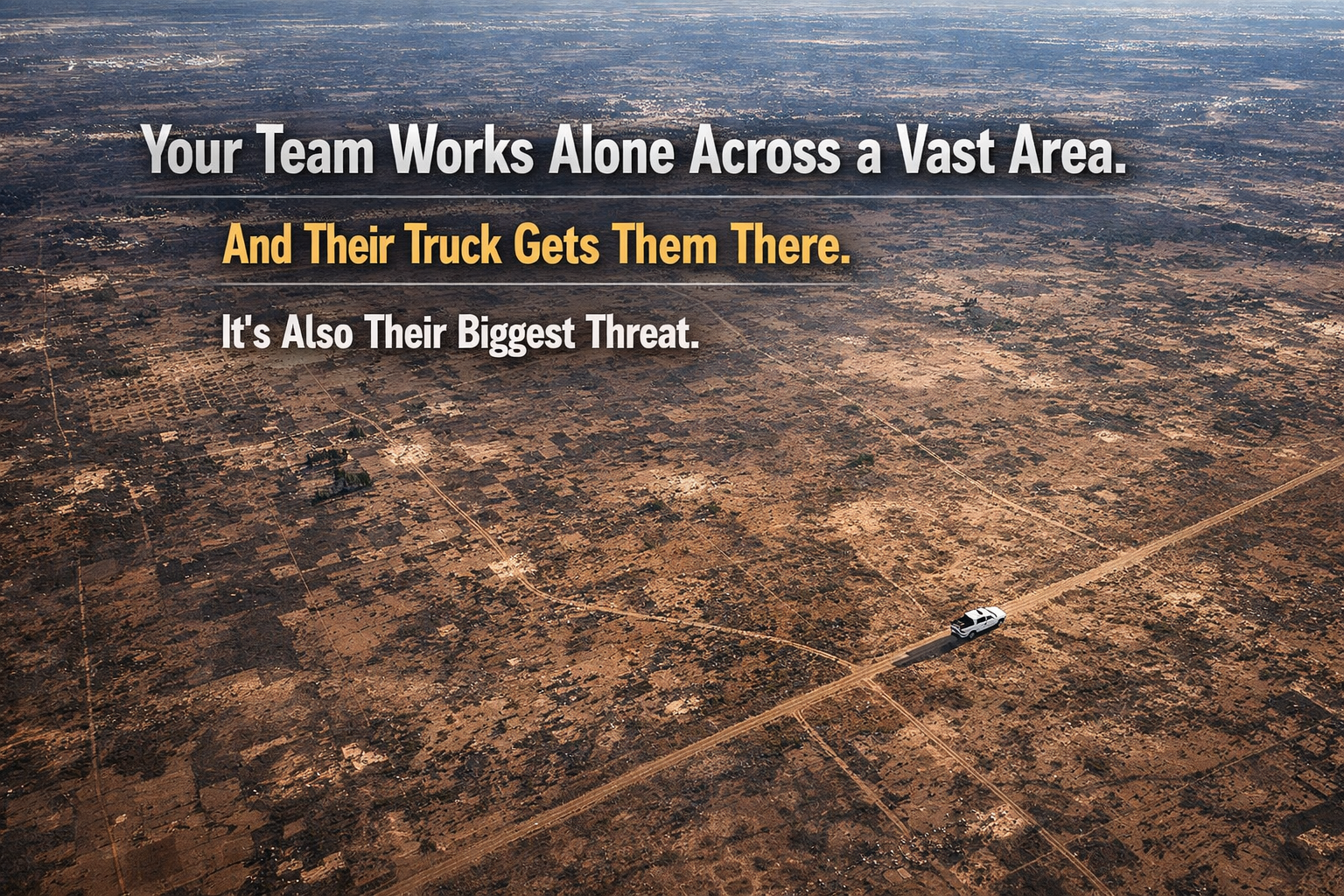
OSHA data is unambiguous: vehicle incidents account for 40% of all oil and gas worker fatalities. It's the number one killer in the industry, and it has been for years.
The CDC tracked 470 fatalities in oil and gas extraction between 2014 and 2019. Of those, 26.8%, 126 people, died in vehicle incidents. Another 21.5% involved lone workers operating alone in remote locations without real-time connection to their team.
These aren't freak accidents happening to careless people. They're systemic outcomes of how field work gets planned and dispatched.
When a pumper drives a 200-mile route built from memory and a spreadsheet, every unnecessary mile is exposure that didn't need to exist. When a superintendent sends a crew to a site that didn't actually need a visit today because his prioritization method is a whiteboard and a phone call, that's unmanaged risk. When a lone worker is deployed to a remote location because nobody optimized the route to pair crews at higher-risk sites, that's a safety decision being made without data.
The oil and gas fatality rate is 7 times higher than the all-industry average across the United States. Seven times. And the single biggest contributor is time on the road.
Reactive Operations Are Dangerous Operations
The connection between operational design and safety outcomes goes deeper than driving miles. It touches every part of how field work happens.
In reactive operations, where the daily plan is built on yesterday's information and changes by the hour, field crews operate in a state of perpetual triage. Priorities shift. Routes get rewritten mid-day. Crews get redirected to emergency callouts that could have been anticipated if someone had been looking at the right data.
Every reactive redirect is a crew on the road that didn't need to be there. Every gut-feel dispatch is a safety decision being made without analysis. Every duplicate site visit is exposure that adds zero value.
OSHA reports that struck-by and caught-in incidents account for 60% of on-site fatalities in oil and gas. These happen at wellheads, compressor stations, and tank batteries, the exact sites that field crews visit every day. The more visits, the more exposure. The more unplanned visits, the more rushed the work becomes. Rushed work in hazardous environments is where incidents happen.
The math is simple and it's unforgiving: fewer unnecessary miles means fewer vehicle fatalities. Fewer unnecessary site visits means fewer on-site exposure hours. Better prioritization means less rushed work at hazardous locations.
Want case studies and benchmarks like these?
For upstream + midstream operations leaders. Share your work email and our team will follow up with case studies, benchmarks, and what's changing in the field.
What Reactive Operations Do to Your People
There's a second-order safety effect that almost never gets discussed in the safety committee meetings: what happens to workforce development when your operation is reactive.
When the schedule is chaos, there's no time for training. No time for ride-alongs. No time for a new hire to build confidence and competence before they're alone on a lease road at 5 AM making decisions they're not ready to make.
I've watched operators throw new crew members into the deep end because there's zero margin in the schedule. Day three, a new operator is alone in a truck covering 30 wells because the senior hand is buried putting out fires somewhere else. No mentorship. No knowledge transfer. No opportunity to ask questions because everyone is running flat out on a plan that was already wrong by 7 AM.
That's not workforce development. That's a liability wrapped in a hard hat.
The operators with the best safety records aren't just reducing exposure. They're creating space. When your schedule is optimized and your priorities are clear, your experienced people aren't buried in reactive firefighting. They have time to mentor. Your new hires aren't guessing, they have clarity on what matters, why it matters, and what to do about it.
Clear priorities create space. Space creates time for development. Development creates competence. Competence creates safety.
The Proof: What Happens When Operations Get Smarter
The evidence that better operational design improves safety outcomes isn't theoretical. It's showing up in the data across every segment of the energy sector.
Upstream: In a live deployment across 1,800+ wells in the Western Anadarko Basin, an operator implementing risk-informed prioritization and optimized routing saw their Total Recordable Incident Rate drop from 1.8 to 0.3, an 83% reduction. Not through a new safety program. Through smarter operational design that reduced exposure, eliminated unnecessary miles, and gave field teams clarity on what mattered most every morning.
Midstream: PHMSA data shows that liquid pipeline incidents declined 23% over the most recent five-year period among operators who invested in integrity-informed operational systems. Better data, better prioritization, fewer incidents.
Utilities: Dominion Energy has reduced their recordable injury rate by 75% since 2006. Williams Companies saw a 31% decline in recordable injuries since 2018. These aren't companies that added more safety posters. They invested in operational systems that reduced the conditions where incidents occur.
The pattern is consistent: when you reduce unnecessary field exposure, optimize crew routing, and prioritize work by risk and economic impact, safety improves as a direct consequence. Not as a side effect. As a primary outcome.
Goal Zero Requires Operational Design, Not Just Commitment
Every major energy operator has a safety commitment. Enterprise Products Partners runs GoalZERO with an industry-leading TRIR of 0.45. ONEOK achieved a TRIR of 0.31, coming in 23% below their own target. SaskEnergy operates under Mission: Zero, zero injuries, zero fatalities, zero suffering.
These commitments are genuine and they matter. But commitment alone doesn't reduce exposure. Systems do.
You cannot achieve Goal Zero with reactive operations. You cannot achieve it when your field crews are driving routes built from habit instead of analysis. You cannot achieve it when your prioritization method is a superintendent's memory. You cannot achieve it when new hires are thrown into the deep end because the schedule has no room for development.
The safest, most capable field teams aren't the ones with the most training hours logged. They're the ones where operational planning gives people the clarity to focus, the time to learn, and the confidence to perform.
Safety isn't a separate program that runs alongside your operations. It's an outcome of how well your operations are designed.
The Question Every Operations Leader Should Ask
The next time your safety committee meets, before you review the incident reports and the near-miss logs and the training completion rates, ask this:
How many unnecessary miles did our field crews drive last month? How many site visits were reactive instead of planned? How many of our new hires worked alone before they were ready?
Those aren't efficiency metrics. They're leading indicators of your next safety incident.
The operators who understand this, who design their operations around reducing exposure, not just tracking what happens after the fact, are the ones rewriting the safety curve for the entire industry.
How does your organization connect operational planning to safety outcomes? Is your safety program reducing exposure or just measuring it after the fact?