
The ranked work plan in every truck cab by 6 AM.
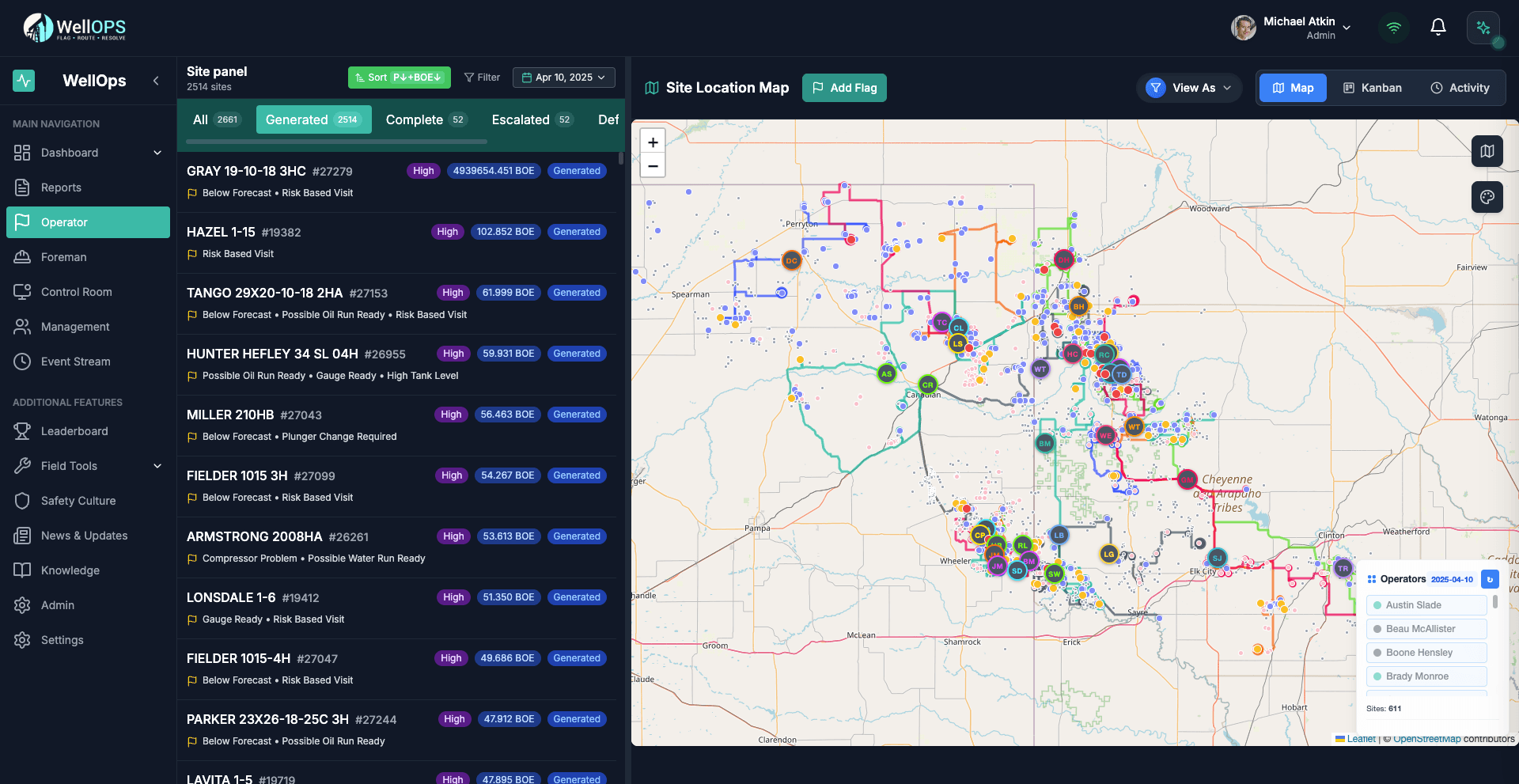
WellOPS is the productized, cloud-hosted Pump by Priority platform. It tells your pumpers what to work on at 6 AM, ranked by cash flow, safety, and production impact. Before: routes by habit, alarm floods, a months-deep backlog. After: every well ranked daily by dollars and risk, the plan in every truck by 6 AM.
The productized rollout
We productized what the supermajors built by hand. Pump by priority, in weeks.
The industry has chased pump by exception for a decade and mostly struggled to implement it. WellOPS is the product version, built for small-to-medium operators, PE-backed roll-ups, and lean independents with no internal software team and no appetite for an 18-month build. It ships with the team that has done it before and a repeatable sprint playbook, so it goes live rapidly, in a way your operations team will love.
See the rollout playbook →Stop wasting time entering data
Delivered by Field Data Capture
Cut out low-value work
Delivered by Work Engine
Finally implement route optimization
Delivered by Route Optimizer
Create a platform where knowledge grows without a huge headache
Delivered by Closed-loop learning + Willie
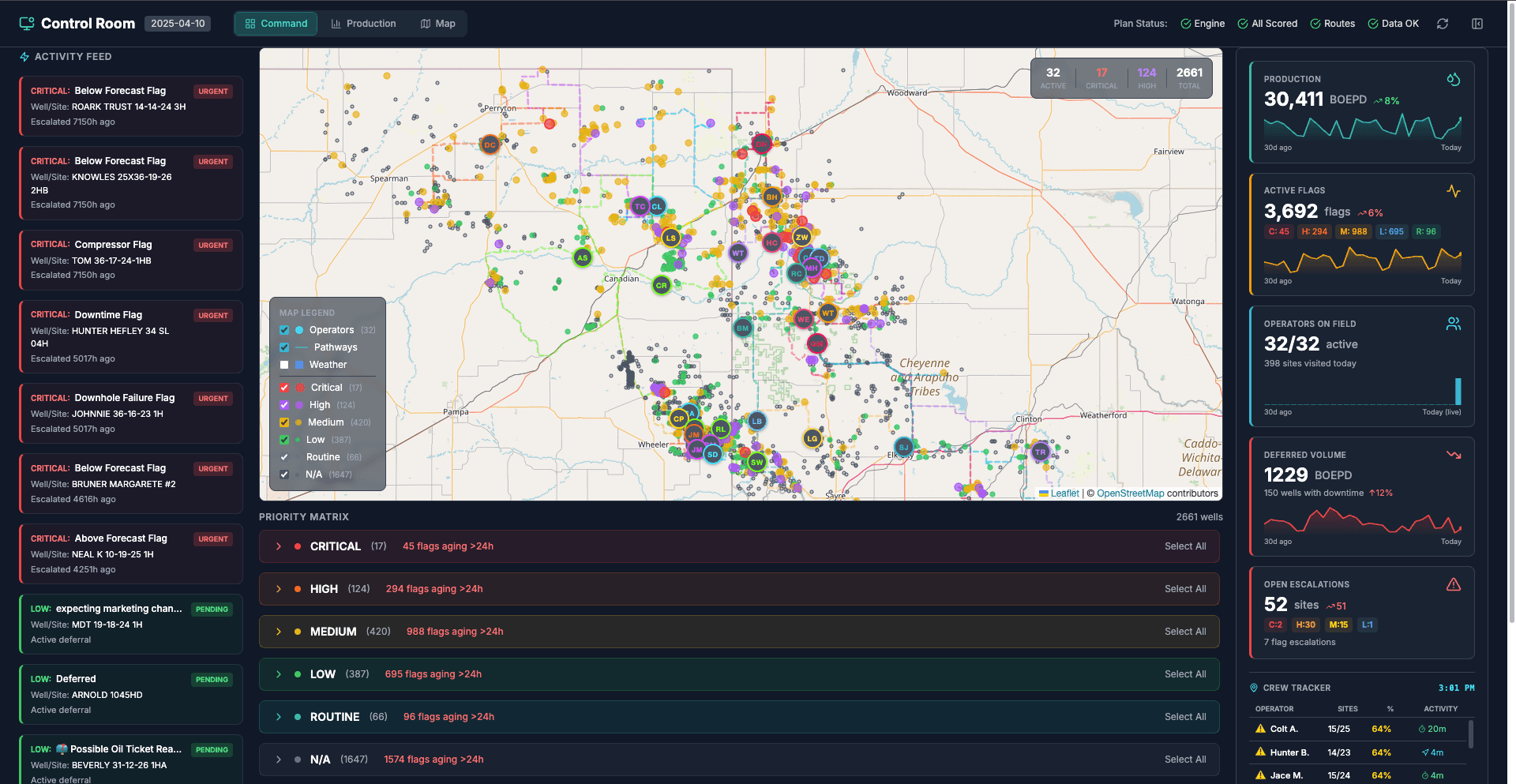
What WellOPS delivers
The ranked plan in every truck cab by 6 AM.
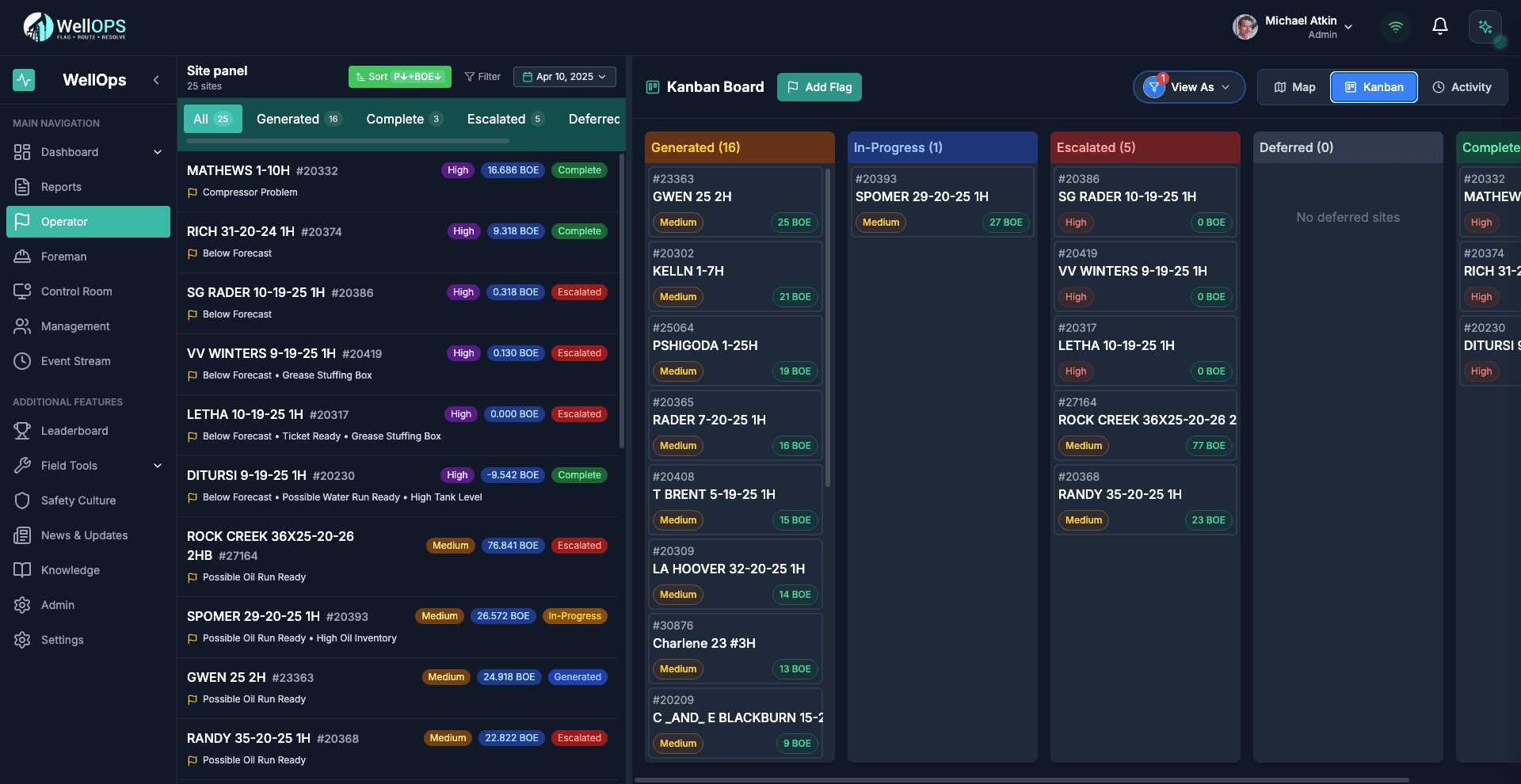
Statistical physics-based models rank wells by cash-flow risk, environmental risk, failure risk, and personal-safety risk. The most important task is on the top of the list when the pumper starts their day.
The first step
The first step is one Tuesday. Not a six-month commitment.
We don’t ask for a procurement cycle. We ask for one week of your data and four weeks of your worst-performing field. Move the metric, sign the license. Don’t, walk away.
Day 1
You send the data.
One week of SCADA, your work order log, and the cost ledger for one field. Read-only. We pull from the systems you already run; no rip-and-replace.
You + your data lead
Day 7
You see Tuesday’s plan.
We deliver a real, ranked work plan for your worst-performing field, scored on cash-flow impact and risk. Not a deck. A plan a foreman could run on Tuesday.
Sample plan + 30-min walkthrough
Week 4
It’s live in the truck.
WellOPS in production on the field you nominated. Crews open the ranked plan at 6 AM. Willie answers questions in the cab. Your VP of Ops watches the metric you anchored on.
Crews + Willie + your foreman
Day 28
You decide.
If the metric you anchored the trial on moved, you sign the annual license and we keep going. If it didn’t, you walk away. No license fee, no kill fee.
You + your CFO
The Impact Guarantee
Move the metric. Or you owe nothing.
4-week pilot · no license fee · no kill fee · no awkward sales call.
Your day is a tradeoff between cash flow, risk, and preventative maintenance.
Most systems optimize for one at a time. Work Engine weighs every task against all three and ranks the day so the highest-value work rises to the top.
The four modules
One platform. Four jobs the field actually has to do every day.
Work Engine
The brain that decides what your field does today.
Pulls signals from SCADA, well tests, run tickets, deferment data, inspections, and route history, then surfaces the work that actually moves production. Every well, facility, and job ranked by the dollar impact of acting today. Includes Opportunity Scoring.
Your pumpers shouldn't be deciding their own routes. Your foreman shouldn't be the last to know a well went down at 2 AM.
Replaces
Manual route lists, spreadsheet prioritization, the morning "what should we do today?" meeting, and the foreman who "just knows" which wells matter.
Module deep-dive →Route Optimizer
The shortest drive day, recalculated every time something changes.
Builds the most efficient drive day for every field worker. Terrain, lease access, well status, weather, scheduled work, crew skill. Re-optimizes on the fly when a well goes down, a permit expires, or a higher-priority job lands. Works in the truck, offline, with turn-by-turn for unmarked lease roads.
Cut windshield time 25% without telling anyone how to do their job.
Replaces
Static daily routes, paper maps, "we drive the same loop every Tuesday," and the foreman re-routing crews over text messages when something blows up.
Module deep-dive →Field Data Capture
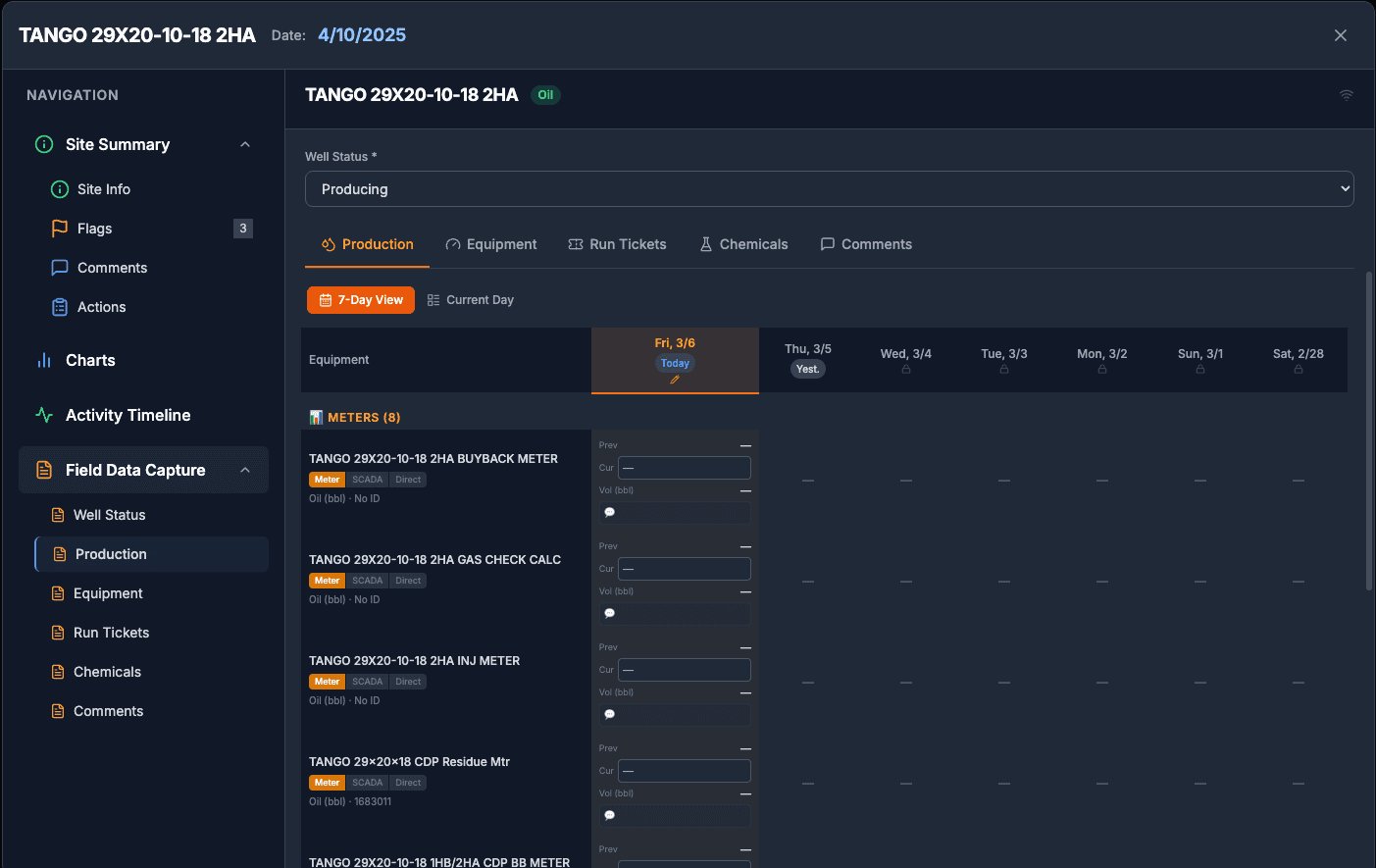
One mobile interface for everything a field worker observes.
Gauge sheets, well tests, hazard observations, near-miss reports, JSAs, equipment inspections, pre-job safety checks, environmental readings. Captured once, on a tablet or phone, online or offline. Voice-enabled so an operator talks through a JSA in 30 seconds. Auto-fills from SCADA and prior shifts.
The form fills itself. The operator just confirms what's true.
Replaces
Paper tickets that get lost in the truck, double-entry from paper into the office system, missed JSAs because nobody had time, and spreadsheet hazard logs that nobody reads.
Module deep-dive →Field Work Management
Every job has an owner. Every permit has a clock. Every lone worker has a check-in.
Assigns, tracks, and closes out every job in the field. Work orders, permits-to-work, isolations, MOCs, hot work, lockout/tagout, lone-worker check-ins, incident investigations, compliance audits, corrective actions. Routes approvals automatically. Won't release high-risk work until safety steps are signed.
Permits don't expire silently. Lone workers don't get forgotten. Incidents don't sit in someone's email for three days.
Replaces
Paper permits, the supervisor's email inbox as a workflow tool, manual lone-worker call-in trees, and the spreadsheet someone keeps to track open MOCs.
Module deep-dive →Work Engine in motion
From SCADA at 5:47 AM to a ranked plan in the truck cab by 6:00.
Four scenes. Twelve seconds. The same mechanism that runs across our customer base: 10+ operators, 5,000+ wells, three basins.
By the time the foreman pours coffee, the plan is in the truck.
Overnight SCADA flows through agents that score, rank, and route. The foreman opens the ranked plan at 6 AM and runs the day. No call to dispatch. No spreadsheet. No "what should we work on?" conversation.
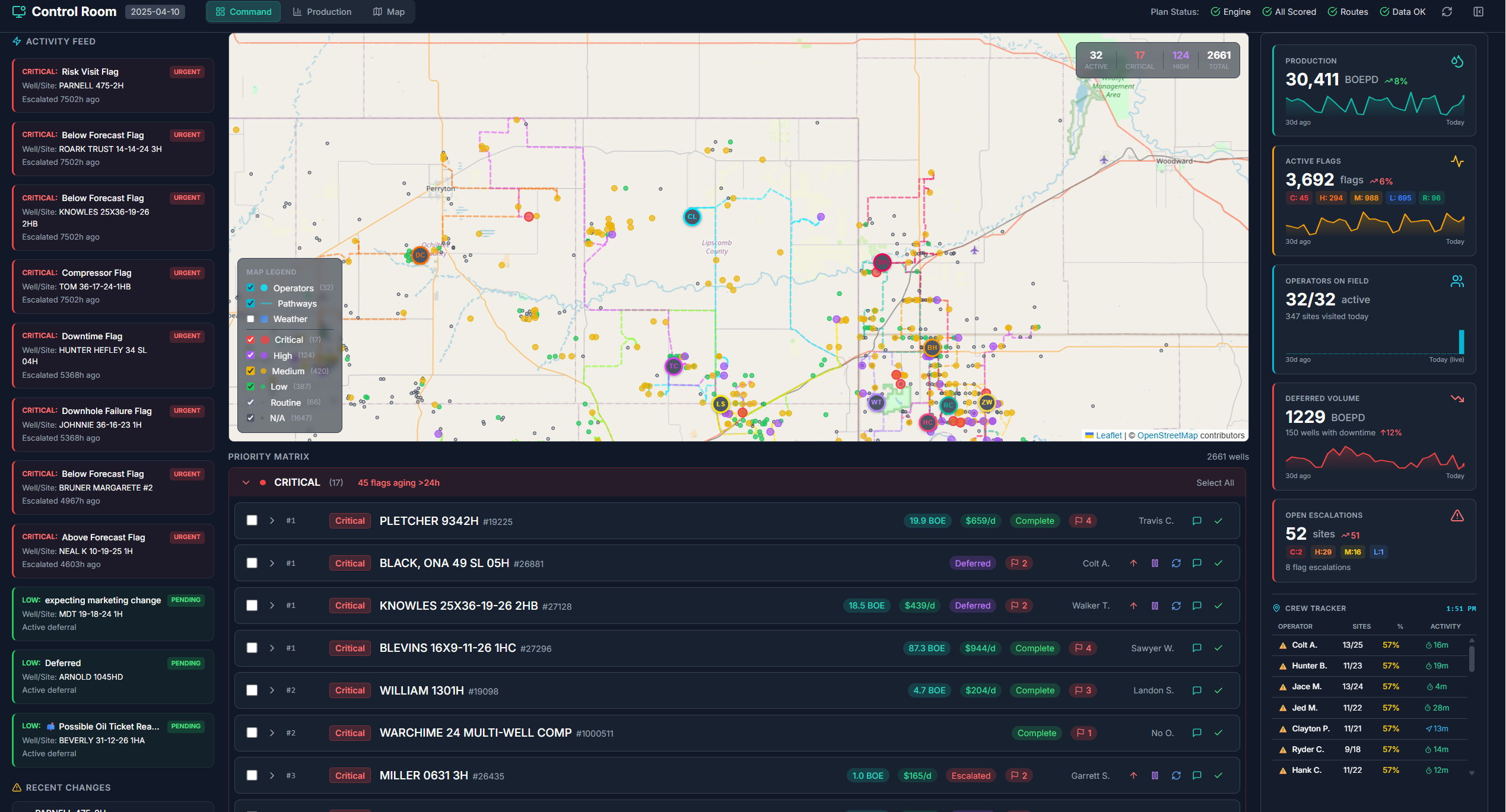
Overnight SCADA lands. Decline forecasts and exception flags refresh on every well.
Every task scored by dollar impact and sorted. The day has an order before anyone wakes up.
Work assembled per crew by qualification, equipment, and drive time. No dispatcher needed.
The foreman opens the ranked plan in the truck and runs the day. No spreadsheet, no radio call.
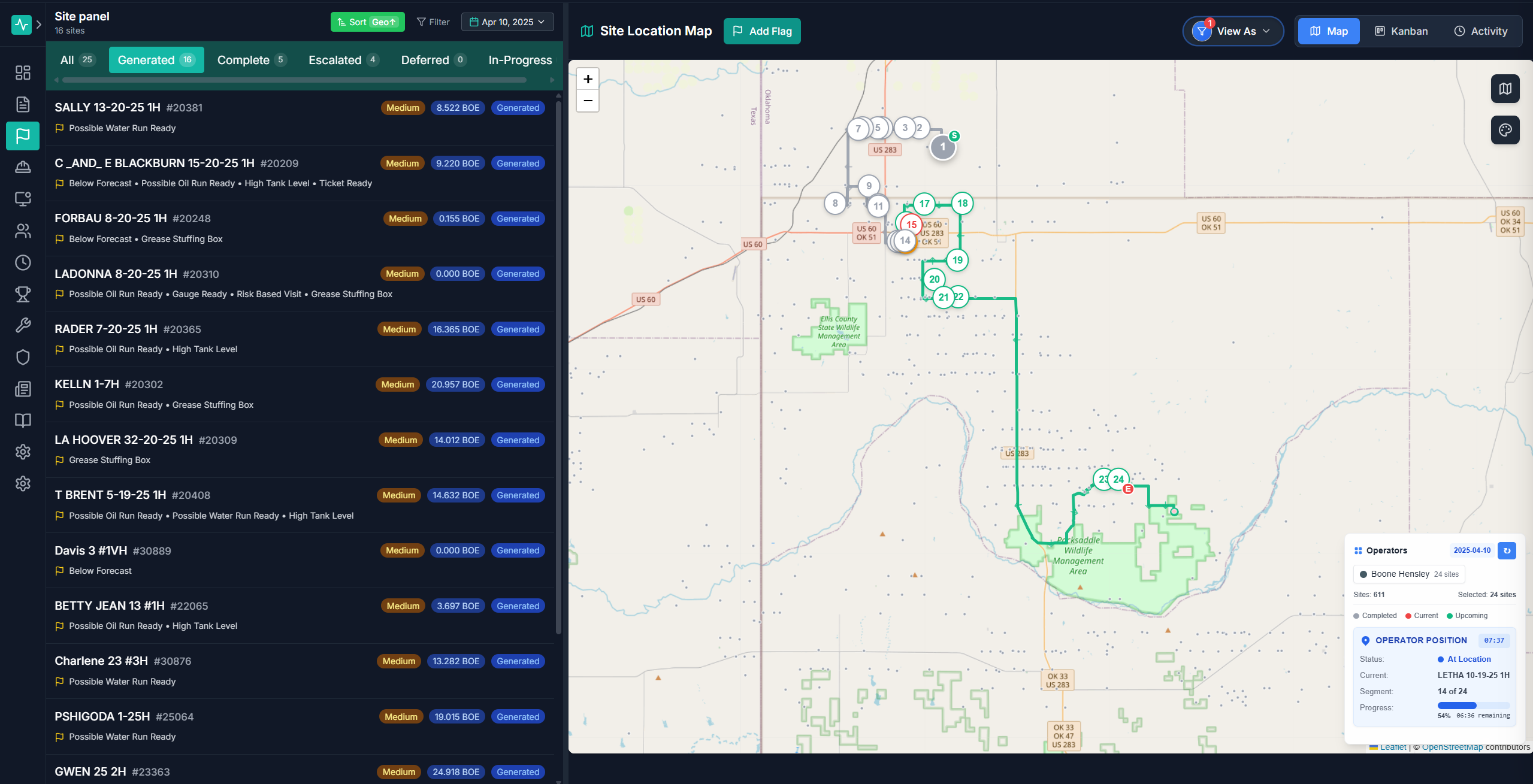
The routing math is field-validated: a 12-month, 5,000-well, three-basin deployment cut site visits 35% and drive miles 40% while lifting free cash flow 15% on the same crew.

Meet Willie · AI Field Specialist
The most experienced pumper on your team. He just happens to be an AI.
Willie is voice-first, hands-free, gloves-on. He talks the operator through a JSA in 30 seconds. He logs a gauge sheet from a verbal report. He photographs and classifies a hazard with one tap. He answers “what’s the procedure for isolating well 14B?” from the cab of the truck.
He knows every asset on the lease, every prior shift’s notes, every open work order, and every compliance requirement. He escalates when something looks wrong. He never forgets to ask the next question on the checklist.
Willie replaces the institutional knowledge that walks out the door when your senior pumper retires. The training cycle for every new hire. The “who knows about this well?” phone tree.
Built to make your best pumpers faster. Not to replace them.
Three ways to deploy
You don’t have to rip out what works.
The decision isn’t “replace your stack.” It’s “where do you want to start?”
Headless
APIs and webhooks for Work Engine, Route Optimizer, and Field Data Capture. Drop our intelligence behind your existing FOM, EAM, or mobile app.
Best for Customers with mature internal tooling who want our engine, not our UI.
Wraps existing tools
WellOPS data layer alongside your current Maximo / SAP / P2 stack. We orchestrate; your systems of record stay.
Best for Customers with sunk cost in legacy CMMS / FOM who want to extend, not replace.
Full platform
Complete WellOPS suite. Every module plus Willie embedded. The platform your field team will love to use.
Best for Customers ready to consolidate and replace legacy field tooling.
Where WellOPS works
See WellOPS in your basin, your stack, and your workflow.
By basin
WellOPS playbook for your basin
- Permian LOE Reduction→
Water handling, takeaway constraints, methane
- Bakken LOE Reduction→
Windshield time, winterization, cold-weather equipment
- Anadarko LOE Reduction→
Where WorkSync was born, 5,000+ wells reference
- Eagle Ford LOE Reduction→
NGL allocation, wet-gas compression
- Marcellus LOE Reduction→
Compression, midstream takeaway
- DJ Basin LOE Reduction→
Reg 7 compliance, surface-use friction
Compare to your stack
Already running something else?
- WorkSync vs Greasebook→
Upgrade path when field data capture isn’t enough
- WorkSync vs PakEnergy→
Adding ranked work + AI on top of accounting
- WorkSync vs Peloton→
WellView records you’ve always wanted
- WorkSync vs Enverus→
Production data vs ranked field execution
- WorkSync vs IBM Maximo→
Field-first vs enterprise asset management
- WorkSync vs IFS→
Mid-tier ops vs enterprise EAM suite
How it works under the hood
Capability deep-dives
- Anomaly Detection→
ML on SCADA streams, 48–72 hr early warning
- Economic Scoring→
Cash-flow weighted task ranking
- Route Optimization→
Value-density routing, not just shortest distance
- Predictive Maintenance→
Per-well failure-mode signatures
- Data Quality Agents→
Cleans + reconciles SCADA before scoring
- Reinforcement Learning→
The plan gets smarter every cycle
The operating discipline
The cluster around WellOPS
- Upstream Optimization→
The umbrella pillar (5 levers + 4-week pilot)
- Manage by Exception→
The operating model Drucker → oilfield
- Pump by Exception→
The definitive guide
- Pump by Priority→
Tasks ranked by $-impact
- Four Eras of Field Ops→
Where you sit on the curve
- 90-day Path Era 2 → 4→
How to upgrade your model
Frequently asked
What VPs of Ops ask in the first 30 days.
How fast can WellOPS be live in the truck cab?
Integrate to your SCADA, accounting, and EAM in under one week. Stand up the Work Engine in two. Crews running on the ranked plan within four. The 4-week pilot is a real production deployment, not a sandbox.
Will pumpers actually use it?
If a pumper can't use it at 6 AM in a truck cab, it fails. WellOPS is mobile-first, offline-capable, voice-enabled. Willie talks the operator through a JSA in 30 seconds. The form fills itself; the operator confirms what's true. Adoption with our customers has hit 90%+ in the first week.
Does it replace Maximo / SAP / our existing FOM?
No. WellOPS sits on top of them via the DataHub. We make those systems talk to each other and write the ranked plan into whatever interface your crews already open. Three deployment modes: headless API behind your existing tools, wraps the stack you already own, or full WellOPS platform. Customer's choice.
What if it doesn't move our metric?
You owe nothing. The 4-week pilot runs at no license cost. Pick the operating metric that matters (cash flow per BOE, OPEX per well, TRIR, drive miles). If the number doesn't move, walk away. No license fee, no kill fee.
Ready to give your field its own brain?
Pick the metric that matters. We’ll run Willie on your field for four weeks. Move the number, or you owe nothing.