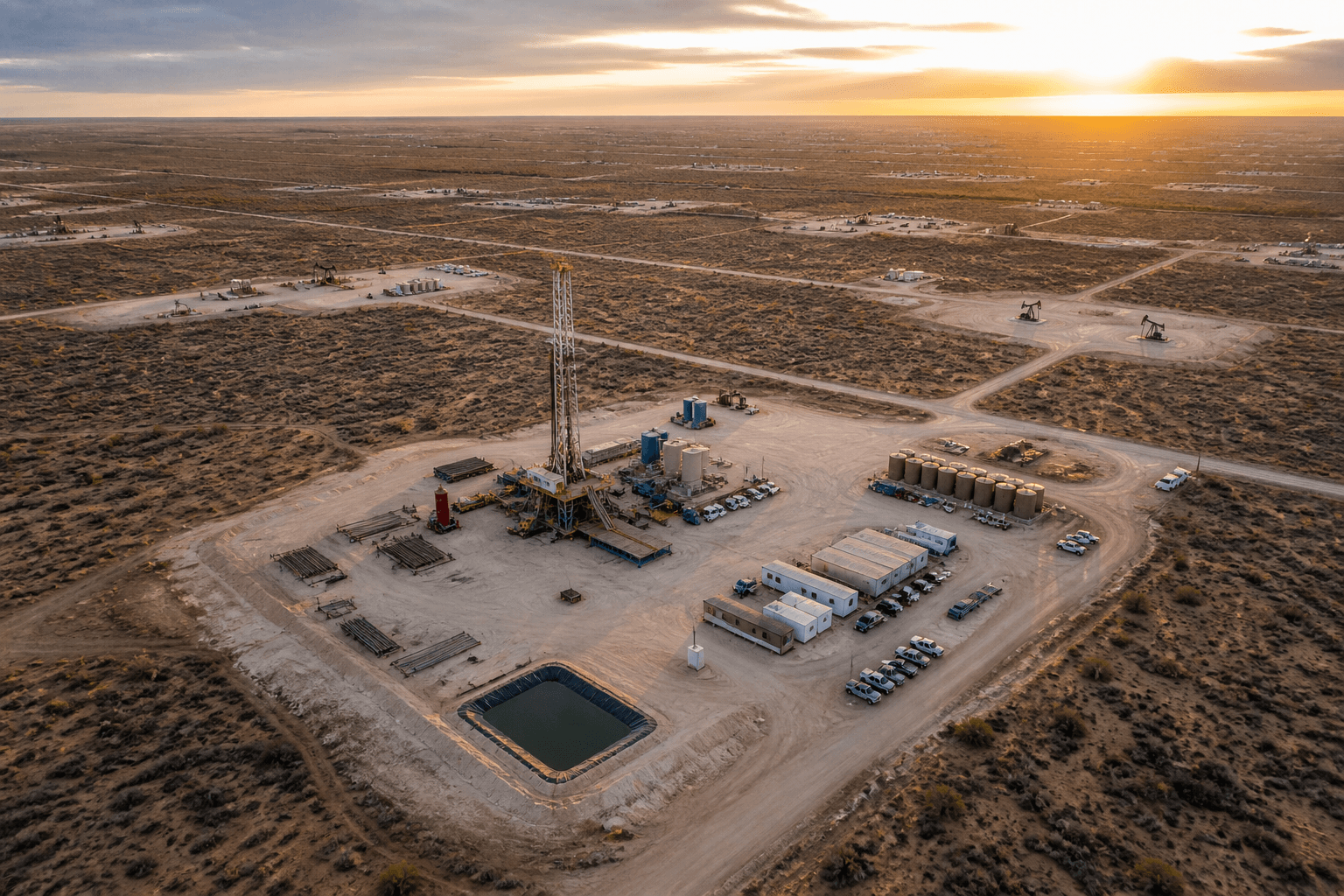
Most AI pitches in oil and gas start with telemetry. That is the wrong order. The data is already there. Nobody is scoring it.
The Vendor Script Most Operators Have Heard This Year
A vendor sits down with a VP of Operations. Within ten minutes, the deck is on the slide that says "instrumentation gap." A network of new edge sensors. A telemetry refresh. A six-month pilot to get the data flowing before the AI can do anything useful.
The CFO has seen this movie. Two years ago it was a pilot. Last year it was a pilot. The capex line moved, the AI deliverable did not.
There is a simpler diagnosis. Most upstream operators do not have a data problem. They have a prioritization problem.
A 500-well operator already produces thousands of SCADA points a day, plus production accounting, plus EAM, plus GIS, plus the pumper's voice on the radio at 9:14 AM saying the tank battery on Section 23 smells a little sour. Almost none of that signal gets ranked by cash-flow impact before the trucks roll. Adding another tank monitor or another pressure transducer to an unscored pile is more noise, not more decision.
The question is not "what sensor do we add." The question is "which well moves the most cash flow if I visit it tomorrow."
That is a software question. Not a hardware question.
What Your Operation Already Produces
Walk through what a mid-sized independent already collects in a 24-hour window. Most of this lives in systems the operator paid for years ago.
From the wellhead and pad. SCADA tags on tubing pressure, casing pressure, flow rate, runtime, fluid level, motor amps, tank levels, separator state. Polled every few seconds for the active wells. Archived in the historian.
From the route. Pumper visit records, equipment readings entered by hand, exception notes, photos of the leak or the corrosion patch, the time stamp of arrival and departure.
From accounting. Production volume by well, allocations, run tickets, prices realized last month, lifting cost ledger.
From maintenance. Open work orders, equipment failure history, parts in inventory, technician availability, last preventive maintenance date.
From people. Radio traffic, end-of-day handwritten tickets, the conversation in the truck on the way back. The signal that lives in the heads of pumpers who have been on the same lease for fifteen years.
A typical operator has between forty and one hundred times more raw signal than the AI in the average vendor pilot is consuming. The bottleneck is not collection. The bottleneck is ranking.
Want case studies and benchmarks like these?
For upstream + midstream operations leaders. Share your work email and our team will follow up with case studies, benchmarks, and what's changing in the field.
Why More Data Does Not Equal Better Decisions
There is an asymmetry in field operations that vendors selling sensor refreshes rarely acknowledge. The supervisor's day is fixed. The pumper's day is fixed. Eight to ten hours, 18 to 35 sites, one truck. The question every morning is the same. Of everything I could do today, which subset moves the most cash flow.
That subset has to be ranked. By dollars at risk. By risk-adjusted intervention cost. By crew available. By weather, weight limits, and chemical inventory. By the contract terms on the gas line. By the price the operator will get for the barrel produced this week.
Without that ranking, the truck still leaves the yard. It just leaves on a route built last quarter. The 60-bopd well sitting one bad run-time away from becoming a 30-bopd well still gets a Thursday visit. Because that is what the schedule says.
A new sensor on that well does not change the visit cadence. It just adds another tag to an unscored historian. The well still sits.
This is why a SCADA refresh, on its own, has not moved the production needle for the operators who have done it. The signal is in there. Nothing is ranking it.
The Better Question
Sit with a pumper for two days and you will hear the right question forming in the cab of the truck.
The pumper does not need a higher sample rate on a tag. The pumper needs to know which of the eighteen wells on the rotation today is the one that is going to cost the operator money if it is not the first stop. Because the other seventeen will either hold for a day or generate an exception that is genuinely lower priority.
That is the question worth scoring overnight. Not "what is the value of this tag." But "what is the cost of not visiting this well tomorrow morning, given everything I know about it right now, including the pumper's observation from last week that the chemical was running short."
To score that question you need three things, not three new pieces of hardware.
One. A unified asset model that knows that this well, in this lease, in this section, is the same entity across SCADA, accounting, EAM, and GIS. Most operators have this in pieces. None of the pieces talk.
Two. A scoring engine that takes per-well production, current realized price, lifting cost, equipment health signals, route distance, crew availability, and risk profile, and ranks every potential field task by expected cash-flow impact and risk. Refineries have run this math (objective plus constraints) under the name advanced process control for forty years. Field operations rarely do.
Three. A capture loop that closes. The pumper's observation from this morning has to make it into tomorrow's score, not into a stack of handwritten tickets the office processes next Tuesday. The radio chatter has to become a scoreable input.
Get those three right and the existing instrumentation is enough to move the metric. Add hardware later if there is a specific well that earns it.
Pumper Observations Are the Operational Gold of the Field
Most of the highest-quality operational signal at a field operator never reaches the dispatch decision. It lives in three places.
In heads. The pumper who has been on the lease for fifteen years can hear a rod pump that is about to fail two weeks before it shows up in motor amps. None of that intuition is in the system.
In radio chatter. "Hey, the chemical tank on three is light, send the truck early next week." That is a maintenance event, a cash-flow event, and an inventory event. None of it gets logged. The supervisor remembers some of it. The system remembers none of it.
In end-of-day tickets. The handwritten note in the truck at 4:47 PM with the exception readings. It goes in a folder. It gets keyed into the EAM Tuesday morning. The next route is already locked.
The cheapest way to double the signal in the system is not a sensor refresh. It is a voice-first capture flow that turns the pumper's observation into a scoreable input by the time the truck pulls back into the yard. WorkSync ships this as Willie, the field agent that captures every visit by voice and writes the structured record back to SCADA, EAM, and the scoring engine before the pumper finishes their coffee.
The pumper does not learn a new tool. The pumper talks. The operation learns.
What This Looks Like in Production
A top 25 private producer deployed this approach across three basins (Western Anadarko, Permian, and Wyoming) on 5,000+ wells. Read-only integration into the existing stack. SCADA, Enertia, Quorum, AVEVA PI, Ignition, GIS, the existing EAM. Voice-first capture in every truck. The Work Engine scoring loop runs every night. A ranked plan lands in every truck cab by 6 AM.
Zero new field-side instrumentation deployed. Not one new pressure transducer, tank monitor, or edge gateway.
Twelve months later:
- 15% free cash flow uplift on the same well count
- 35% fewer site visits relative to pre-deployment baseline
- TRIR moved from 1.8 to 0.3
- Near-miss reporting up 300% (because the voice loop made it a 30-second action instead of a paper form)
Same crew. Same SCADA. Same trucks. Different daily plan.
The number that matters is the one at the top. The recovered cash flow is roughly equal to the cost of every sensor refresh the operator was being asked to authorize in the previous three quarters, paid back inside year one and recurring annually. Hardware did not move the metric. Scoring did.
What to Do This Quarter If You Are Asking This Question
A pragmatic sequence for an operator considering an AI pilot.
One. Inventory the data already in your stack. SCADA tags, accounting fields, EAM records, GIS features, historian retention. Count the points per day. The number will be larger than the team expects.
Two. Pick one metric the CFO would sign for if it moved. Deferred production. Lifting cost per BOE. TRIR. Time from anomaly to dispatch. Write it down. Date it. This becomes the pilot acceptance metric.
Three. Run a 4-week pilot on existing infrastructure. Read-only integration. No new sensors. Score the existing data overnight. Rank the day. Capture the field observation by voice. Measure on Day 28 against the Week 0 baseline.
Four. If the metric moves, sign. If it does not, walk away with no license fee owed.
This is the loop. The cheaper, faster path that the operators leading the basin are already on.
The supermajors started here a decade ago and paid the tuition. Independent operators do not need to repeat that journey. The technology, the methodology, and the proof now exist out of the box.
The window to close the gap is the next eighteen months. The operators who score the data they already own will widen the spread on the ones who keep waiting for the sensor refresh.
FAQ
Do you really not need new sensors to deploy AI on an oil and gas field operation?
For most upstream independents, no. The existing SCADA, accounting, GIS, and EAM stack already produces orders of magnitude more signal than the average vendor pilot consumes. The bottleneck is scoring, not collection. WorkSync deploys read-only onto the existing stack, scores the data overnight, and publishes a ranked daily plan without adding field-side instrumentation. If a specific well later earns a new sensor on its own ROI math, add it. Do not gate the AI deployment on a hardware refresh.
What happens to all the data the pumper currently captures by hand?
It becomes the highest-leverage input into tomorrow's plan. Voice-first capture (Willie) turns every visit into a structured record that flows back into SCADA, EAM, and the scoring engine within minutes. The pumper does not change their workflow. The radio chatter, the handwritten ticket, the gut call about a well that "felt wrong" all become scoreable inputs the operation actually uses.
How is this different from a SCADA alarm-priority dashboard?
A SCADA alarm-priority dashboard ranks alarms by alarm severity, not by cash-flow impact. A separator high-pressure alarm and a 60-bopd well that drifted off forecast both throw alarms. The dashboard treats them as comparable. A cash-flow scoring engine treats them as fundamentally different. The first is a 30-minute reset. The second is $4,200 a day of deferred production. The output of one is a longer alarm queue. The output of the other is a ranked plan for the truck.
What if our SCADA stack is older than our newest competitor's?
It probably does not matter. The Work Engine reads what is there. Operators on 15-year-old SCADA installations have deployed and moved the metric. The bigger lever is whether the data is reaching the score, not how new the historian is.
How fast can a 4-week pilot actually produce a measurable result?
Week 0: baseline. Week 1 to 2: read-only integration into the existing stack. Week 3: scoring loop live, ranked plan in the truck cab by 6 AM, voice capture deployed. Week 4: measure against baseline. Operators on the deployed reference saw measurable production-deferment recovery inside the first 30 days, before any optimization passes were run on the score function.
Start the 4-week pilot and we will run the integration on a slice of your stack. Pick the metric Week 0. If it moves, you sign. If it does not, you walk away. No license fee.