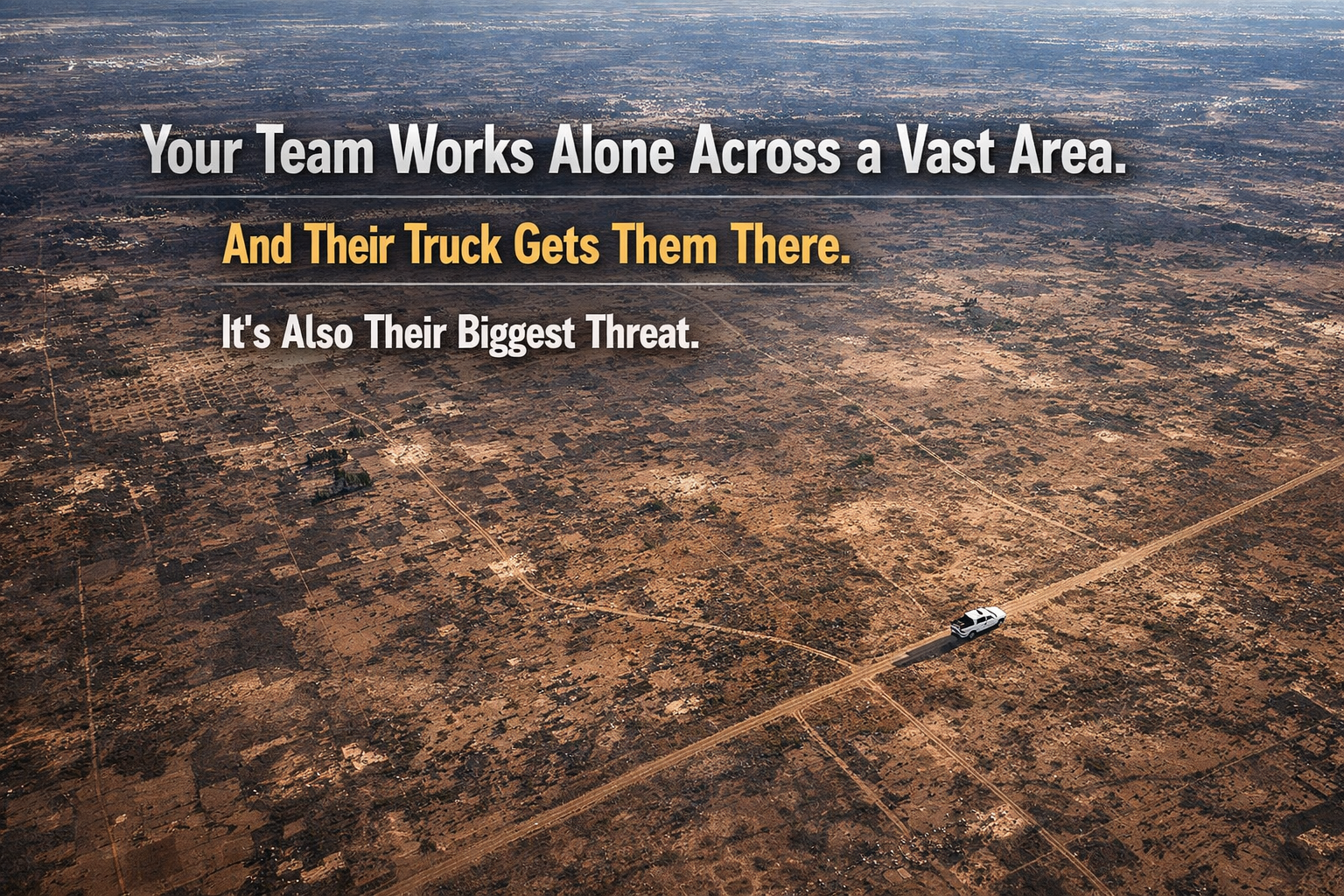
A field worker in oil and gas is 5 to 8 times more likely to die on the job than the average American worker. The #1 cause isn't a blowout. It isn't H2S. It isn't equipment failure.
It's driving.
Your crews log 50,000+ miles a year on routes that weren't engineered, just inherited. When the day changes, they don't have context. They adjust on the fly. And 1 in 5 fatalities involves someone working alone.
The industry's response: hardware. SoloProtect ID. Blackline G7. Garmin inReach. Grace Industries. Ok Alone. All world-class devices. All solve a piece of the problem.
But hardware alone misses the point.
What Hardware Does Well
Lone-worker hardware does three things well:
- Location tracking via GPS, you know where the person is.
- Man-down detection via accelerometer, if they fall and don't get up, the device triggers.
- Scheduled check-ins, the worker confirms they're OK at intervals.
Hardware is necessary. For the 40% of lone-work incidents that involve a crash, a fall, or a sudden medical event, hardware is what saves the worker. There's a reason Blackline and SoloProtect are in the field. They work.
What Hardware Doesn't Do
Hardware doesn't know what the worker is doing. It doesn't know the hazard profile of the asset they're visiting. It doesn't know the weather. It doesn't know whether they have the right qualifications for the task. It doesn't know that the last worker at this site reported a corroded valve that was never fixed.
Hardware sees a worker at GPS coordinates 35.12, -100.87 but it doesn't know they're walking into a confined space at Well 47-3 with a history of H2S readings above 50 ppm and a crew that's missing the refresher cert.
Hardware tells you where the worker is. The platform tells you what they're walking into.
Want case studies and benchmarks like these?
For upstream + midstream operations leaders. Share your work email and our team will follow up with case studies, benchmarks, and what's changing in the field.
Why Operational Context Matters
Consider two scenarios, both involving the same Blackline G7 device.
Scenario 1, Hardware Only
Worker arrives at Well 47-3. G7 logs location. Worker starts the task. 15-minute check-in reminders go out. Worker misses a check-in because they're dealing with something in the field. Supervisor gets escalation notification. Supervisor calls. Everything is fine. False alarm. Supervisor is now desensitized to the next escalation.
Happens every week. Alarm fatigue is the #1 reason lone-worker programs fail.
Scenario 2, Platform + Hardware
Worker arrives at Well 47-3. The system already knows Well 47-3 has a confined-space component, H2S history, and a required JSA checklist. Before the worker can start the task, the G7 device receives the JSA auto-generated from the asset hazard profile, today's weather, the H2S reading from 2 hours ago, and the chemical inventory on site. The worker signs off via the device, GPS-verified at the site. The supervisor gets an automated notification that the JSA was completed. The check-in cadence is shorter for this high-risk task, every 10 minutes instead of 15, because the risk score is higher.
If the worker misses a check-in on this specific task, the escalation is immediate, not 15 minutes later. The supervisor knows the context before they pick up the phone.
The Integration
The platform overlay doesn't replace the hardware. Keep the G7. Keep the SoloProtect. They're doing their job. The platform adds the operational context, asset hazard profile, crew qualifications, work plan, weather, H2S, task complexity and uses it to:
- Auto-generate the JSA specific to this site and this task. Not a template. A tailored document based on live data.
- Block dispatch if the crew lacks required qualifications (confined space, H2S, hot work). Not advisory. Enforced.
- Adjust check-in cadence dynamically based on the Hazardous Task Index score.
- Escalate missed check-ins with context attached, "Missed check-in at Well 47-3, which has H2S history and confined-space component."
- Capture incident data automatically when something happens, because the platform knows what the worker was doing, not just where they were.
What Changes With a Platform-First Approach
Operators that integrate lone-worker hardware into an operational platform see TRIR drop from 1.8 to 0.3 or lower. Not because the hardware got better. Because the decisions around the hardware got better. Fewer false alarms. Shorter response times on real emergencies. More qualified crews on high-risk tasks. Better documentation of every safety decision.
50–70% of oilfield labor is contractor. Contractor competency tracking is a separate silo (ISNetworld, Avetta, Veriforce) that most operators handle manually at dispatch. The platform pulls contractor qualifications into the same dispatch decision, so unqualified contractors never get on site for high-risk work.
OSHA PSM penalties can run $156K per willful violation. The platform isn't about compliance, it's about making compliance automatic.
Where to Start
If you already have Blackline or SoloProtect, keep them. We integrate with them. You don't need to rip out hardware your HSE team has standardized on.
What you add is the platform layer. Field Safety deploys in under 4 weeks. The first outcome: your crews know the hazard profile of every asset before they arrive. Your supervisor sees missed check-ins with context. Your HSE director has a single dashboard across employees and contractors.
A top 25 private producer deployed Field Safety across three basins (Western Anadarko, Permian, Wyoming) and cut TRIR from 1.8 to 0.3, an 83% reduction, over 12 rolling months. The Blackline devices stayed in place the whole time.
Want to see how Field Safety overlays on your existing Blackline or SoloProtect deployment? See This on Your Data, qualified operators get a 4-week proof of value at no license cost.