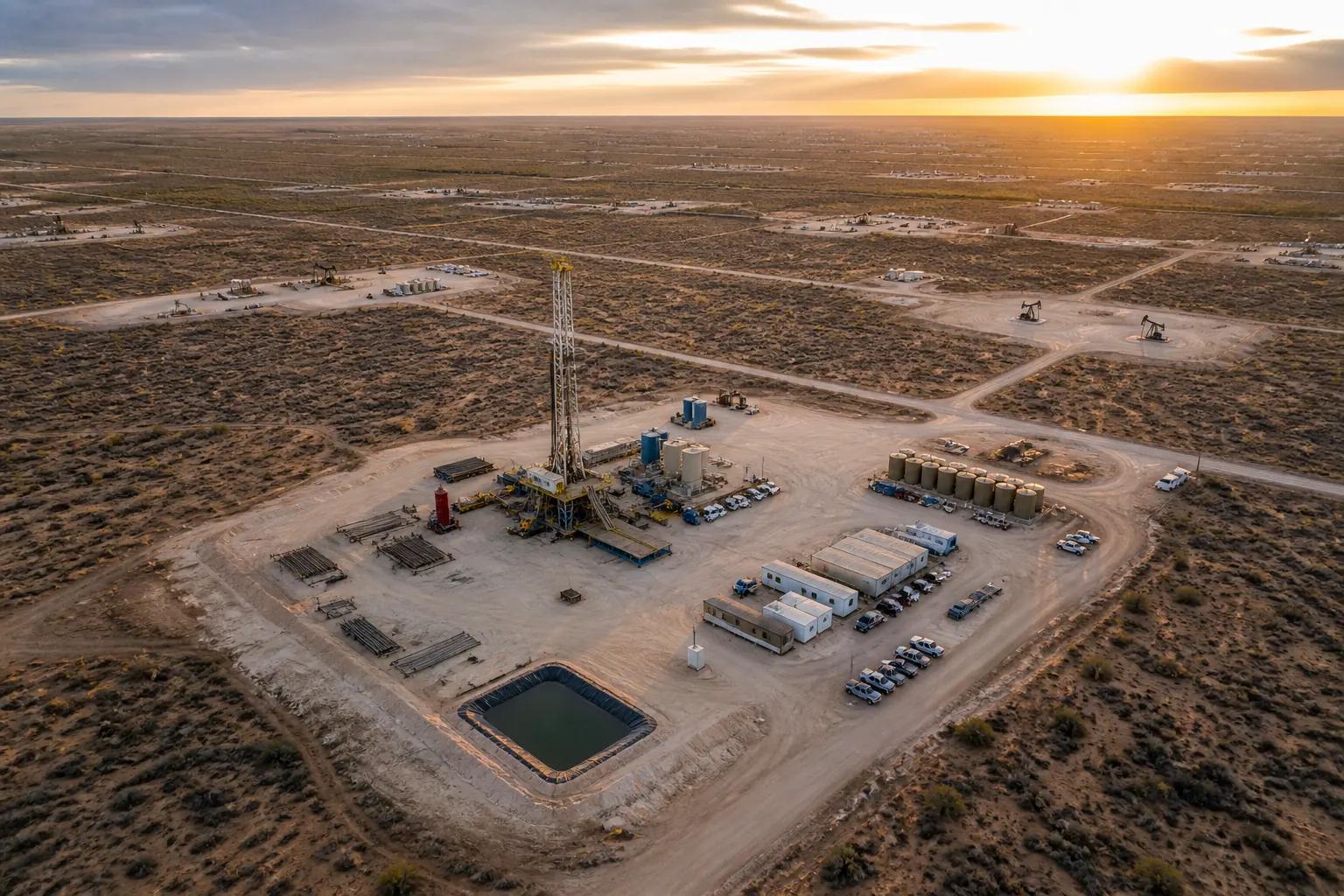
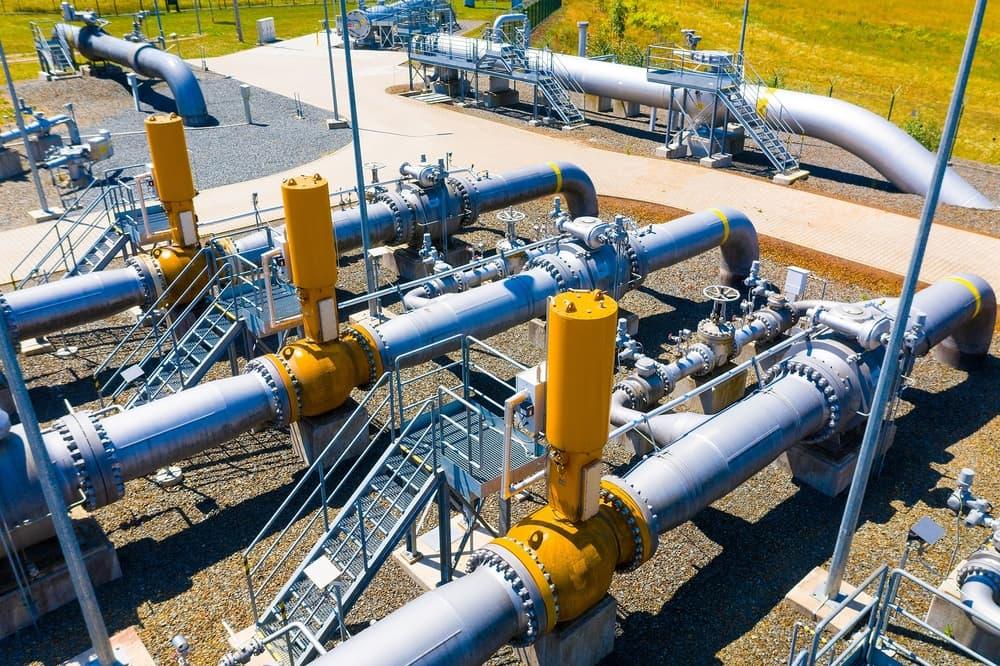
$300M at APA. $300M+ at Devon. $9.7B booked at ExxonMobil. 10% of Permian production attributed to AI at Chevron. AI is no longer a slide in the strategic plan. It is a number the CFO is being asked to defend on the quarterly call. The question for every other operator is whether the bar gets cleared on the operator's stack, or whether the company joins the roughly 70 percent still stuck in pilot purgatory.
The Bar Got Quantified in Public
For most of the last decade, "AI in oil and gas" was a tradeshow conversation. The proof points sat behind NDAs. The internal pilots were rolled into broader digital programs and never disclosed at the line-item level. The CFO had nothing to defend, because nothing was being measured at a level the investor could ask about.
That changed in the 2024 and 2025 reporting cycle. The five operators below now publish AI outcomes at a granularity the investor can underwrite. Each number is sourced to a primary disclosure. None of these are vendor claims.
Devon Energy. ChatDVN 3.0 is used daily by roughly half the company. Engineer and geoscientist productivity lift of 15 to 30 percent. 850-plus wells on autonomous artificial-lift optimization. The 2025 optimization target was raised from $200M to $300M-plus mid-year, with AI named as a core lever. Source: the Hart Energy CTO interview and the Q4 2024 earnings call summary.
ConocoPhillips. Global Digital Twin program rolled out across business units, with the Norway BU posting 80 to 90 percent reductions in select maintenance task time and 90 percent less time to locate equipment for preventive work. Source: the JPT and CIO coverage of the deployment.
APA Corporation. Palantir AIP deployed across planning, maintenance, production optimization, and contracts. The 2025 optimization target was raised from $200M to $300M, with the AI partnership extended in September 2024. Source: BusinessWire and World Oil coverage of the Palantir partnership.
Chevron. A 10 percent production increase in the Permian basin attributed to the data-driven approach. The ApEX generative AI tool was deployed for Gulf of America subsurface workflows. Source: Chevron's newsroom and the VentureBeat coverage.
ExxonMobil. $9.7B booked against a $15B-by-2027 efficiency target, with AI workflows named as a core lever. Source: the Constellation Research coverage of the company's process automation and AI program.
The pattern across all five is the same. Each operator is running a vertical AI deployment against the SCADA, EAM, production accounting, and historian data the operator already owned. None of them paused for a multi-year data lake. None of them paid for a horizontal copilot license and waited for it to figure out the operating problem on its own. The work was vertical, the data was the operator's own, and the outcomes were measured at the level the CFO needed to disclose.
What the Other 70 Percent Are Doing
The same year these five disclosures rolled into the earnings transcripts, three of the most-quoted research firms in oil and gas boardrooms published the counter-statistic. The bar exists. Most operators are not clearing it. The structural reasons keep showing up across every industry conversation.
Gartner. 30 percent of generative AI projects will be abandoned after proof of concept by the end of 2025. The agentic-AI version is worse: 40 percent of agentic-AI projects will be canceled by 2027. The model is not the problem. The data the model was asked to learn from is. Source: Gartner press releases July 2024 and June 2025.
McKinsey. Roughly 70 percent of oil and gas companies have not moved past the pilot phase. Only 17 percent of firms realize more than 75 percent of expected savings from digital programs. Source: McKinsey's industry insights on oil and gas digital transformation.
BCG. Fewer than 15 percent of oil and gas respondents say digital has meaningfully created value. The dashboard nobody opens is the most expensive code in the operator's stack. Source: BCG, "Creating Value Through Digital in Oil and Gas."
The generic-LLM trap. ChatGPT, Microsoft Copilot, and the other horizontal copilots cannot see the operator's SCADA, EAM, AFE history, reserves forecast, or historian. Asking a horizontal copilot to optimize the operation is asking it to guess. There is no published US operator failure case that names this as the proximate cause, because the failures get rolled into "the pilot was inconclusive" and shelved. The structural problem is consistent: a model that is not connected to the operator's data cannot produce field-grade decisions.
Three of those four anti-patterns are research-firm statistics. The fourth is a structural truth that every junior engineer who has pasted production data into ChatGPT will recognize. The operators clearing the bar in the section above are clearing it because they avoided all four.
Want case studies and benchmarks like these?
For upstream + midstream operations leaders. Share your work email and our team will follow up with case studies, benchmarks, and what's changing in the field.
What the Independent Sees on the Other Side of the Disclosure
Every operator below the supermajor tier is being asked the same question by the board right now: what is the operator's number against the AI bar? The honest answer for most independents is some version of "we are running a pilot." That answer was acceptable in 2023. It is not acceptable in 2026, because the supermajors have moved the bar from "is AI ready for our operation" to "what is the booked value, on what asset population, against what baseline." The independent that walks into a board meeting in late 2026 with a pilot-phase update will be benchmarked against ExxonMobil's $9.7B booked figure, fairly or not.
Here is the part that should worry the independent and excite it at the same time. AI has barely reached the trades that run oil and gas. The capability is broad, the highest of any occupation in computer and math work, but observed AI usage in engineering and production work sits near the bottom of the curve. The capability is here; the adoption is not. That means the five names above are early, not late, and the gap between them and everyone else is still widening. The supermajors crossed it by paying for bespoke internal builds; the independent that waits is letting the gap widen against it without the budget to close it later. The full third-party-cited picture of where operations sits on AI adoption shows how much of the field is still untouched.
The path forward is not to copy the supermajor playbook. The supermajors paid six to eight years of tuition to learn what worked. They built data lakes that they no longer use as the primary AI substrate. They hired chief data officers who manage organizations that are too large for an independent to fund. The lesson the independent should extract is not the architecture. It is the result. The supermajor proof points (ExxonMobil and SLB gas-lift optimization on 1,300-plus wells, ConocoPhillips PLOT on 4,500-plus wells, Devon's autonomous lift on 850-plus wells) all ran against the SCADA history the operator already owned. The independent that has the same SCADA history can run the same class of decision against it, without paying the supermajor tuition. The detailed argument lives in The Data Lake Is a 2017 Idea.
Four Use Cases That Travel from the Supermajor to the Independent
The five operator disclosures above all reduce to a small set of use cases that operate at any scale, against the data the operator already has. Each one ties back to a WorkSync product line. Each one has either a public supermajor proof point or a deployed reference at a top-25 private producer running on 5,000+ wells.
Pump-by-priority. Predictive maintenance plus autonomous artificial lift, scored by economic impact rather than fixed-interval routing. Devon's autonomous-lift program on 850-plus wells is the public proof. The same loop runs at the top-25 private producer reference deployment of WellOPS, scoring every active well overnight by revenue variance and risk, publishing the ranked list before 6 AM. The four-week pilot version of this is laid out in The 4-Week Pump-by-Priority Pilot.
Variance commentary that writes itself. The agent reads the historian, the production database, and the ledger, drafts the weekly variance commentary, and surfaces the deviation worth investigating. Devon's ChatDVN 3.0 is the public proof of the daily-use case. The independent version is the WorkSync DataHub plus the variance-commentary agent, running on the existing production accounting feed.
Engineering-hour compression. Hydraulic and facilities modeling from a multi-hundred-hour study cycle to a sub-hour iteration. FlowSync runs the engineer's own model against the calibrated network, drafts the MOC language, and cites every change back to the source document. The detailed gas utility case is in The Million-Dollar Model.
Closed-loop work management. Voice-first field capture into the system of record, every observation tagged to the well, the asset, and the cash-flow impact. The pumper's 90 minutes of post-route data entry compresses to zero, and the next day's plan reflects yesterday's actual conditions. The structural argument is in Exception-Based Surveillance.
Every one of those four use cases runs against the operator's existing data. None of them requires a multi-year data lake. None of them is a horizontal-copilot deployment. Each one is the operator's own SCADA, EAM, production accounting, and well file, surfaced to the lease operator, the dispatcher, the planning engineer, and the operations manager, in the form each one already uses.
What Clearing the Bar Looks Like on a Small-to-Mid Independent
The supermajor case studies above ran on asset bases of 850 to 4,500-plus wells. The deployed reference at the top-25 private producer on WorkSync runs across 5,000+ wells in the Western Anadarko, Permian, and Wyoming basins. The minimum viable footprint is smaller than that.
An operator with a single SCADA system, a production accounting feed, and an EAM tool has enough operating data to clear the bar on at least one of the four use cases above. The constraint at small scale is not data volume. It is the maturity of the field workflow that consumes the ranked decisions. The DataHub integration time on a typical independent stack is under one week, in read-only mode, with no rip-and-replace. The first ranked daily plan publishes inside 30 days. The first closed-loop deployment runs inside 90.
The Impact Guarantee is in writing. Pick the metric in week zero (production uplift, deferment reduction, route-time recovery, study turnaround, whichever metric the CFO will sign for). Run the loop for four weeks. If the metric moves, the operator signs the annual subscription. If it does not, the operator walks away. No license fee. No kill fee. The pilot is planned with the WorkSync implementation team.
The supermajors paid six to eight years of tuition to learn what works. The vertical-AI substrate that produced their disclosures is accessible to the 500-well independent at a fraction of the supermajor cost, without paying tuition the supermajors already paid. The question is whether the operator answers the board's AI question with a pilot update in late 2026, or with a booked outcome.
Five names cleared the bar. The math says most operators are still stuck behind it. The bar is not theoretical, the proof points are not vendor claims, and the path is no longer 18 months.
You are one week away. Start the 4-week pilot.