The oilfield is changing faster than most operators realize. AI is no longer a conference slide or a pilot project that never scaled. It is already redefining how decisions get made in the field.
The operators who adopt it first will capture 15%+ more cash flow from the same wells. They will keep crews focused on high-value tasks. They will cut wasted miles, unnecessary downtime, and rising LOE.
Those who wait will still be buried in dashboards, chasing SCADA alarms, and explaining to leadership why production keeps slipping.
The Gap Between Data and Decisions
Your ERP, SCADA, and CMMS were not built to decide what needs to be done next. They were built to report the past.
SCADA tells you what is happening right now, but not which of the 200 overnight alerts matters most. CMMS tracks work orders that someone has already created, but it cannot detect emerging problems or rank them by economic impact. Production accounting reconciles volumes 30-60 days after the fact. ERP tracks costs but has no concept of field execution.
Each system does its job. None of them answer the question your superintendent needs answered at 5:30 AM: "What should my crews work on today, in what order, and why?"
That gap between data and decisions is where most operators lose 10-15% of their operational cash flow. Not from catastrophic failures but from thousands of daily dispatch decisions made without economic context.
What AI-First Operations Actually Look Like
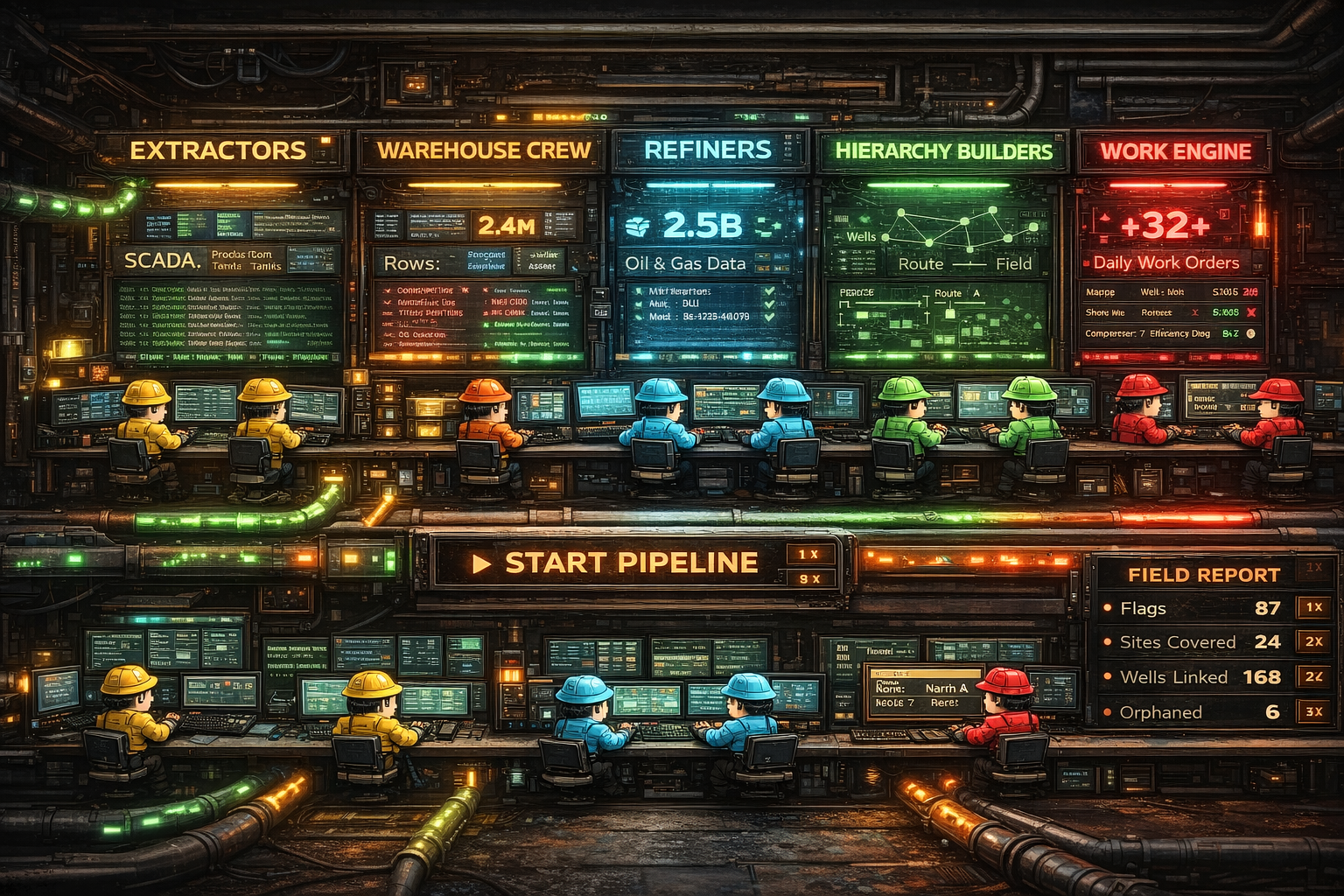
AI in the oilfield is not a chatbot answering questions about your wells. It is a system of specialized agents and purpose-built ML models that runs continuously, processing your operational data and delivering actionable output.
Continuous state estimation creates a real-time operational picture of your entire field. Every well, every piece of equipment, every crew, every active issue, all connected and updated continuously. This is not a dashboard you check. It is a living model that the agents inside WorkSync maintain.
Machine learning anomaly detection learns what "normal" looks like for each individual well. When behavior deviates from the learned baseline, the system flags it, estimates the production at risk, and scores it by dollar impact. This catches gradual declines and intermittent issues that fixed SCADA thresholds miss.
AI economic scoring converts every flagged issue into a dollar value. A rod pump showing early failure signs on a 200 BOE/day well gets a different priority than the same pattern on a 10 BOE/day stripper well. The scoring factors in production rate, commodity price, working interest, lifting cost, trend trajectory, and intervention success probability.
Constraint-based route optimization takes the scored task list and builds executable daily plans for each crew. It accounts for geography, crew qualifications, equipment requirements, and time constraints. The result is a ranked, route-optimized work plan delivered to every crew before 6 AM.
Reinforcement learning closes the loop. Every completed task feeds back into the models. Did the intervention work? Did production recover? The system learns from outcomes and adjusts future scoring accordingly. Each week, the plan gets smarter.
Want case studies and benchmarks like these?
For upstream + midstream operations leaders. Share your work email and our team will follow up with case studies, benchmarks, and what's changing in the field.
The Results Are Not Theoretical
In a live deployment across 5,000+ wells in the Western Anadarko Basin, operators using agent-driven prioritization inside WorkSync achieved:
- 15%+ free cash flow uplift from earlier anomaly detection and prioritized response
- 35% fewer site visits with higher task completion rates
- 83% reduction in TRIR (from 1.8 to 0.3) through reduced road exposure
These results came not from producing more oil but from working the right wells in the right order with better decision context.
The Wave That Has Not Happened Yet
US oil and gas has already run through three efficiency waves. Fraccing unlocked the rock. Big data and analytics raised exploration and reserves success rates. Manufacturing discipline drove down the cost per lateral foot. Every one of those waves landed in the subsurface and in drilling. Production operations never got the same treatment, and the data shows it. AI capability is broad today, the highest of any occupation in computer and math work, but observed AI usage in the trades that actually run the field sits near the bottom of the curve. The capability is here. The adoption is not. That gap is the next wave, and it is the one the operators above are stepping into first. The full third-party-cited picture of where operations sits on AI adoption makes the size of the gap plain.
The industry already has a name for the operational version of this fix: pump by exception. It struggled to stick for more than a decade outside the supermajors, because the only versions that worked were bespoke builds inside companies with internal software teams. WorkSync productized it as pump by priority. You do not need an internal AI team or an 18-month build to cross the gap; you need a productized path across it.
The Question Is Not If, But When
The industry is moving from fixed routes to exception-based to priority-based to fully intelligent operations. Most operators are stuck between era one and era two. The few who have reached era three are outperforming on every metric that matters: cash flow, safety, LOE, and crew productivity.
The transition does not require replacing your SCADA, CMMS, or ERP. WorkSync's agent pipeline connects to your existing systems, adds the intelligence layer, and delivers results within 90 days. No 18-month implementation. No data science team required.
The question is not whether your company will use AI to run the field. It is whether you will be one of the first to benefit or one of the last to catch up.
Ready to see what agent-driven field operations look like for your team? Request a walkthrough or calculate your potential ROI.