Best pump-by-priority software 2026

WellOPS, the best pump-by-priority system built for oil & gas.

Six platforms. Twelve capabilities. One honest matrix.

The capability matrix

Twelve capabilities. Six platforms. Honest scoring.

Native shine Strong Partial / Limited Not in scope

Capability
Greasebook
Mobile capture, well-loved at small scale
JOYN 2 / W Energy
Pump-by-exception pioneer (2018), now under W Energy
MuddyBoots
Task visibility + contractor scheduling
eLynx
SCADA-native production monitoring
IFS Merrick Field Operator
Enterprise field-ops + Merrick accounting
WellOPS
Pump-by-priority closed loop, statistical physics under the hood
1. Statistical physics-based well prioritization
Physics models that rank wells by risk to cash flow, environmental risk, failure risk, and personal-safety risk against the data you have, including without SCADA.
Not in scope
Capture only, no ranking model
Limited
Rules-based exception engine, not physics-based
Not in scope
Task visibility, no ranking model
Not in scope
Threshold alarms, not a ranking model
Limited
Route Surveillance exception alerts, not physics-based
Native shine
Native, the core differentiator. Works with or without SCADA
2. Work Engine (ranked daily plan in the truck cab)
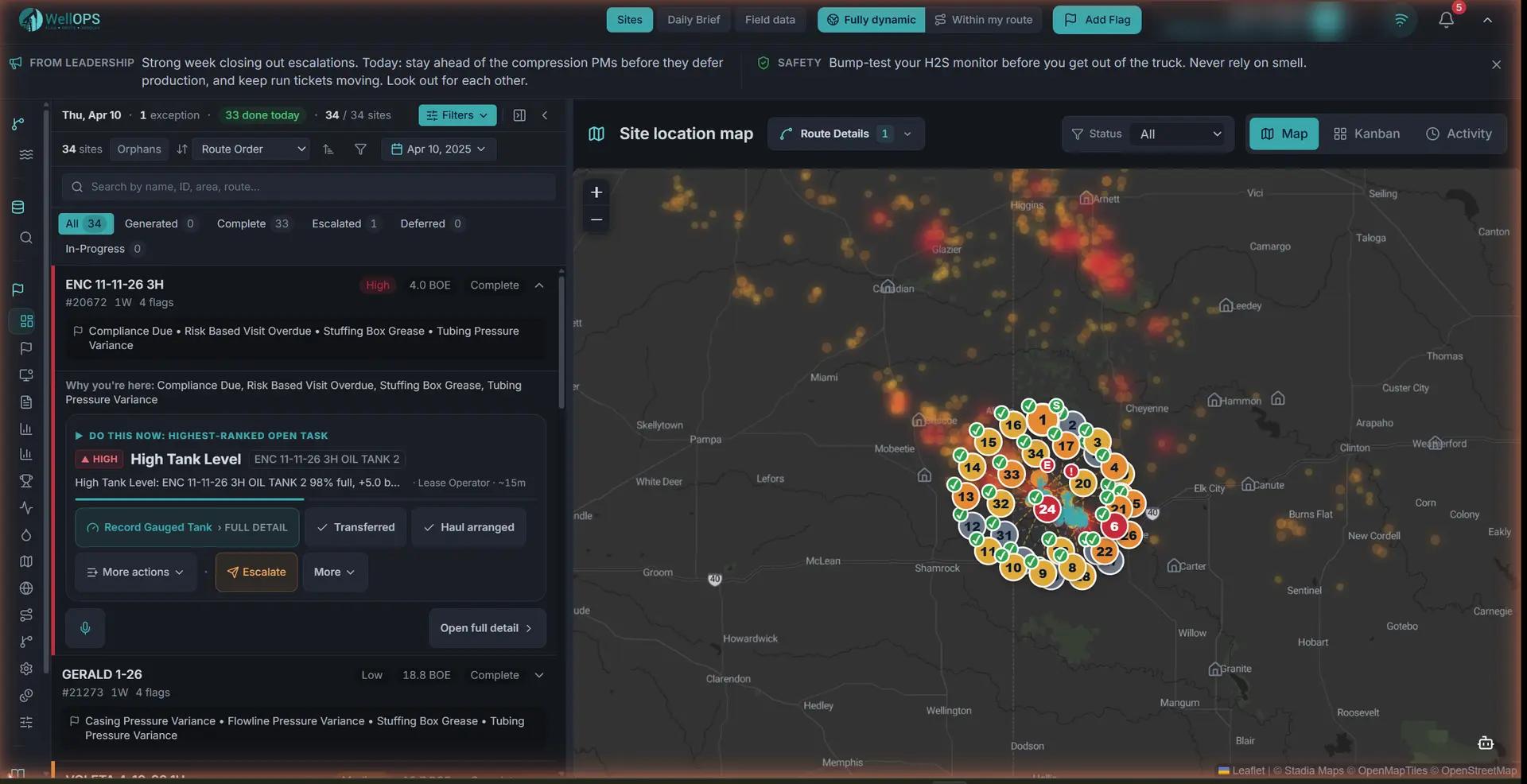
Pulls signals from every system, scores tasks by economic impact, assembles the day, and pushes the ranked plan to the truck cab by 6 AM. End-to-end closed loop.
Not in scope
Pumper sets order, no ranking
Partial
Resource-to-Task Matching Engine; not closed-loop with QA
Partial
Task scheduling and visibility
Not in scope
Dashboards, not work execution
Partial
Field Operator + Route Surveillance assemble the day
Native shine
Closed-loop ranked work, by 6 AM, every shift
3. Financial-aware ranking (dollars at risk per hour)
Every task scored by dollar impact: production at risk, commodity price, working interest, lifting cost, intervention payback. Highest-dollar problems surface first.
Not in scope
No economic scoring layer
Limited
Priority weighting, not full financial scoring
Not in scope
No financial scoring
Not in scope
No financial scoring
Limited
Indirect via accounting integration with Merrick
Native shine
Native, every task ranked in dollars
4. Site-specific risk model (per-asset hazard profile)
A risk profile per pad, per battery, per well: environmental exposure, regulatory windows, equipment vintage, operating envelope, basin rules. Not a one-size-fits-all alarm.
Not in scope
No risk model
Limited
Resource-skill matching, not asset-risk profile
Limited
BLM and D17 compliance metadata
Limited
Threshold alarms per asset
Partial
Asset-level risk fields if configured
Native shine
Per-pad, per-battery, per-well, kept current
5. Risk profile by task (JSA-gated dispatch, OQ enforcement)
Every dispatch scored by hazard, qualification, weather, contractor compliance, basin-specific rules. Hard constraints, not weights. The unqualified worker cannot be dispatched.
Not in scope
No safety enforcement layer
Limited
Skill-matching for resource assignment
Partial
Contractor scheduling, no JSA enforcement
Not in scope
Not in scope
Partial
Workflow-level qualification checks
Native shine
Hard-constraint enforcement at dispatch in WellOPS Field Work Management
6. End-to-end equipment management (predictive maintenance + work orders + workover ranking)
Anomaly detection 48 to 72 hours before failure on rod pumps, ESPs, compressors, valves, instrumentation. Workover ranking on cost-of-failure × probability × intervention payback. Same data layer as Operations.
Not in scope
No predictive maintenance
Partial
Workflow-based maintenance task tracking
Partial
Preventative-maintenance scheduling and tracking
Limited
Alarm-based equipment status, no predictive layer
Strong
Enterprise EAM heritage, work orders + maintenance
Native shine
Predictive + ranked + integrated with the work loop
7. Mobile field data capture (offline-first)
Gauges, downtime codes, run tickets, well tests, photos, e-signatures, JSAs, hazard observations. Mobile-first, offline-capable, voice-enabled.
Native shine
Best-in-class for the segment, well-loved by pumpers
Strong
Mobile-first, well-built
Strong
Offline access, task-focused
Partial
Mobile dashboard, lighter on capture
Strong
Field Operator + geospatial
Strong
Equally capable; same scope as Greasebook in the Field Data Capture module
8. Route optimization with crew qualifications
Constraint-based optimization on geography, crew skills, equipment, weather, and value-density. Re-optimizes mid-shift when conditions change.
Not in scope
Pumper or supervisor sets the route
Partial
Resource-to-Task Matching, geography-aware
Partial
Schedule and assign tasks
Not in scope
Not in scope
Strong
Field Service Management routing
Native shine
Value-density routing with hard-constraint OQ enforcement
9. SCADA integration (when present)
Native read-only ingestion from major SCADA / historian platforms. Required by some legacy pump-by-priority tools; optional for WellOPS.
Not in scope
Capture is manual; no SCADA layer
Strong
Native SCADA ingestion (legacy)
Strong
Pulls from SCADA for trending
Native shine
SCADA-native, this is their core
Strong
Merrick + Field Operator native ingest
Strong
40+ pre-built integrations (Ignition, AVEVA PI, Cygnet, eLynX, Emerson). Optional, not required
10. Production accounting integration
Bi-directional integration with the operator's accounting system: production volumes, allocations, downtime codes, AFE workflows.
Partial
Exports to Enertia, Quorum, QuickBooks
Strong
W Energy stack native after acquisition
Partial
Data export to well programs
Limited
Lighter on accounting integration
Native shine
Merrick is the heritage strength
Strong
Native to Enertia, Quorum, Pak, IFS Merrick, W Energy, WolfePak, Oildex
11. Closed-loop AI with QA discipline (drift detection, audit trail, honest hand-off)
The agent stays honest: constraint enforcement, confidence-aware routing, drift detection, outcome feedback, audit trail drillable to source, honest hand-off on exceptions.
Not in scope
Capture app, no agent layer
Limited
AI/ML rules engine (2018-era), not closed-loop with QA
Not in scope
Visibility tool, no agent layer
Not in scope
Monitoring tool, no agent layer
Limited
Exception-based workflow, not agentic with QA
Native shine
Six-element QA discipline native to the platform
12. Pricing tier
Approximate annual price band for a 1,000-well operator (varies by configuration, integrations, and term).
Strong
Per-well subscription, mid-tier-friendly
Partial
W Energy stack pricing, enterprise tier
Strong
Mid-tier-friendly, contractor scheduling included
Strong
SCADA-services pricing, plan-tiered
Limited
Enterprise tier, $200K-$1M+ all-in
Strong
$20K to $95K per year per module, Data Hub free for integration

Scoring reflects what each platform delivers natively. We do not penalize a vendor for being out-of-scope on a capability they were never built for; we just say so. If we got something wrong about a competitor, tell us. We will fix it.

Curious how WellOPS earns the “native shine” on the first two rows? See how the statistical physics filter works →

How it works · the statistical physics filter

The model under the Work Engine. Why WellOPS ranks before it dispatches.

The matrix above shows where WellOPS shines. This section shows why. Every other platform in the comparison is a workflow tool wrapped around a threshold alarm or a rule engine. WellOPS runs a statistical physics filter, the same class of math used in reservoir surveillance and process control, applied to your whole field every shift. It is what lets us rank wells with or without SCADA, and what lets the Work Engine put a defensible plan in the truck cab by 6 AM.

The pipeline, end to end

  1. 01
    Ingest
    Production accounting, SCADA / historian, run tickets, manual gauges, lease files, weather, commodity strip. Whatever you have.
  2. 02
    Reconcile
    Material-balance and energy-balance checks across sources. Disagreements get scored, not silently averaged.
  3. 03
    Estimate
    Bayesian state estimation infers what is happening at each well, even where the sensor is missing. Confidence interval per estimate.
  4. 04
    Score
    Four risk axes: cash flow, environmental, failure, personal safety. Combined into a per-task expected dollar impact.
  5. 05
    Rank
    The Work Engine assembles the day. Highest expected dollar impact first, hard safety constraints enforced.

The four risk axes the filter scores, in detail.

Every well, every shift, gets a vector of four numbers. Each number is an expected dollar impact per hour over a defined recovery window. The Work Engine maximizes the sum subject to crew, qualification, weather, and basin constraints.

01 · Cash flow risk

Deferred production, weighted by netback.

Decline curves, type curves, and lift physics estimate the gap between observed rate and expected rate. The gap times working interest, times realized price net of LOE, gives the deferred-production dollar rate at risk per well per hour.

Inputs

Daily allocations, type curve, lift physics state, working interest, realized price, lifting cost, intervention payback window.

02 · Environmental risk

Spill, emissions, and regulatory exposure, in dollars.

Tank-level dynamics, vapor-recovery state, flare permit limits, and basin-specific rules (Texas RRC Chapter 4, Colorado ECMC, North Dakota gas-capture). Probability of breach times expected fine, cleanup, and downtime cost.

Inputs

Tank gauge cadence, secondary containment status, flare permit headroom, weather forecast, basin regulatory calendar, prior incidents at the site.

03 · Failure risk

Time-to-failure on the equipment, not the alarm.

Survival models on rod pumps, ESPs, plungers, compressors, and instrumentation. Anomaly detection 48 to 72 hours ahead of nominal failure. Probability of failure times the cost of a reactive workover (deferred barrels, premium crew, expedited parts) versus a planned one.

Inputs

Run time since install, dyna-card / amp-card signatures, vibration spectra, temperature drift, prior failure history, vendor reliability priors.

04 · Personal-safety risk

Lone-worker exposure, qualification gaps, weather windows.

Scored as a hard constraint, not a weight. Unqualified worker cannot be dispatched to the unsafe job. The filter routes the work to a qualified crew when one exists, defers the work when none does, and surfaces the qualification gap to ops leadership when the deferral keeps repeating.

Inputs

Crew qualifications, contractor compliance, lone-worker status, weather forecast, hazard class of the task, basin-specific PPE rules.

Why we call it a statistical physics filter, not a rule engine

Three properties no rules-based system has.

Property 01

Conservation laws are enforced.

Mass and energy balance across the well, the gathering line, the battery, and the LACT. If your accounting and your SCADA disagree, the filter does not pick a side; it reports the residual and ranks where to investigate. Rule engines silently average.

Property 02

Estimates carry uncertainty.

Every rate, every pressure, every state estimate is paired with a confidence interval derived from the data you actually have. A wide interval routes the rank toward action; a tight one supports a confident defer. Threshold alarms have no such concept.

Property 03

Missing data is a first-class case.

No SCADA on a battery is a known unknown, not an exclusion. The filter ranks the well using lift physics, type-curve priors, and run-ticket cadence, and recommends where SCADA investment would pay back fastest. Rule engines need the sensor first.

What it produces

A ranked daily plan in the truck cab. Not a dashboard.

The Work Engine consumes the filter output, the available crews and their qualifications, the route topology, and the weather, and writes the day. Every line item is a dispatchable task with an expected dollar impact, a hazard class, and a defensible reason it is on the list.

  • Top of the list: the well or the failure-risk signal with the highest expected dollar impact per hour, qualification-cleared.
  • Each task carries: well ID, expected $/hr at risk, the axis driving it, the crew qualification required, the route slot.
  • Each task carries a why: the residual that flagged it, the survival-model alarm, the regulatory window closing, the contractor cert expiring.
  • Operator can override. Override gets logged. The model learns from the override pattern (within QA gates) for next shift.
  • Closeout in the field, offline-capable. The closure feeds the next-day filter. Closed loop, every shift.
  • Reconciliation against the accounting system monthly. Recovered barrels and avoided cost are a defensible number, not a slide.

Where each one shines

One paragraph per platform. Honest read.

The matrix is the analytical view. This is the buyer’s view. If you are evaluating any of these tools, this is the quick read on which one fits which operator profile.

Greasebook

The right call for small independent operators (under 200-300 wells, simple ops, paper-or-Excel baseline) where the binding need is "get gauges off paper into a phone." Pumpers love it. We respect what they built and acknowledge it directly.

JOYN 2 / W Energy

Defined the pump-by-exception category in 2018 with a strong rules engine and mobile-first oilfield design. Now part of W Energy after the May 2022 acquisition, with the brand de-prioritized. Operators on JOYN 2 are exactly the buyers shopping for the next generation. Our positioning vs JOYN: same purpose, more under the hood.

MuddyBoots

Strong on task visibility, contractor scheduling, and BLM/D17 compliance. The right fit for operators whose primary pain is "I need to see what is happening across my contractors and crews" rather than "I need to rank what should happen next."

eLynx

SCADA-native and excellent at it. The right tool when SCADA telemetry, real-time dashboards, and remote control of artificial-lift parameters is the primary need. Many WellOPS customers run eLynx as their SCADA layer; the two coexist.

IFS Merrick Field Operator

Enterprise-grade field operations integrated with Merrick production accounting. Strong for large operators already in the IFS stack who want a single-vendor field+accounting solution. Heavy implementation, multi-quarter rollout, enterprise pricing tier. Different buyer profile from WellOPS.

WellOPS

The pump-by-priority closed-loop platform for mid-tier US operators. Statistical physics-based well prioritization that works with or without SCADA. Financial-aware ranking, site-specific risk models, JSA-gated dispatch, predictive maintenance, and Work Engine that puts it on one ranked daily plan in the truck cab. Same price band as Greasebook and JOYN. More under the hood.

Where WellOPS uniquely shines

Six capabilities the rest of the field does not deliver natively.

All six are native to WellOPS. None of the other five platforms in this comparison delivers all six. None delivers the first one (statistical physics-based prioritization) natively at all.

01 · Statistical physics-based prioritization

The model under the hood. Ranks wells by risk to cash flow, environmental risk, failure risk, and personal-safety risk against whatever data you have. Works with or without SCADA. Recommends where SCADA investment would pay back fastest if it is not in place. This is what makes WellOPS pump-by-priority rather than pump-by-exception.

02 · Work Engine

The brain that decides what your field does today. Pulls signals from every system, assembles the ranked plan, and puts it in the truck cab by 6 AM. End-to-end closed loop with the QA discipline that keeps the agent honest.

03 · Financial-aware ranking

Every task scored by dollar impact: production at risk, commodity price, working interest, lifting cost, intervention payback. The highest-dollar problems surface first, every shift. Most platforms in this matrix have priority weighting; WellOPS has full economic scoring.

04 · Site-specific risk model

A risk profile per pad, per battery, per well: environmental exposure, regulatory windows, equipment vintage, operating envelope, basin rules. Kept current as conditions change. Not a one-size-fits-all alarm threshold.

05 · Risk profile by task

Every dispatch scored by hazard, qualification, weather, contractor compliance, basin-specific rules. Hard constraints, not weights. The unqualified worker cannot be dispatched to the unsafe job. Lives in WellOPS Field Work Management alongside the work-order layer.

06 · End-to-end equipment management

Anomaly detection 48 to 72 hours before failure on rod pumps, ESPs, compressors, valves, instrumentation. Workover ranking on cost-of-failure × probability × intervention payback. Same data layer, same ranked queue as Operations. Maintenance does not run in a separate CMMS that does not talk to the dispatch loop.

Same price band as Greasebook and JOYN. A whole lot more under the hood. Graduate to WellOPS.

Common questions

Is this comparison fair?

We tried to make it fair. Where Greasebook, JOYN 2, MuddyBoots, eLynx, and IFS genuinely shine, we say so. Where each one stops, we say so. WellOPS shines on the six capabilities the rest of the field does not deliver natively: statistical physics-based prioritization, the Work Engine, financial-aware ranking, site-specific risk model, risk profile by task, and end-to-end equipment management. If you are evaluating any of these tools, the comparison should help you pick the right one for your operation, not just the one we sell.

Why do you compete directly with Greasebook? They serve a different segment.

Mostly true historically; less true now. Greasebook is excellent for very small independents (under 200 to 300 wells) and we acknowledge that on the head-to-head comparison page. From roughly 200 wells up, the buyer is asking a bigger question than data capture: which wells should we visit tomorrow, ranked by dollar impact and risk. WellOPS competes head-on at the same price band Greasebook charges per well, with broader scope. Most operators who graduate from Greasebook do so because they need ranking, not just capture.

How do you compare to JOYN 2 / W Energy specifically?

Same purpose, more under the hood. JOYN 2 invented pump-by-exception in 2018. WellOPS is pump-by-priority: physics-based ranking on cash flow risk + environmental risk + failure risk + personal-safety risk, end-to-end closed loop with the QA discipline that keeps the agent honest. We work with or without SCADA. The detailed JOYN 2 head-to-head is in the works.

Does WellOPS actually work without SCADA?

Yes. The statistical physics models rank wells against whatever data you have, manual gauges, run tickets, accounting, lease files, partial SCADA, full SCADA, or any combination. If SCADA is in place, the models are sharper. If it is not, the same models recommend where SCADA investment would pay back fastest. Most legacy pump-by-priority tools (including JOYN 2 and eLynx-paired stacks) require SCADA as a hard prerequisite. WellOPS does not.

What does "pump by priority" actually mean?

Pump by priority is the next generation of pump-by-exception. Pump-by-exception flags problems when sensor thresholds breach. Pump-by-priority ranks every flagged issue (and every scheduled task, and every failure-risk signal) by financial impact and risk, so operators address the highest-value work first rather than treating every alarm equally. WellOPS is the only platform we know of that takes pump-by-priority all the way to a closed-loop automated workflow with the QA discipline to keep the model honest.

How do I get started with WellOPS?

Request a free trial. We run a 4-week pilot at no license cost. Pick the operating metric that matters (cash flow per BOE, OPEX per well, TRIR, drive miles, deferred-production capture). If the number does not move in 4 weeks, you owe nothing. Most pilots produce a first reconcilable ranked plan in the truck cab inside 30 days.

Ready to graduate

Pick the metric that matters. Run a 4-week pilot at no license cost.

We deploy WellOPS on top of whatever data you have. The statistical physics models score wells by cash flow, risk, and safety. The Work Engine puts the ranked plan in the truck cab by 6 AM. If your number does not move in 4 weeks, you owe nothing.

24-hour reply · 4-week pilot · walk-away discipline