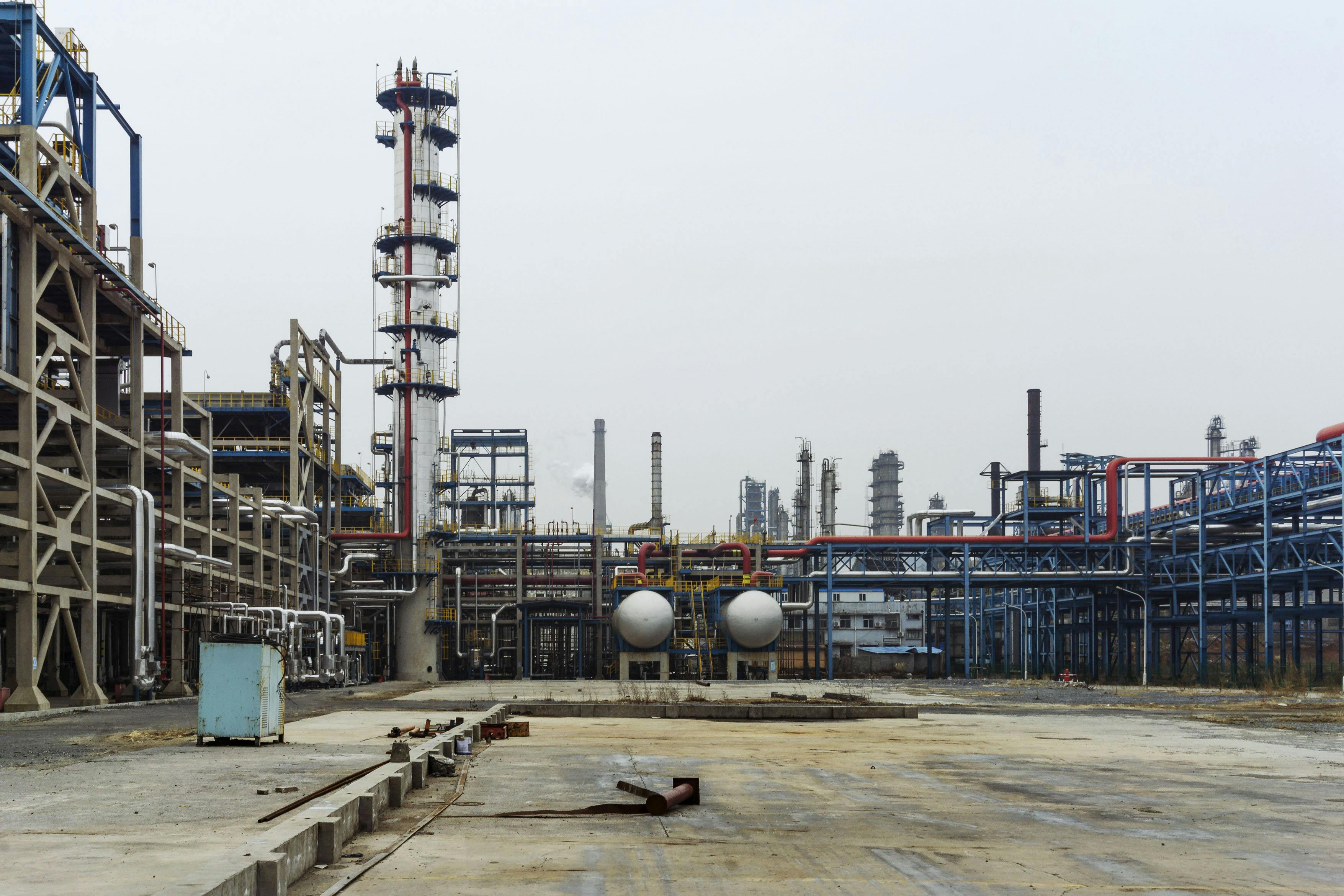
Models That Took Months and Cost Tens of Thousands of Dollars — Built in Minutes.
FlowSync automates the creation, calibration, and maintenance of hydraulic and process engineering models — massive networks with tens of thousands of nodes, ingested directly from GIS, SCADA, engineering drawings, and enterprise systems, delivered as simulator-ready outputs in minutes instead of months.
Born From the Problem It Solves
FlowSync didn’t start in a lab. It started in the field.
Our founders spent years building hydraulic models by hand for pipeline operators and utilities — massive models with tens of thousands of nodes spanning entire transmission and distribution networks. A single model took 200+ hours of manual work. At $20,000+ per engagement, operators were paying consultants every time they needed an engineering analysis, and still waiting weeks for results.
Then one client looked at their network and said: “We need 13 more models just like this one.”
Thirteen models. At 200 hours each. That’s 2,600 hours of manual engineering — over a full year of work for a single person. The math was obvious. Instead of building a bigger team to do the same manual work faster, we asked a different question: What if we built a tool that generates the model in minutes instead of months?
So we did. We took nine years of hydraulic modeling expertise, combined it with modern data engineering and AI, and built FlowSync. Models that once cost tens of thousands of dollars and took months to deliver now build in minutes. The same fidelity. The same accuracy. A fraction of the time.
The Engineering Time Tax Is Costing You Millions
Every hydraulic model your team builds follows the same painful cycle: export GIS data, re-key network topology into simulation software, manually assign pipe properties and fluid compositions, import operating data from SCADA, run trial-and-error calibration, and hope the model is still valid by the time you finish.
A single model build takes 200+ hours. Massive models can take months and cost tens of thousands of dollars. By the time they’re ready, business conditions have already changed. Your engineers — the most expensive, hardest-to-replace people in your organization — spend 60–80% of their time on data preparation instead of actual analysis.
The result: stale models, limited scenario coverage, slow commercial response times, and engineering bottlenecks that directly impact revenue capture. One engineer who knows the models. One person the whole company depends on. And when they need a new analysis, everyone waits.
FlowSync Eliminates the Bottleneck Entirely
FlowSync connects directly to your authoritative data sources, auto-builds the hydraulic model, continuously calibrates it against live operating conditions, and generates simulator-ready outputs for any platform. Engineers skip straight to validation and analysis.
Auto-Extract Network Topology
Reads network structure directly from GIS. No manual digitization. Pipe segments, diameters, lengths, materials, elevations, and connectivity are extracted automatically and validated against engineering drawings.
Auto-Ingest Operational Data
Connects to SCADA for live pressures, flows, and temperatures. Pulls demand profiles from production accounting. Imports equipment specifications from engineering drawings and supplier datasheets. All data streams are reconciled automatically.
Auto-Tune Hydraulic Parameters
ML-driven calibration engine matches model behavior to observed conditions — replacing weeks of trial-and-error with automated optimization. Friction factors, heat transfer coefficients, and fluid properties are tuned continuously against measured data.
Generate Simulator-Ready Outputs
Exports in native format for 15+ simulation platforms. Engineers open the model in their preferred tool and begin analysis immediately. No re-keying, no format translation, no data loss.
Four Authoritative Data Sources. One Unified Engineering Model.
FlowSync connects to the systems you already use — GIS, SCADA, engineering drawings, and enterprise platforms — and synthesizes them into a continuously updated, simulator-ready hydraulic model.
GIS (Network Topology)
Auto-extracts pipe network structure, diameters, lengths, materials, elevations, and connectivity from your GIS platform. Supports ArcGIS, QGIS, and custom geodatabases.
SCADA (Live Operating Data)
Connects to your SCADA/historian for live pressures, flows, temperatures, and equipment status. Supports OSIsoft PI, Aveva Historian, Honeywell PHD, Emerson DeltaV, Siemens WinCC, and standard OPC-UA/DA interfaces.
Engineering Drawings
NEWAI-powered ingestion of P&IDs, PFDs, isometric drawings, and equipment datasheets. Five specialized AI agents work in concert to extract equipment specifications, trace connectivity, and reconcile design-basis data against operational reality.
5 Specialized AI Agents:
Enterprise Systems (Demand & Context)
Integrates with production accounting, CMMS, ERP (SAP, Oracle), and supply chain platforms to pull demand profiles, maintenance history, and equipment inventory. Leverages WorkSync’s existing 40+ validated system connectors.
From Gathering Lines to Distribution Networks — FlowSync Models It All
Multiphase Flow
Gas, liquid, and multiphase flow behavior in gathering systems, transmission pipelines, and processing facilities. Accurate phase behavior modeling under varying pressure and temperature conditions.
Pipeline Hydraulics
Pressure drop, velocity profiles, and flow distribution across complex branched and looped network topologies. Identifies constraints, bottlenecks, and capacity limits automatically.
Compressor Modeling
Compressor performance curves, fuel consumption, station optimization, and surge analysis. Imports compressor maps directly from engineering drawings and manufacturer datasheets.
Facility Throughput
Processing plant and facility capacity analysis under varying inlet conditions, seasonal demand, and equipment availability scenarios.
Scenario Modeling
What-if analysis for expansion planning, new connections, contingency assessment, and regulatory compliance. Where you used to run 2–3 scenarios per quarter, FlowSync enables 100+.
Distribution Networks
Seasonal demand modeling, pressure management, supply disruption scenarios, and system resilience analysis for gas and water distribution systems.
Five Ways FlowSync Transforms Engineering Workflows
The Problem
Load studies evaluate whether a pipeline system can handle proposed new connections or increased throughput. Each study requires manual model rebuilds taking days to weeks, limiting operators to a handful of scenarios when they need dozens.
How FlowSync Solves It
Auto-ingest current system state from SCADA, overlay proposed changes from engineering drawings and commercial requests, auto-tune to observed conditions, and batch-generate 100+ load scenarios. Export simulator-ready files for Synergi, SPS, AFT, or any other platform.
AI Enhancement
ML-based sensitivity analysis identifies the load scenarios most likely to reveal constraints, prioritizing which scenarios to run first. The system learns over time which analyses yield the most actionable insights.
The Problem
When commercial teams receive requests for new connections or volume commitments, they need engineering analysis to validate feasibility and cost. Slow turnaround from engineering creates a bottleneck that directly impacts revenue capture.
How FlowSync Solves It
Instant access to an always-current hydraulic model means commercial teams can request what-if analysis and receive results in hours, not weeks. FlowSync auto-generates the base model from live SCADA/GIS data, overlays proposed deal parameters, and delivers a feasibility assessment.
AI Enhancement
AI Economic Scoring (proven in the OPS platform across 4,000+ wells) ranks proposed deals by net cash flow impact, factoring in capital required, operational constraints, and system utilization.
The Problem
Long-range planning requires understanding how pipeline capacity, compression, and processing assets will perform under future demand scenarios. Manual modeling means planners work with outdated snapshots rather than dynamic analysis.
How FlowSync Solves It
Continuous model updates from SCADA and GIS keep the system model synchronized with operational reality. FlowSync generates planning horizon scenarios (1-year, 3-year, 5-year) with parametric variations in demand growth, supply mix, and infrastructure additions.
AI Enhancement
Predictive demand modeling using ML trained on historical SCADA patterns and external market signals. Anomaly detection identifies emerging bottlenecks before they become constraints.
The Problem
True digital twins require a continuously updated virtual replica of the physical system. Current enterprise approaches require 12–18 month deployments, multi-million dollar budgets, and still depend on manual model maintenance.
How FlowSync Solves It
FlowSync provides the rapid on-ramp to digital twin value. By continuously syncing GIS topology, SCADA operating data, and engineering drawing specifications, FlowSync maintains a living hydraulic model. POC live in 2 weeks. ROI in under 6 months.
AI Enhancement
ML anomaly detection (proven in OPS across 4,000+ wells) identifies deviations from normal hydraulic behavior in real-time. AI Data QA detects sensor drift, stuck values, and bad readings before they corrupt model accuracy.
The Problem
Engineering studies for system modifications, new construction, or regulatory compliance require detailed analysis of specific subsystems. Each study starts from scratch because previous models are outdated.
How FlowSync Solves It
Engineers start from an always-current base model and scope their study to the relevant subsystem. FlowSync auto-extracts equipment details from engineering drawings — pump curves, valve data, compressor maps — and generates simulator-ready files.
AI Enhancement
Drawing interpretation agents automatically parse engineering drawings to extract equipment parameters and map them to simulator inputs. The system learns which drawing elements correspond to which simulator parameters, improving accuracy with each study.
Simulator-Agnostic. Exports to Every Major Platform.
FlowSync is not a simulator — it’s the automation layer that feeds every simulator. We generate native-format outputs so your engineers work in the tools they already know.










Pipeline & Network Simulation
Synergi Pipeline Simulator (SPS) · DNV Synergi Gas · Emerson Pipeline Manager · AFT Fathom · AFT Arrow · AFT Impulse · OLGA (Schlumberger) · PipeSim (Schlumberger) · Stoner (Enverus) · FluidFlow (Flite Software) · Pipenet (Sunrise Systems) · EPANET (EPA/Open Source)
Process & Facility Simulation
Aspen HYSYS · Aspen Plus · UniSim Design (Honeywell) · ProMax (Bryan Research) · Petro-SIM (KBC/Yokogawa) · CHEMCAD (Chemstations) · PRO/II (Aveva) · WinSim (Design II) · gPROMS (Siemens)
Water & Wastewater
EPANET · WaterGEMS (Bentley) · InfoWater Pro (Autodesk/Innovyze) · MIKE+ (DHI) · Pipe2 (KYPipe) · WaterCAD (Bentley) · HAMMER (Bentley) · SewerGEMS (Bentley)
Multiphase Flow
OLGA · LedaFlow (Kongsberg) · PipeSim
Mechanical & Stress
CAESAR II · AutoPIPE (Bentley)
CFD & Specialized
ANSYS Fluent · OpenFOAM · COMSOL Multiphysics · Simcenter STAR-CCM+ (Siemens)
AI That’s Proven in Production — Not a Science Project
FlowSync’s AI capabilities are built on the same architecture proven in WorkSync’s OPS platform across 4,000+ wells over 18 months of live operations.
Deployed Today
ML Anomaly Detection
Per-asset models that learn normal operating patterns for every pipeline segment, compressor station, and processing facility. Catches the subtle deviations that fixed thresholds miss.
AI Data QA
Automated detection of sensor drift, stuck values, and bad readings in SCADA feeds before they corrupt model inputs. Your models stay accurate without manual data cleaning.
Auto-Tuning Engine
ML-driven parameter calibration that matches model behavior to observed conditions continuously. Replaces weeks of manual trial-and-error with automated optimization.
Scenario Intelligence
ML-based sensitivity analysis that identifies the most informative scenarios to run, maximizing insight per simulation cycle.
Coming Next
Engineering Drawing Ingestion
Computer vision and NLP agents for P&ID parsing, symbol recognition, equipment spec extraction, and automated reconciliation against GIS and SCADA data.
Natural Language Query
Engineers ask questions in plain English (“What happens if we add 50 MMcf/d at the Midland interconnect?”) and FlowSync configures and runs the analysis automatically.
Cross-System Reconciliation
Automated conflict detection and resolution between GIS, SCADA, engineering drawings, and model state. No more manual data audits.
Intelligent Scenario Generation
AI that learns from historical analyses to suggest the most valuable scenarios for each use case, based on which past analyses yielded the most actionable insights.
Future Vision — Agentic Engineering Analysis
The long-term roadmap is a multi-agent AI system where specialized agents autonomously handle the full engineering analysis lifecycle — from interpreting engineering intent to constructing models to orchestrating simulations to generating reviewable reports. This architecture doesn’t replace engineers. It amplifies them. Engineers shift from data wrangling to decision-making.
Purpose-Built for the Industries That Move What Matters
Midstream Oil & Gas
Pipeline hydraulics, compressor performance, capacity planning, flow assurance, gas quality tracking, and NGL pipeline analysis. FlowSync supports the full midstream workflow from gathering systems through transmission and processing — including post-acquisition integration of acquired pipeline networks.
We Automate Steps 1–6. Your Engineers Start at Step 7.
Building a hydraulic model has always had 8 steps. FlowSync automates the first 6 completely. With engineering drawing ingestion, it also auto-extracts equipment specifications, control logic, and design-basis parameters that engineers previously looked up manually.
Export GIS data
Digitize network topology
Assign pipe properties and materials
Define fluid compositions
Import operating data from SCADA
Calibrate parameters against measured data
Validate model against known conditions
Run analysis and interpret results
Your engineers start at step 7 — validation and analysis. The work that actually requires their judgment, expertise, and experience.
Results That Speak for Themselves
Metric
Before FlowSync
With FlowSync
Proven across the WorkSync platform
From Analysis to Action — Connected to Your Supply Chain
FlowSync extends beyond analysis into operational execution. When an engineering study identifies the need for new equipment, FlowSync’s equipment spec extraction from engineering drawings directly feeds procurement workflows.
Auto-extracted specifications from P&IDs and datasheets map to vendor catalogs and inventory databases. Hydraulic analysis results identify performance requirements that constrain equipment selection. Integration with SAP, Oracle, and asset management platforms ensures that specified equipment is available and correctly rated.
This transforms FlowSync from an engineering analysis tool into a comprehensive asset management accelerator — connecting analytical insight to operational execution.
FlowSync in Action
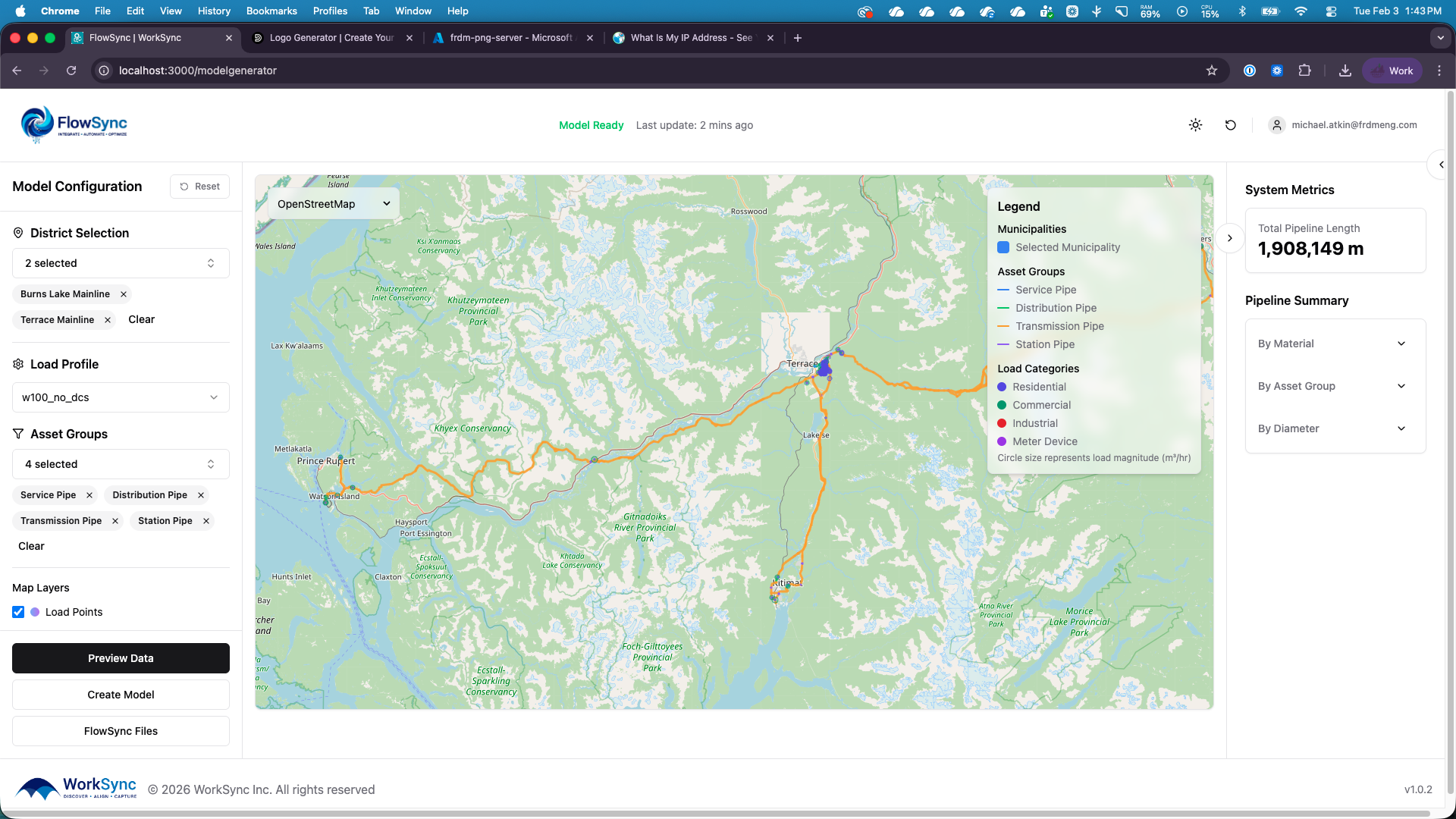
Auto-built infrastructure models from live data — no manual digitization, no stale spreadsheets.
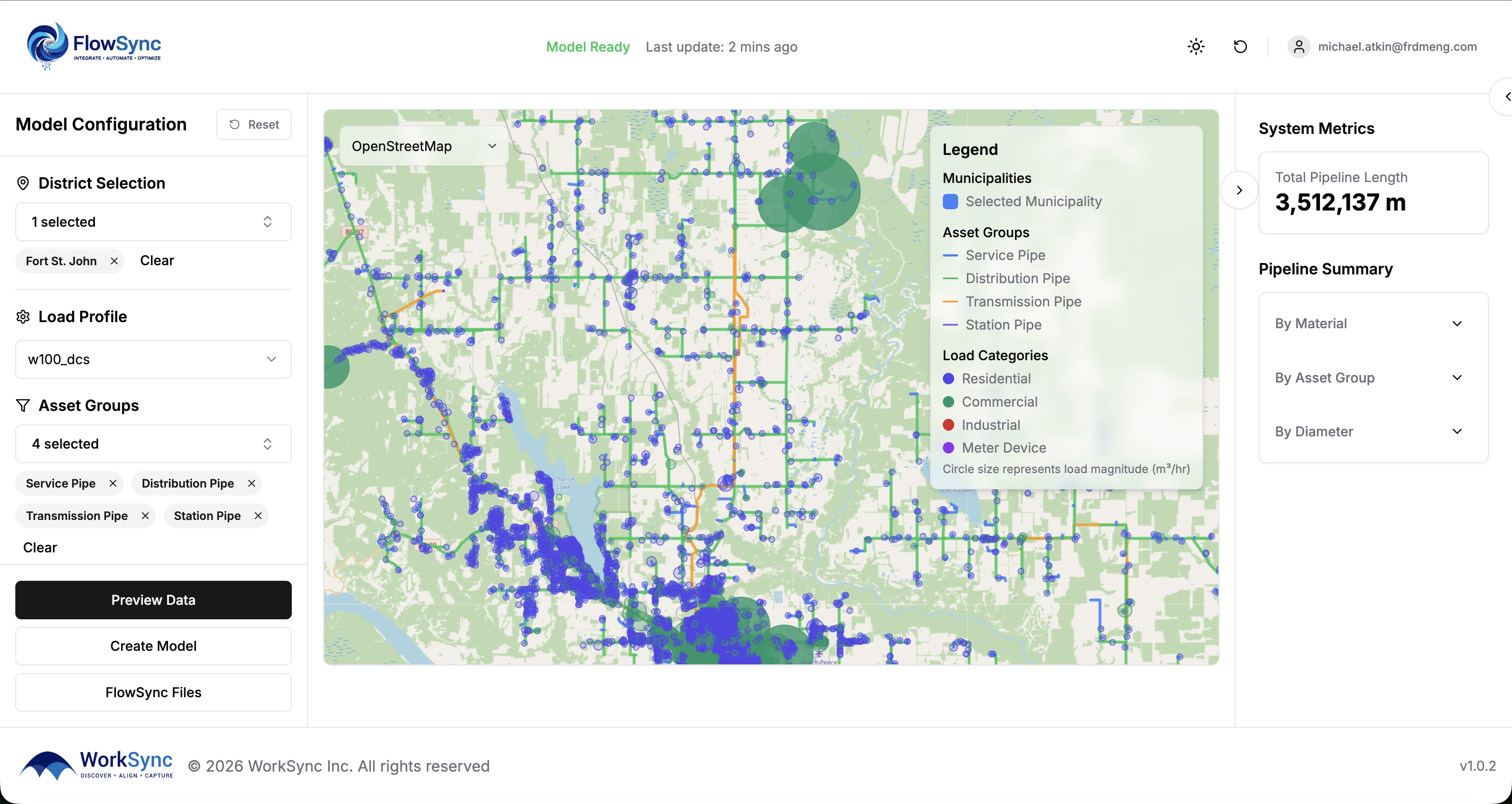
Full System Overview
3.5 million meters of pipeline infrastructure — auto-modeled from GIS and SCADA data.
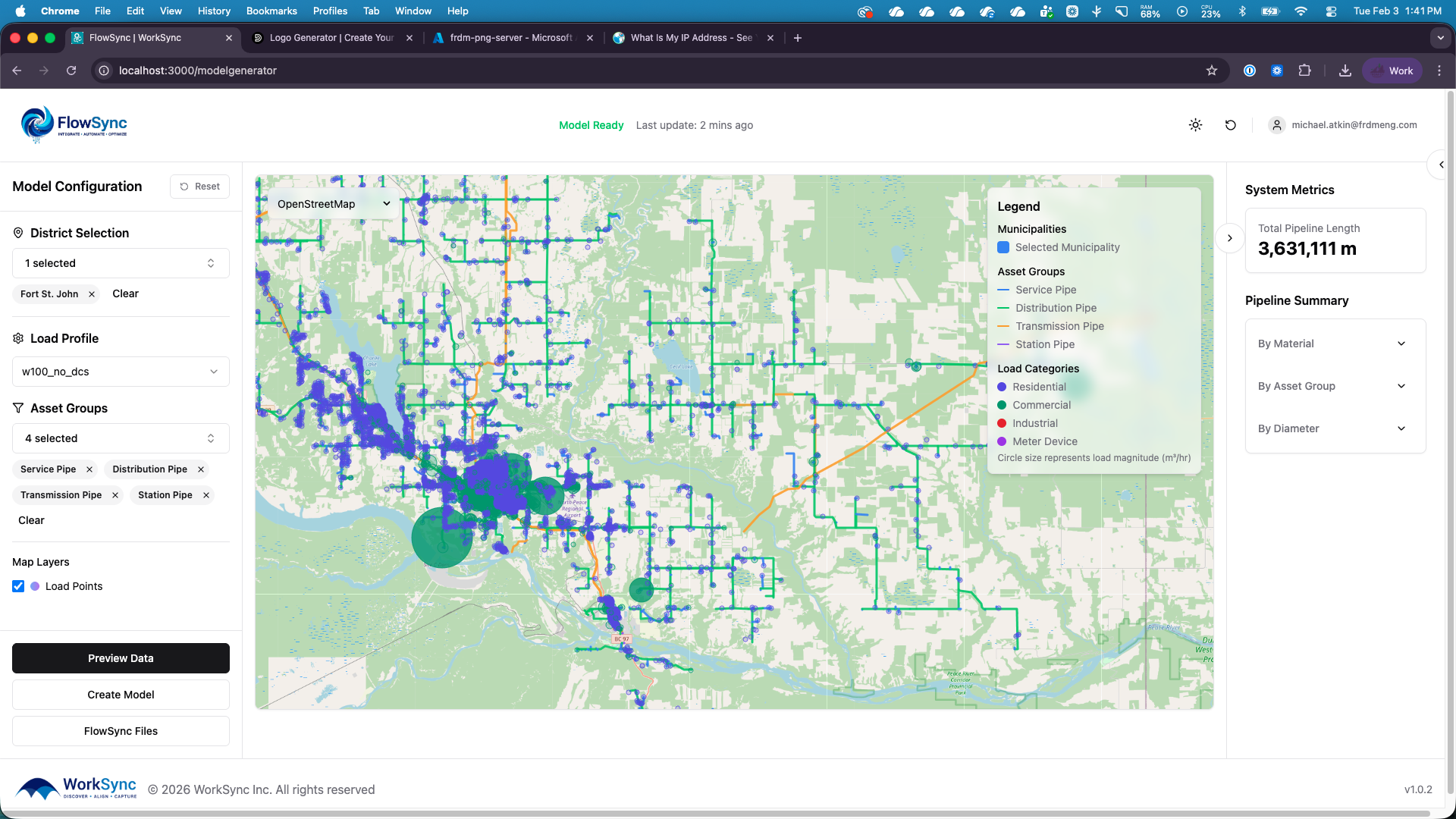
Load Points
Load point identification and categorization across the distribution network.
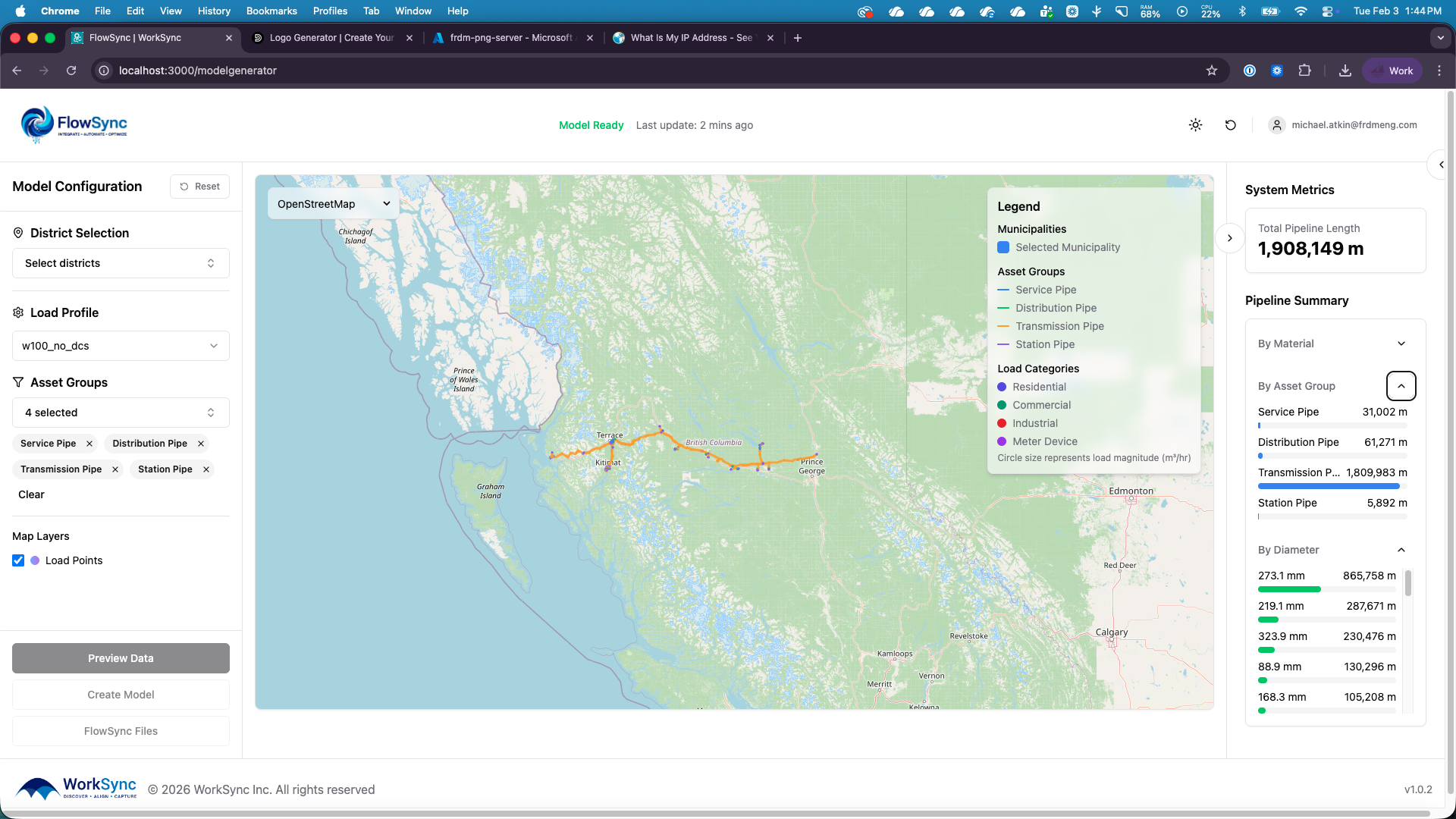
Pipeline System
Complete pipeline network with asset groups, diameter breakdowns, and pipeline summary metrics.
Transmission System
Transmission line routing with terrain-aware visualization and system metrics.
FlowSync is one half of the WorkSync platform. While FlowSync tells your engineers what to model, OPS tells your field crews what to work on.
See What 95% Automation Looks Like — On Your Data, In Your Environment
We’ll connect FlowSync to your GIS and SCADA, auto-build a hydraulic model of your actual system, and show you what your engineering team could do with 80% of their time back.